1Overview
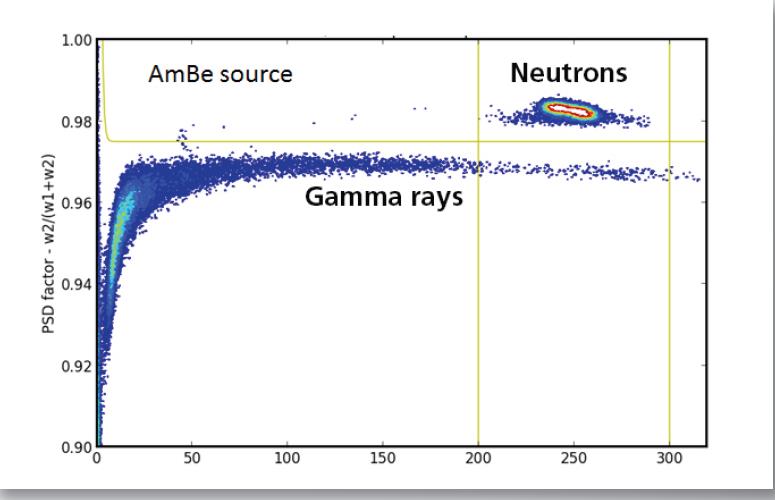
CLYC (Cerium-doped Caesium Lithium Yttrium Chloride, Cs₂LiYCl₆:Ce) is a halide scintillation crystal engineered for dual-mode radiation detection. A single CLYC detector simultaneously responds to thermal neutrons through Li-6 neutron capture and to gamma rays through normal Compton and photoelectric interactions. The two signal types are cleanly separated in the time domain using pulse-shape discrimination (PSD), making dedicated neutron-only or gamma-only detectors unnecessary in most fielded RIID systems.
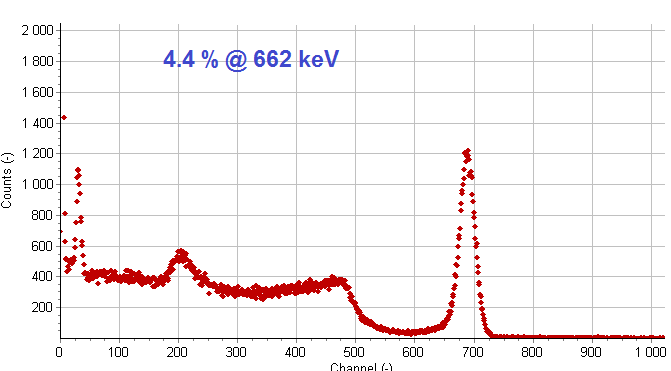
What sets CLYC apart from other dual-mode materials is the combination of high Li-6 enrichment (96%), a relatively high light yield (approximately 20,000 photons/MeV), and decay components that support effective PSD. The gamma energy resolution of 4.5 to 5.5% FWHM at 662 keV is competitive with larger NaI(Tl) detectors, which is a meaningful advantage in nuclear identification instruments where source identification accuracy matters directly.
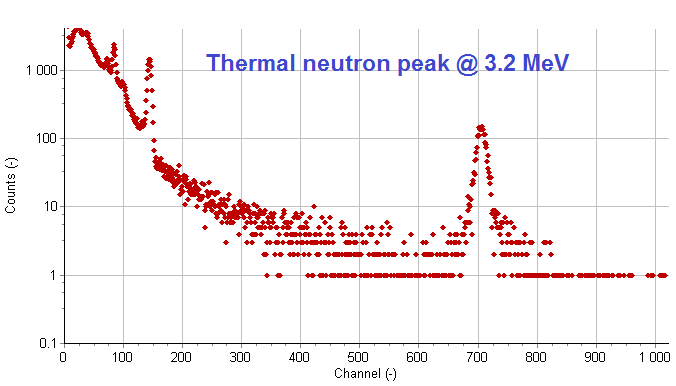
CLYC is hygroscopic and must be housed in a hermetically sealed detector assembly. Berkeley Nucleonics supplies CLYC fully packaged, matched to your readout preference. The thermal neutron peak appears at 3.1 to 3.3 MeV equivalent electron energy, well separated from the gamma continuum, which simplifies threshold-based discrimination even without full PSD processing.
For neutron-gamma applications requiring the highest resolution, see also the CLLBC:Ce data sheet, which trades some neutron cross-section for improved gamma resolution. For a deep treatment of PSD methods and figure-of-merit analysis, refer to the Neutron-Gamma Discrimination technical note.
2Specifications
| Parameter | Value | Notes |
|---|---|---|
| Chemical formula | Cs₂LiYCl₆:Ce | Cerium-doped Caesium Lithium Yttrium Chloride |
| Crystal class | Scintillation crystal (halide) | |
| Density | 3.31 g/cm³ | |
| Refractive index | 1.81 (at 400 nm) | |
| Wavelength of emission | 275–450 nm | Emission band |
| Peak emission wavelength | 370 nm | UV-visible range; well matched to bialkali PMTs |
| Decay time constants | 1 ns, 50 ns, 1000 ns | Three components; PSD exploits the difference between neutron and gamma decay profiles |
| Scintillation light yield | approx. 20,000 photons/MeV | |
| Li-6 enrichment | 96% | High enrichment maximizes thermal neutron cross-section |
| Melting point | 640 °C | |
| Hygroscopic | Yes | Hermetic sealed housing required |
| Pulse-shape discrimination | Well possible | Neutron/gamma separation confirmed; FOM depends on geometry and readout |
| Fast neutron detection | Yes (via Cl-35) | Neutron interaction with Cl-35 enables fast neutron response |
3Energy Resolution and Performance
| Parameter | Value |
|---|---|
| Energy resolution at 662 keV (gamma) | 4.5–5.5% FWHM (geometry-dependent) |
| Thermal neutron peak position | 3.1–3.3 MeV (electron-equivalent) |
| Neutron/gamma discrimination | Well possible via pulse-shape discrimination |
The 4.5 to 5.5% range at 662 keV reflects genuine geometry dependence: smaller crystals often achieve the better end of that range. For comparison, NaI(Tl) typically delivers 7% at the same energy. The thermal neutron peak at 3.1 to 3.3 MeV equivalent sits well above the Cs-137 full-energy peak and Compton continuum, providing a wide separation window for software- or hardware-threshold discrimination.
The three-component decay structure (1 ns, 50 ns, 1000 ns) is key to PSD performance. Gamma interactions produce a different ratio of fast-to-slow components compared to neutron interactions, and modern pulse-shape analysis algorithms take advantage of this difference even in compact, low-power electronics. See the Neutron-Gamma Discrimination technical note for a detailed treatment of PSD figure of merit, thresholding, and implementation in portable RIID systems.
4Typical Applications
- Radioisotope identification devices (RIID): dual-mode neutron and gamma ID in a single portable instrument, meeting ANSI N42.34 and similar standards
- Radiation portal monitors: high-throughput neutron/gamma screening at border crossings, ports, and checkpoints
- Homeland security and threat detection: SNM (special nuclear material) detection where neutron sensitivity is required alongside gamma isotope ID
- Nuclear safeguards and non-proliferation: field-deployable neutron/gamma coincidence measurements
- Nuclear physics research: neutron spectroscopy, fast-neutron detection, coincidence experiments
- Emergency response and decontamination surveys: simultaneous neutron and gamma mapping without detector changes
- Active interrogation systems: induced fission signature detection requiring both radiation types
5Available Configurations
Berkeley Nucleonics supplies CLYC:Ce detectors as fully assembled, hermetically sealed packages. Crystal dimensions and readout options are configured to application requirements. The specifications below represent general capabilities; contact us with your dimensional and performance targets for a formal quotation.
| Option | Details |
|---|---|
| Crystal form | Cylindrical or rectangular; custom dimensions (verify max dimensions with factory) |
| Housing | Hermetically sealed aluminum or stainless steel (required; crystal is hygroscopic) |
| Readout: PMT | Coupled to bialkali PMT optimized for 370 nm emission; standard voltage divider available |
| Readout: SiPM | SiPM coupling available for compact, low-voltage, and high-magnetic-field environments (verify) |
| Window material | UV-transmissive glass (standard); quartz available on request |
| Li-6 enrichment | 96% standard (maximizes thermal neutron sensitivity) |
| Matched electronics | Compatible with the ScintIQ bMCA, TOPAZ-HR, and bPAD readout modules |
For the complete multi-crystal RIID detector configuration including housings, divider chains, and signal conditioning, see the V102AR406 PMT and Voltage Divider Assembly data sheet. For digital multi-channel analyzer readout, see the bMCA Ethernet data sheet.
6Request a Quote
Talk to a Berkeley Nucleonics Engineer
CLYC:Ce configurations are built to order. Share your crystal dimensions, readout preference, and performance targets and we will provide a formal quotation and lead-time estimate.
info@berkeleynucleonics.com 800-234-7858You can also use the ScintIQ Detector Configurator to build a specification and submit a quote request online. For deeper background on neutron-gamma discrimination, pulse-shape discrimination techniques, and CLYC performance benchmarks, refer to the Neutron-Gamma Discrimination white paper.