1Overview
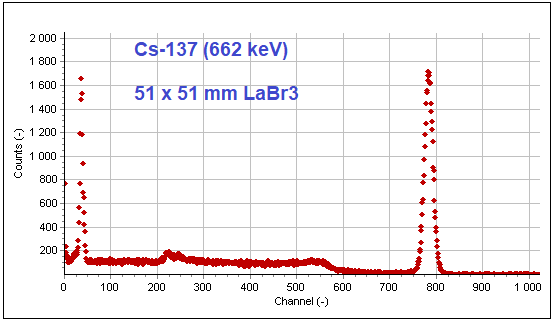
LaBr3(Ce) sets the benchmark for energy resolution among inorganic scintillators in routine production. At 662 keV (Cs-137), a 51 x 51 mm crystal achieves approximately 3.0% FWHM, well ahead of NaI(Tl) at roughly 7% and CeBr3 at approximately 4%. The photon yield is approximately 66,000 photons per MeV, and the decay time of 16 to 20 ns (size dependent) allows high count rates without excessive pile-up.
The material is hygroscopic and requires a sealed, hermetic housing. Its high refractive index (2.09 at 380 nm) is well matched to standard borosilicate and synthetic silica optical windows with appropriate coupling.
Best-in-class among production scintillators
When to Choose LaBr3(Ce)
Choose LaBr3(Ce) when gamma energy resolution is the primary selection criterion. Isotope identification in complex or mixed-source fields, medical isotope quality control, and nuclear security screening all benefit from the material's sharp photopeaks and fast response. For applications where the intrinsic La-138 background at approximately 1.4 MeV would interfere with the signal of interest, CeBr3 is a lower-background alternative at the cost of slightly reduced resolution.
2Specifications
| Parameter | Value | Notes |
|---|---|---|
| Density | 5.07 g/cm³ | |
| Ce concentration (typical) | 0.5 mole percent | |
| Maximum emission wavelength | 370 nm | UV/visible; bialkali PMT or SiPM with UV-extended response |
| Decay time (typical) | 16-20 ns | Size dependent |
| Refractive index | 2.09 | At 380 nm |
| Photon yield | Approx. 66,000 / MeV | Relative light yield ~150 vs. NaI(Tl) = 100 |
| Hygroscopic | Yes | Requires hermetic sealed assembly |
| Typical energy resolution @ 662 keV | 3.0% FWHM | 51 x 51 mm crystal; ~2.7% achievable with optimized coupling (verify) |
| Maximum dimensions | 76 mm diameter, 76 mm high | Larger custom sizes: verify availability |
| Intrinsic background (unshielded, 51 x 51 mm) | Approx. 2.5 counts/s/cm³ | Beta/gamma continuum from La-138 |
All values from the authoritative source datasheet (rev. 20-01-2025). Items marked "verify" are pending confirmation against current production data.
3Energy Resolution & Performance
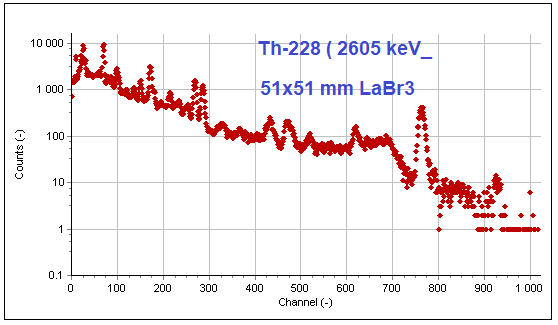
LaBr3(Ce) resolves gamma lines that other scintillators blend together. The combination of high light yield, good proportionality, and fast decay makes it effective across a wide energy range. The figures below show typical spectra measured with a 51 x 51 mm crystal.
Resolution Comparison at 662 keV
4Intrinsic Background
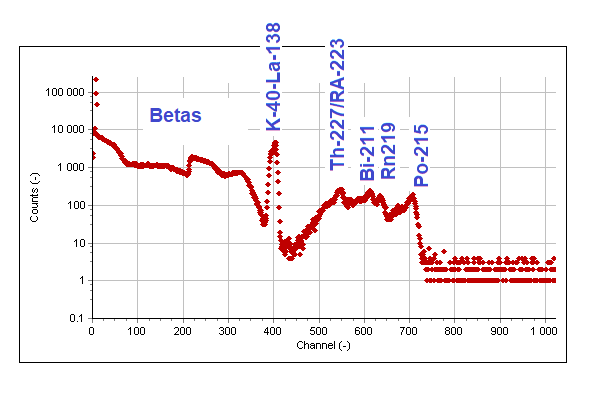
The natural abundance of La-138 (approximately 0.09%) produces a characteristic background in the beta/gamma spectrum at a rate of approximately 2.5 counts per second per cubic centimeter in an unshielded 51 x 51 mm crystal. In addition, alpha lines above 2.5 MeV arise from the Ac-227 decay chain associated with trace actinide impurities in the lanthanum feedstock.
For most spectroscopy tasks, these features are predictable and can be subtracted with a measured background file. In extremely low-background counting or in searches for signals near the La-138 gamma at 1.4 MeV, CeBr3 is the preferred alternative. It is free of the La-138 contribution while retaining high light output and fast decay.
5Typical Applications
- Isotope identification (RIID / NORM screening): Sharp photopeaks enable confident isotope library matching in complex mixed-source fields.
- Nuclear security and border monitoring: High resolution and fast counting support rapid threat discrimination at portals and checkpoints.
- Medical isotope quality control: Resolves closely spaced gamma lines in radiopharmacy production and dose calibration.
- Environmental gamma spectrometry: Resolves Eu-152, Cs-134/Cs-137, and other environmental radionuclides that NaI blends together (background subtraction required near La-138 features).
- Nuclear research and physics: Fast decay and high rate capability suit coincidence measurements and time-of-flight experiments.
- Homeland security and defense: Used in handheld, backpack, and vehicle-mount systems where resolution and portability both matter.
- Industrial gauging and process control: High count-rate tolerance is an advantage in high-flux industrial environments.
6Available Configurations
ScintIQ LaBr3(Ce) detectors are built to order. Standard configurations cover a range of crystal sizes up to 76 mm diameter by 76 mm high. Larger custom geometries are available; contact us to verify feasibility and lead time.
| Configuration Option | Details |
|---|---|
| Crystal sizes (standard) | Up to 76 mm diameter x 76 mm high; common standard sizes available (verify current stock) |
| Readout options | PMT (bialkali, UV-extended) or SiPM; photodiode readout not recommended due to mismatch at 370 nm emission |
| Housing | Hermetic sealed assembly required; aluminum or mu-metal housings available (verify) |
| Window material | Borosilicate glass or synthetic silica (quartz); quartz preferred for improved UV transmission at 370 nm (verify) |
| Voltage divider / preamplifier | Matched dynode chain or integrated preamp options; specify with order (verify) |
| MCA / electronics pairing | Compatible with ScintIQ TOPAZ-HR, bMCA-Ethernet, bMCA-USB, and bPAD readout electronics |
| Custom assemblies | Phoswich, well configurations, large-area arrays: inquire |
7Request a Quote
Talk to a BNC Detector Engineer
Configuration, lead time, pricing, and compatibility with your readout electronics can all be discussed directly with the ScintIQ team. Custom geometries and volume orders welcome.