1Overview
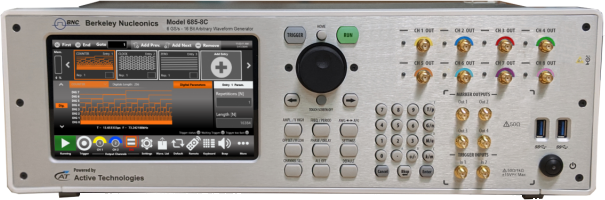
The Berkeley Nucleonics Model 685C is a high-performance arbitrary waveform generator built for laboratories and production lines that need both speed and signal fidelity from one instrument. Sample rate can be programmed up to 3 GS/s, with 16-bit vertical resolution throughout and analog bandwidth to 2 GHz. The combination delivers exceptional signal integrity across baseband work.
The platform scales with the channel count. It is available with 2, 4, or 8 analog channels, each backed by deep arbitrary waveform memory of up to 4 Gpts per channel. Optional digital channels, up to 32 in total, run in lockstep with analog generation, so a single unit can drive both the analog and digital sides of a mixed-signal design.
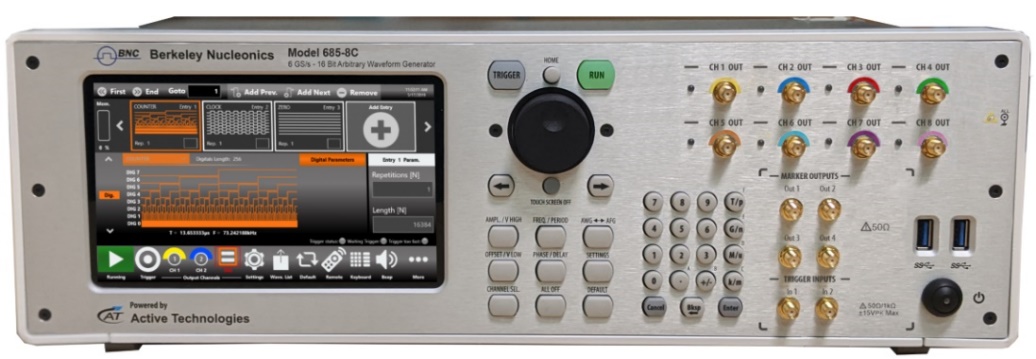
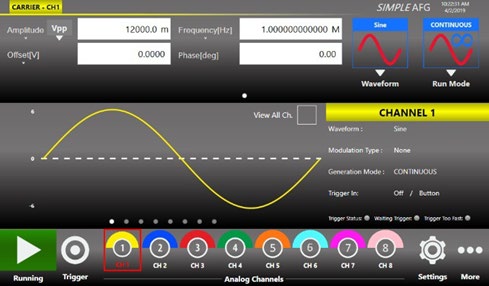
Three operating modes cover the full span of waveform work. Simple Rider AFG provides a direct digital synthesis function generator, True Arb gives variable-clock arbitrary generation in baseband and RF, and the Serial Pattern Generator produces PRBS and custom data patterns to 1.5 Gbaud. A 7-inch capacitive touchscreen, front-panel buttons, and a control knob make local operation fast, while LAN, USB-TMC, and GPIB support full remote automation.
2Key Features
- High sample rate, high resolution. Programmable up to 3 GS/s, with 16-bit vertical resolution for exceptional signal integrity.
- Deep waveform memory. Arbitrary waveform memory up to 4 Gpts for each analog channel.
- Mixed-signal generation. 2, 4, or 8 analog channels with 8, 16, or 32 synchronized digital channels for debugging and validating digital designs.
- Three operating modes. Simple Rider AFG (DDS function generator), True Arb (variable-clock arbitrary generation), and SPG (Serial Pattern Generator).
- Fast edges. Fast rise and fall times for clean pulse generation, with analog bandwidth to 2 GHz.
- Flexible amplitude. Up to 5 Vpp output and a hardware offset of plus or minus 2.5 V into 50 ohms.
- High-rate digital outputs. Up to 1.54 Gb/s data rate in LVDS format, with an optional LVDS to LVTTL adapter.
- Advanced sequencer. Up to 16,384 user-defined waveforms for complex signal scenarios with efficient memory use.
- Multi-unit synchronization. Up to 4 instruments combine into a 32 analog, 128 digital channel generator over a dedicated synchronization bus.
- Built for the bench and the rack. Compact Windows-based platform that fits a 3U 19-inch rack-mount standard, with LAN, USB-TMC, and GPIB control.
3Model Selection
The Model 685 is configured by analog channel count, with an optional digital-channel variant in each size. Models with the D suffix add synchronized digital pattern outputs alongside the analog channels.
| Model | Analog channels | Digital out (optional) | Marker out | Output type |
|---|---|---|---|---|
| Model 685-2C | 2 | 0 / 8 | 1 | Single ended, DC coupled |
| Model 685-2CD | 2 | 0 / 8 | 1 | Differential, DC coupled |
| Model 685-4C | 4 | 0 / 8 / 16 | 2 | Single ended, DC coupled |
| Model 685-4CD | 4 | 0 / 8 / 16 | 2 | Differential, DC coupled |
| Model 685-8C | 8 | 0 / 8 / 16 / 24 / 32 | 4 | Single ended, DC coupled |
| Model 685-8CD | 8 | 0 / 8 / 16 / 24 / 32 | 4 | Differential, DC coupled |
4User Interface
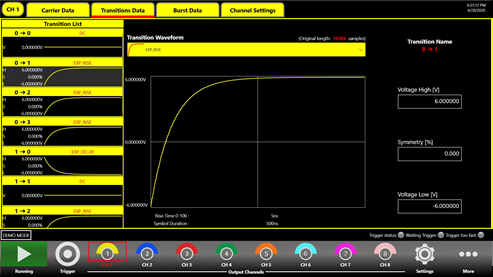
Every mode is driven from a 7-inch capacitive touchscreen that recalls the simplicity of a modern tablet. Swipe gestures expose output parameters, a touch-friendly numeric keypad speeds data entry, and intuitive icons shorten instrument setup. The same screen also exposes the advanced sequencer, where loops, jumps, and conditional branches define the execution flow of analog waveforms and digital patterns.
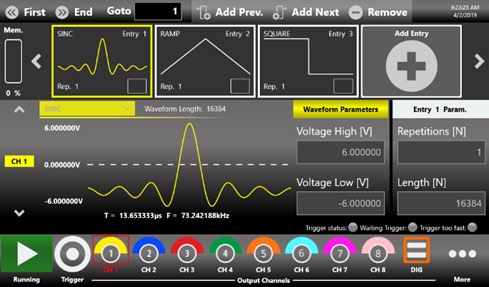
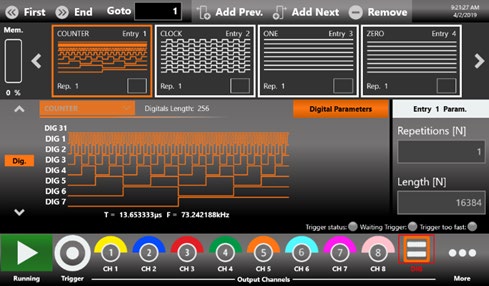
In True Arb, the waveform memory of up to 4 GSamples per channel, combined with up to 16,384 sequence entries and up to 4,294,967,294 repetitions, makes the Model 685 suited to the most demanding technical applications. Up to 4 instruments synchronize over a dedicated bus to form a 32 analog, 128 digital channel system, and the standard Ethernet interface supports remote control and custom programming.
5General Specifications
All specifications are typical unless noted otherwise. Guaranteed performance refers to a calibrated instrument stored for a minimum of 2 hours within the operating temperature range of 5 C to 40 C and given a 45-minute warm-up, within plus or minus 10 C after auto-calibration.
Output Channels
| Parameter | 685-2C / 4C / 8C | 685-2CD / 4CD / 8CD |
|---|---|---|
| Output type | Single ended, DC coupled | Differential, DC coupled |
| Output impedance | 50 ohms single ended | 50 ohms single ended, 100 ohms differential |
| Connectors | SMA on front panel | |
DC Amplitude
| Parameter | 685-2C / 4C / 8C | 685-2CD / 4CD / 8CD |
|---|---|---|
| Amplitude range | Plus or minus 2.5 V (into 50 ohms) | Plus or minus 0.75 V Se. (into 50 ohms); plus or minus 1.5 V Diff. (into 100 ohms) |
| Resolution | 100 uV (nominal), 5 digits | |
| Amplitude accuracy (guaranteed) | Plus or minus (1% of |setting| + 5 mV) | Plus or minus (0.5% of |setting| + 2 mV) |
DC Baseline Hardware Offset (Common Mode Offset)
| Parameter | 685-2C / 4C / 8C | 685-2CD / 4CD / 8CD |
|---|---|---|
| Resolution | Less than 4 mV or 4 digits | |
| Range (50 ohms into 50 ohms) | -2.5 V to +2.5 V | -2 V to +2 V |
| Range (50 ohms into high-Z load) | -2.5 V to +2.5 V | -4 V to +4 V |
| Accuracy (50 ohms into 50 ohms, guaranteed) | Plus or minus (1% of |setting| + 5 mV) | |
| AC accuracy (1 kHz sine, 0 V offset, >5 mVp-p, 50 ohm load, guaranteed) | Plus or minus (1% of setting [Vpp] + 5 mV) | |
6True Arb, Baseband Mode
| Parameter | Specification |
|---|---|
| Operating mode | Variable clock (True Arbitrary), baseband mode |
| Sample rate | 1 S/s to 6.16 GS/s |
| Sin(x)/x | 2.72 GHz at 6.16 GS/s |
| Run modes | Continuous, Triggered Continuous, Single/Burst, Stepped, Advanced |
| Vertical resolution | 16 bit |
| Waveform length | 128 to 2G samples per channel (up to 4G samples optional) |
| Waveform granularity | 1 if entry length > 416 samples; 32 if entry length is between 128 and 416 samples |
| Sequence length | 1 to 16,384 |
| Sequence repeat counter | 1 to 4,294,967,294 or infinite |
| Timer range / resolution | 20 ns to 1.39 s; plus or minus 1 sampling clock cycle |
| Channel-to-channel skew range | 0 to 2.63 us |
| Skew resolution | 100 fs |
| Skew accuracy | Plus or minus (1% of setting + 20 ps) |
| Initial skew | Less than 20 ps |
Dynamic Performance
| Parameter | 685-2C / 4C / 8C | 685-2CD / 4CD / 8CD |
|---|---|---|
| Calculated bandwidth (0.35 / rise or fall time) | Greater than or equal to 2 GHz | Greater than or equal to 2.2 GHz |
| SFDR at 100 MHz (Fsa = 6 GS/s, DC to Fs/2) | Less than -80 dBc | Less than -90 dBc |
| SFDR (Fsa = 6.16 GS/s, DC to Fs/2) | 1 uHz to 600 MHz: < -80 dBc 600 MHz to 1.5 GHz: < -75 dBc 1.5 GHz to 2 GHz: < -65 dBc 2 GHz to 3 GHz: < -55 dBc | 1 uHz to 100 MHz: < -90 dBc 100 MHz to 600 MHz: < -82 dBc 600 MHz to 1.5 GHz: < -75 dBc 1.5 GHz to 2 GHz: < -70 dBc 2 GHz to 3 GHz: < -62 dBc |
| Rise/fall time (1 Vp-p single ended, 10% to 90%) | Less than or equal to 175 ps | Less than or equal to 155 ps |
| Rise/fall time (1 Vp-p single ended, 20% to 80%) | Less than or equal to 110 ps | Less than or equal to 100 ps |
| Overshoot (1 Vp-p single ended) | Less than 5% | Less than 6% |
| Random jitter on clock pattern (rms, typical) | Less than 2 ps | |
7True Arb, RF Mode
| Parameter | Specification |
|---|---|
| Operating mode | Variable clock (True Arbitrary), RF mode |
| Output sample rate | 8.5 GS/s to 12.32 GS/s |
| Sin(x)/x | 5.04 GHz at 12.32 GS/s |
| RF modulation | I/Q quadrature |
| RF carrier count per output channel | Single carrier (2 components, I0, Q0); double carrier (4 components, I0, Q0 and I1, Q1) |
| RF carrier frequency range | 0 up to 6 GHz |
| RF carrier frequency resolution | 1 mHz |
| RF carrier phase | Programmable |
| I/Q component data rate | 1/8 of the output sample rate |
| I/Q component prescaler | 0 to 2^32 |
| Run modes | Continuous, Triggered Continuous, Single/Burst, Stepped, Advanced |
| I/Q component vertical resolution | 16 bit |
| I/Q component waveform length | 32M to 500M samples per component (up to 1G samples optional) |
| I/Q component waveform granularity | 1 if entry length > 104 samples; 8 if entry length is between 32 and 104 samples |
| Sequence length | 1 to 16,384 |
| Sequence repeat counter | 1 to 4,294,967,294 or infinite |
| Timer range / resolution | 20 ns to 1.39 s; plus or minus 1 component sampling clock cycle |
| I/Q component-to-component skew range | 0 to [16200 x 8 / output sampling clock] s |
| Skew resolution | [8 / output sampling clock] s |
| Skew accuracy | Plus or minus (1% of setting + 20 ps) |
| Initial skew | Less than 20 ps |
8AFG Mode
| Parameter | Specification |
|---|---|
| Amplitude | 0 to 5 Vpp (into 50 ohms); 0 to 3 Vpp Diff. (into 100 ohms); 0 to 1.5 Vpp Se. (into 50 ohms) |
| Resolution | 100 uV (nominal), 5 digits |
| Operating mode | DDS mode |
| Standard waveforms | Sine, Square, Pulse, Ramp, Noise, DC, Sin(x)/x, Gaussian, Lorentz, Exponential Rise, Exponential Decay, Haversine |
| Run modes | Continuous, modulation, sweep, burst |
| Arbitrary waveforms | 16-bit vertical resolution; waveform length 16,384 points |
| Internal trigger timer | Range 10.4 ns to 88 s; resolution 80 ps; accuracy plus or minus (0.1% setting + 5 ps) |
Sine Waves
| Parameter | Specification |
|---|---|
| Frequency range (50 ohms into 50 ohms) | 1 uHz to 1 GHz: 5 Vpp; 1 GHz to 2 GHz: 4 Vpp; 1 uHz to 2 GHz: 3 Vpp Diff.; 1 uHz to 2 GHz: 1.5 Vpp Se. |
| Flatness (1 Vpp, relative to 1 kHz) | DC to 2 GHz: plus or minus 0.5 dB (also for 1 Vpp diff.) |
| Harmonic distortion (1 Vp-p) | 1 uHz to 20 kHz: < -75 dBc; 20 kHz to 400 MHz: < -70 dBc; 400 MHz to 1 GHz: < -60 dBc; 1 GHz to 2 GHz: < -55 dBc |
| Total harmonic distortion (1 Vp-p) | 10 Hz to 20 kHz: < 0.05% |
| Spurious (DC to Fs/2) | Single ended: 1 uHz to 500 MHz < -75 dBc, 500 MHz to 1.5 GHz < -70 dBc, 1.5 GHz to 2 GHz < -55 dBc. Differential: 1 uHz to 250 MHz < -85 dBc, 250 to 500 MHz < -80 dBc, 500 MHz to 1.5 GHz < -70 dBc, 1.5 GHz to 2 GHz < -60 dBc |
| Phase noise (1 Vp-p, 10 kHz offset) | 20 MHz: < -127 dBc/Hz typ.; 100 MHz: < -123 dBc/Hz typ.; 1 GHz: < -105 dBc/Hz typ. |
Square, Pulse, and Other Waves
| Parameter | Specification |
|---|---|
| Square wave frequency range | 1 uHz to 770 MHz |
| Square rise/fall time | 400 ps (10% to 90%); 300 ps (20% to 80%) |
| Square overshoot / jitter | Less than 2%; less than 2 ps rms |
| Pulse frequency range | 1 uHz to 770 MHz |
| Pulse width | 500 ps to (Period - 500 ps) |
| Pulse width resolution | 20 ps or 15 digits |
| Pulse duty | 0.1% to 99.9% (pulse-width limits apply) |
| Edge transition time | 400 ps to 1000 s (10% to 90%); 300 ps to 1000 s (20% to 80%) |
| Transition time resolution | 2 ps or 15 digits |
| Double pulse frequency range | 1 uHz to 385 MHz: 10 Vpp (Se., where Vpp = |Vpp1| + |Vpp2|); 6 Vpp Diff. / 3 Vpp Se. |
| Ramp frequency range / linearity | 1 uHz to 75 MHz; linearity less than or equal to 0.1% (< 10 kHz, 1 Vp-p) |
| Other waves (Exp. Rise/Decay, Sin(x)/x, Gaussian, Lorentz, Haversine) | 1 uHz to 75 MHz; Sin(x)/x to 150 MHz |
| Additive noise bandwidth (-3 dB) | 2 GHz |
| Arbitrary analog bandwidth (-3 dB) | 950 MHz |
| Frequency accuracy | Plus or minus 2.0 ppm of setting; plus or minus 500 ppb optional |
9Modulation & Sweep
The Model 685 supports AM, FM, PM, FSK, PSK, and PWM, plus linear, logarithmic, staircase, and user-defined sweeps. Modulation sources can be internal or external.
| Function | Specification |
|---|---|
| Amplitude Modulation (AM) | Carrier: standard waveforms (except Pulse, DC, Noise), ARB; source internal or external; modulating waveforms Sine, Square, Ramp, Noise, ARB; modulating frequency internal 500 uHz to 61 MHz, external 10 MHz max; depth 0.00% to 120.00% |
| Frequency Modulation (FM) | Carrier: standard waveforms (except Pulse, DC, Noise), ARB; source internal or external; modulating waveforms Sine, Square, Ramp, Noise, ARB; modulating frequency internal 500 uHz to 61 MHz, external 10 MHz max; peak deviation DC to 2 GHz |
| Phase Modulation (PM) | Carrier: standard waveforms (except Pulse, DC, Noise), ARB; source internal or external; modulating waveforms Sine, Square, Ramp, Noise, ARB; phase deviation range 0 to 360 degrees |
| Frequency Shift Keying (FSK) | Modulating waveform Square; key rate internal 500 uHz to 61 MHz, external 10 MHz max; hop frequency 1 uHz to 2 GHz; 2 keys |
| Phase Shift Keying (PSK) | Modulating waveform Square; key rate internal 500 uHz to 61 MHz, external 10 MHz max; hop range 0 to +360 degrees; 2 keys |
| Pulse Width Modulation (PWM) | Carrier Pulse; source internal or external; modulating waveforms Sine, Square, Ramp, Noise, ARB; deviation range 0% to 50% of pulse period |
| Sweep | Linear, logarithmic, staircase, user defined; sweep time 30 ns to 2000 s; hold/return 0 to (2000 s - 30 ns); total sweep time accuracy less than or equal to 0.4%; start/stop range Sine 1 uHz to 2 GHz, Square 1 uHz to 770 MHz; trigger internal, external, or manual |
| Burst | Trigger or gated; burst count 1 to 4,294,967,295 cycles or infinite |
| Timing and clock | Sampling rate 1 S/s to 6.16 GS/s (to 12.32 GS/s in RF mode); resolution 32 Hz; accuracy plus or minus 2.0 ppm, plus or minus 500 ppb optional |
10Digital Outputs (Optional)
| Parameter | Specification |
|---|---|
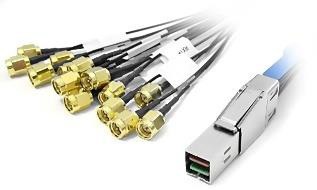
| Connectors | Mini-SAS HD on rear panel (custom pin-out) |
| Number of connectors | 1, 2, 4 |
| Number of outputs | 8 bits, 16 bits, 32 bits |
| Output impedance | 100 ohms differential |
| Output type | LVDS |
| Rise/fall time (10% to 90%) | Less than 1 ns |
| Jitter (rms) | 20 ps |
| Maximum update rate | 1.54 Gbps per channel |
| Memory depth | 512M samples per digital channel (up to 1G optional) |
8-bit LVDS to LVTTL Converter Probe (Optional AT-DTLL8)
| Parameter | Specification |
|---|---|
| Output connector / type | 20-position 2.54 mm 2-row IDC header; LVTTL |
| Output impedance | 50 ohms nominal |
| Output voltage | 0.8 V to 3.8 V, programmable in groups of 8 bits |
| Maximum update rate | 125 Mbps at 0.8 V, 400 Mbps at 3.6 V |
| Dimensions | W 2 in x H 0.9 in x D 3 in [52 mm x 22 mm x 76 mm] |
| Cable | Proprietary standard, 1 meter |
11Auxiliary Input and Output
| Parameter | Specification |
|---|---|
| Sync in / out connector | Infiniband 4X on rear panel (custom pinout) |
| Marker output connector | SMA on front panel; 1, 2, or 4 connectors |
| Marker output impedance | 50 ohms |
| Marker output level (into 50 ohms) | Voltage window -0.5 V to 1.65 V; amplitude 100 mVpp to 2.15 Vpp; resolution 1 mV; accuracy plus or minus (5% setting + 25 mV) |
| Marker max update rate (True Arb) | 6.16 Gbps; max data rate > 4 Gbps at 1 Vpp swing |
| Marker max frequency (AFG) | 96.5 MHz (continuous mode) |
| Marker rise/fall time (10% to 90%, 2 Vpp) | Less than 150 ps |
| Marker jitter (rms) | Less than 10 ps |
| External modulation input | SMA on rear panel; impedance 10 kohms; bandwidth 10 MHz at 50 MS/s; input range -1 V to +1 V (except FSK, PSK at 0 to 3.3 V with 1.65 V threshold); 12-bit resolution |
| Pattern Jump In (optional) | DSUB15; DATA[0..7] + Data Select + Load; 14-bit internal width; 16,384 addressable entries; data rate DC to 1 MHz |
12Clock & Reference
| Parameter | Specification |
|---|---|
| Reference clock input | SMA on rear panel; 50 ohms AC coupled; input 0.2 Vpp to 2 Vpp; frequency 5 MHz to 200 MHz; resolution 1 Hz; damage level -0.3 V to 3.6 V, 30 dBm max into 50 ohms |
| Reference clock output | SMA on rear panel; 50 ohms AC coupled; 10 MHz TCXO, 100 MHz VCOCXO optional; initial accuracy at 25 C plus or minus 1.0 ppm (500 ppb opt.); aging plus or minus 1.0 ppm/year (500 ppb/year opt.); stability vs. temperature plus or minus 1 ppm (50 ppb opt.); amplitude 1.65 Vpp |
| Reference clock phase noise (20 MHz carrier) | -120 dBc/Hz at 100 Hz; -140 dBc/Hz at 1 kHz; -150 dBc/Hz at 10 kHz |
| Reference clock phase noise (100 MHz carrier, opt.) | -120 dBc/Hz at 100 Hz; -145 dBc/Hz at 1 kHz; -150 dBc/Hz at 10 kHz |
| External clock input | SMA on rear panel; 50 ohms AC coupled; True Arb SampleRate / N (N = 4, 8, 16, 32 for 5.0 to 6.16 GHz; N = 2, 4, 8, 16, 32 for 3.08 to 5.0 GHz); AFG 192.5, 385, 770, or 1540 MHz; input power +0 dBm to +10 dBm; damage level 15 dBm |
| Sync clock output | SMA on rear panel; 50 ohms AC coupled; AFG 6.16 GHz / N (N = 16 to 2048); AWG 6.16 GHz / 16 to 6.16 GHz / 4096; amplitude 1 Vpp into 50 ohms |
13Trigger / Event Inputs
| Parameter | Specification |
|---|---|
| Connector | SMA on front panel |
| Number of trigger inputs | 2 (Trig.in 1, Trig.in 2) |
| Input impedance | 50 ohms / 1 kohm |
| Slope / polarity | Positive, negative, or both |
| Input damage level | Below -15 V or above +15 V |
| Threshold control level / resolution | -10 V to 10 V; 50 mV |
| Threshold control accuracy | Plus or minus (10% of |setting| + 0.2 V) |
| Input voltage swing | 0.5 Vp-p minimum |
| Minimum pulse width (1 Vp-p) | 3 ns |
| Trigger/gate to analog output delay | Slow trigger: AFG < 355 ns (< 405 ns triggered sweep), True Arb < 1550 x DAC clock period (ns) + 10 ns. Fast trigger: AFG < 335 ns (< 385 ns triggered sweep), True Arb < 1360 x DAC clock period (ns) + 27 ns |
| Trigger-in to output jitter (rms) | AFG < 20 ps; True Arb 0.29 x DAC clock period |
| Programmable delay range / resolution | 0 ps to 2418 ps; 78 ps |
| Maximum frequency | AFG 65 MTps rising/falling, 80 MTps both edges; True Arb 1 / (period of analog waveform + 48 DAC clock periods) |
14System & Power
| Parameter | Specification |
|---|---|
| Display | 7 in, 1024 x 600, capacitive touch LCD |
| Operating system | Windows 10 |
| External dimensions | W 17.6 in, H 5.4 in, D 12.6 in (3U 19-inch rack-mount) [445 mm x 135 mm x 320 mm] |
| Weight | Max. 26.45 lb (12 kg) |
| Front panel connectors | CH N OUTPUT (SMA, N = 2, 4, 8); MARKER N OUT (SMA, N = 1, 2, 4); TRG IN N (SMA, N = 1, 2); 2 USB 3.0 ports |
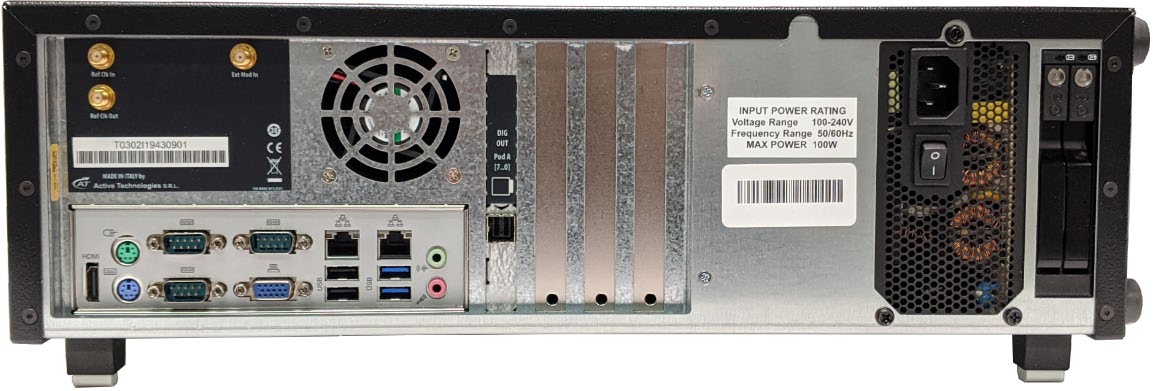
| Rear panel connectors | Ref. Clk. IN/OUT (SMA); Ext. Mod. IN (SMA); Sync Clk Out (SMA); Ext Clk IN (SMA); Sync IN/OUT (Infiniband 4X); Pattern Jump In (DSUB15, FSS option); POD X[7..0] (Mini-SAS HD); external monitor ports; USB 2.0 and 3.0; 10/100/1000BaseT Ethernet (RJ45); PS/2; DPI; DVI |
| Hard disk | 1 TB SSD or better |
| Processor | Intel Pentium 3.7 GHz or better |
| Processor memory | 32 GB or better |
| Remote interfaces | LAN, USB-TMC, GPIB |
| Source voltage and frequency | 100 to 240 VAC plus or minus 10% at 45 to 66 Hz |
| Max. power consumption | 100 W (685-2C / 2CD); 200 W (685-4C / 4CD); 300 W (685-8C / 8CD) |
15Environmental, EMC & Safety
| Parameter | Specification |
|---|---|
| Temperature (operating) | +41 F to +104 F [+5 C to +40 C] |
| Temperature (non-operating) | -4 F to +140 F [-20 C to +60 C] |
| Humidity (operating) | 5% to 80% RH, maximum wet-bulb 84 F (29 C) at or below 104 F (40 C), non-condensing |
| Humidity (non-operating) | 5% to 95% RH, maximum wet-bulb 104 F (40 C) at or below 140 F (60 C), non-condensing |
| Altitude (operating) | 9,842 ft (3,000 m) maximum at or below 77 F (25 C) |
| Altitude (non-operating) | 39,370 ft (12,000 m) maximum |
| Safety | EN61010-1 |
| EMC | EN 61326-1:2013 (emissions and immunity) |
16Applications
The Model 685 pairs a 6.16 GS/s sample rate with 16-bit vertical resolution, which makes it well suited to demanding test challenges across several industries.
Aerospace and Defense
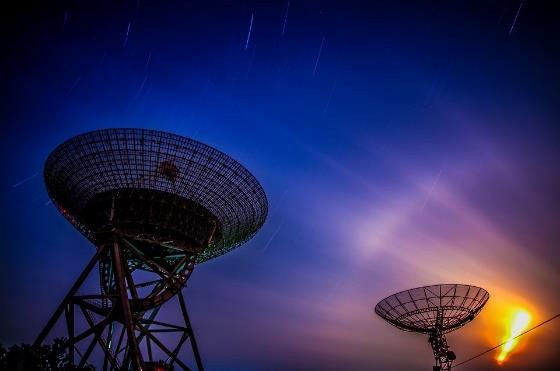
The Model 685 works with electronic warfare signals such as those produced by radar or sonar systems, and it fits into modular systems for radio or I/Q modulation. It can create pulses useful in pulsed electron beams, X-ray sources, flash X-ray radiography, lightning pulse simulators, and high-power microwave modulators. Typical uses include frequency response, intermodulation distortion, and noise-figure measurements, PLL pull-in and hold-range characterization, and radar baseband signal emulation.

Institute and University Research
Research centers and universities are key users of the Model 685. Complex waveforms and sophisticated pulse emulation based on variable edges or multiple levels are straightforward to create. Fast edge generation, wide dynamic range, and an easy interface suit work in quantum research and large experiments such as accelerators, tokamaks, and synchrotrons. Uses include detector emulation, signal sources with added noise, playback of real-world signals, long PRBS sequences, and driving laser diodes.
Semiconductor Tests
Emulation of complex signals with added noise or distortion supports compliance component testing for semiconductor engineers. Fast edges and pulse generation help characterize fast power devices.
Automotive
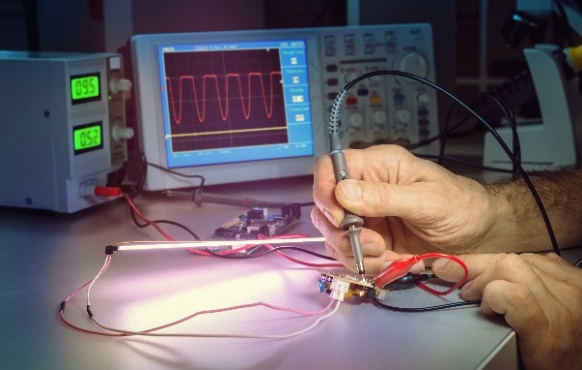
Modern vehicles carry sophisticated, electronically controlled units with sensitive components. The Model 685 supports EMI debugging, troubleshooting, and testing, along with electrical standards emulation up to 5 V.
IoT and Industry 4.0
The Model 685 emulates complex RF I/Q modulation for simulation and test against wireless devices and Internet of Things or Industry 4.0 systems. Engineers can import waveforms to emulate devices and impose distortion, such as noise, to test compliance with standards.


17Software & Support
The Model 685 runs a Windows-based platform with an intuitive touchscreen interface for local operation, and it accepts remote control over LAN, USB-TMC, and GPIB. For programmatic control and integration into automated test systems, a software development kit is available.
Software Development Kit: Download the Model 685 SDK (opens in a new window).
18Contact
For a quote, configuration help, or application support, reach the Berkeley Nucleonics team.
Email: info@berkeleynucleonics.com
Phone: 800-234-7858
For a quick question, chat with an engineer at berkeleynucleonics.com.