
1 Overview
CLLBC (Cs2LiLaBr4.8Cl1.2:Ce) is a cerium-doped elpasolite crystal that delivers properties closely comparable to LaBr3:Ce while adding a second, distinct capability: thermal neutron detection. The crystal contains lithium enriched to 95 % in 6Li, which generates a sharp thermal neutron peak at 3.1–3.2 MeV. That peak sits well clear of the gamma continuum, making CLLBC one of the very few materials that can perform high-resolution gamma spectroscopy and neutron counting at the same time, in a single detector element.
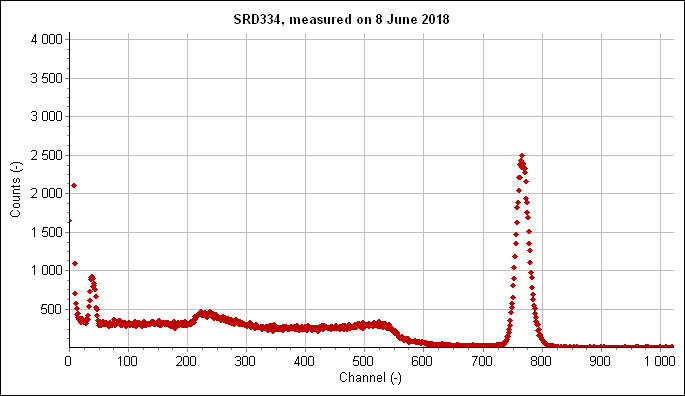
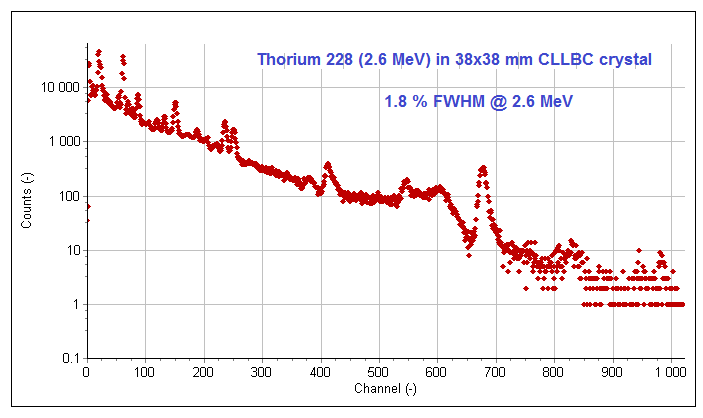
Energy resolution around 3.2 % FWHM at 662 keV is standard, roughly half the figure for NaI(Tl). At higher energies the advantage grows: CLLBC achieves 2.3 % at 1332 keV (Co-60) and 1.8 % at 2600 keV (Th-228). That resolution level supports isotope identification in real-world mixed-radiation environments without the complexity and cost of a separate neutron detector module.
Choose CLLBC when an application demands both radiation types in a compact package: radiation portal monitors, handheld RIID instruments, field-deployed nuclear identifiers, or physics setups where neutron/gamma pulse-shape discrimination (PSD) is required. For pure gamma spectroscopy without the neutron channel, CeBr3 or LaBr3:Ce may offer a simpler path. CLLBC is the material when both channels matter.
2 Specifications
| Parameter | Value |
|---|---|
| Chemical formula | Cs2LiLaBr4.8Cl1.2:Ce |
| Density | 4.08 g/cm³ |
| Maximum emission wavelength | 420 nm |
| Decay time (typical) | 120 ns, 500 ns (average approx. 150 ns) |
| Refractive index | 1.90 |
| Photoelectron yield vs. NaI(Tl) | 70 % |
| Light output | Approx. 30,000 photons/MeV |
| Hygroscopic | Yes |
| 6Li enrichment | 95 % |
| Energy resolution @ 662 keV | < 3.5 % FWHM |
| Thermal neutron peak position | 3.1–3.2 MeV equivalent |
| Neutron/gamma discrimination | Yes, via pulse-shape discrimination (PSD) |
| Maximum dimensions | verify |
3 Energy Resolution Performance
The table below compares CLLBC typical resolution figures against CeBr3 and NaI(Tl) across six reference energies. Values are FWHM percentages. CLLBC leads at every energy point listed; the advantage is most pronounced in the mid-range (662 keV) and at higher energies where separation of closely spaced photopeaks is critical.
| Energy (keV) / Source | CLLBC (typical) | CeBr3 (typical) | NaI(Tl) (typical) |
|---|---|---|---|
| 30 keV (129I) | 15 % | 20 % | 18 % |
| 59.5 keV (241Am) | 10 % | 13 % | 11 % |
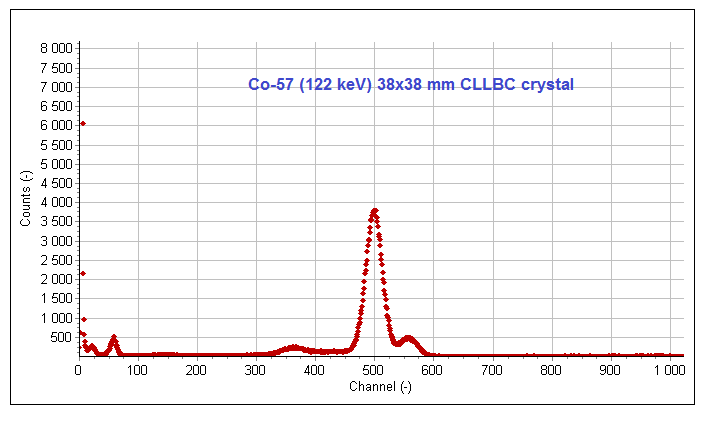
| 122 keV (57Co) | 6.4 % | 8 % | 8.5 % |
| 662 keV (137Cs) | 3.2 % | 4 % | 7 % |
| 1332 keV (60Co) | 2.3 % | 3 % | 5.5 % |
| 2600 keV (228Th) | 1.8 % | 2.5 % | 4.0 % |
The resolution advantage at 662 keV (3.2 % vs. 7 % for NaI(Tl)) directly translates to cleaner separation of nearby isotope lines in field RIID instruments and portal monitors. At 1332 keV the gap widens further, supporting reliable identification of man-made radionuclides against natural background.
4 Performance Plots
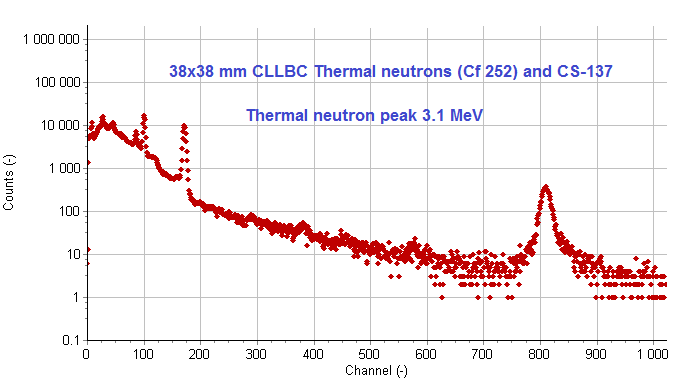
Note: Figure captions above are inferred from surrounding datasheet text. Verify axis labels and source isotopes against original measurement data before publication.
5 Typical Applications
CLLBC is selected wherever simultaneous neutron and gamma detection is required in a single compact crystal, or where high-resolution gamma spectroscopy must operate alongside a neutron channel without adding detector size or complexity.
- Radiation isotope identification devices (RIID): handheld and backpack instruments for field identification of nuclear and radiological threats. CLLBC resolves closely spaced gamma lines while flagging neutron presence via PSD, removing the need for a separate He-3 or 6Li neutron tube.
- Nuclear material detection and interdiction: border security portals and chokepoint monitors where accurate isotope ID must be maintained at high throughput.
- Homeland security and radiological defense: mobile survey instruments and fixed monitoring systems where both gamma identification and neutron detection capability are mandatory requirements.
- Physics research: experiments requiring neutron/gamma PSD, mixed-field characterization, or high-resolution spectroscopy with a dual-mode detector.
- Nuclear non-proliferation monitoring: treaty verification and safeguards instruments where material-specific spectral signatures must be resolved in field conditions.
- Environmental and emergency response: rapid field assessment of mixed radiation environments following incidents, where both radiation types must be characterized.
6 Available Configurations
Berkeley Nucleonics supplies CLLBC detectors in custom configurations matched to the application. Because CLLBC is hygroscopic, all crystals ship hermetically sealed. Standard options are summarized below; contact Berkeley Nucleonics to confirm availability and lead times for a specific geometry.
Crystal Sizes
CLLBC is available in cylindrical and rectangular crystal forms. Specific maximum dimensions are not published in the current datasheet; mark as verify. Common RIID and physics configurations range from small-volume units (for handheld detectors) through medium cylindrical formats for stationary instruments. Request a quote for your target size.
Readout Options
| Readout Type | Notes |
|---|---|
| PMT (photomultiplier tube) | Standard high-voltage readout, excellent single-photon sensitivity, well-matched to 420 nm emission. Common for lab and cabinet instruments. |
| SiPM (silicon photomultiplier) | Low-voltage, compact, magnetic-field tolerant. Well-suited to portable and handheld RIID instruments. CLLBC emission at 420 nm is compatible with standard SiPM spectral response. |
Housing and Sealing
CLLBC crystals require hermetic encapsulation due to hygroscopicity. Berkeley Nucleonics supplies assembled detectors with hermetically sealed aluminum or stainless steel housings, optical coupling compound, and a borosilicate or UV-glass window matched to the readout device. Teflon reflector and mu-metal shielding are available as options (verify specific configurations at order time).
Complementary Electronics
Pair a CLLBC detector with the Berkeley Nucleonics ScintIQ readout and analysis electronics, including the bMCA multi-channel analyzer and TOPAZ-HR high-resolution spectroscopy module, to complete the detection chain. See the separate electronics datasheets for specifications.
Request a Quote or Engineering Consultation
Specify your target crystal size, readout preference, housing requirements, and application environment. Our engineers will confirm availability and provide a formal quotation.