1Spectrum Analyzer Fundamentals
A spectrum analyzer measures and visualizes signal characteristics in the frequency domain, the time domain, and the modulated domain. It is a core instrument in RF engineering, telecommunications, and electronics, used for analyzing signal behavior, identifying interference, and troubleshooting systems. A handheld analyzer takes that capability out of the lab and into the field, where the signal environment is uncontrolled and the answer is often needed on the spot.
This guide walks through the parameters that separate a capable field analyzer from a compromised one. The order roughly follows how an engineer scopes a purchase. Start with the frequencies you must see. Decide whether you need real-time capture. Then weigh sensitivity, spectral purity, dynamic range, and speed, and finish with the practical realities of form factor and battery life. Software and programmability close the loop, because an analyzer that cannot integrate into your toolchain limits what you can build around it.
2Types of Analyzer
Before comparing numbers, it helps to know which class of instrument you are looking at. The classification matters because it sets the ceiling on what any single specification can deliver.
By analysis method
Swept-tuned analyzer. The classical design tunes a local oscillator to mix with the input signal at each frequency point. The intermediate-frequency (IF) signal is filtered, and a digital detector measures its amplitude before it is shown on screen. It works, but it looks at one slice of the spectrum at a time.
FFT-based analyzer. Instead of detecting voltage point by point, an FFT analyzer applies a Fast Fourier Transform to the IF signal. A single conversion can return amplitude information for thousands of frequency points at once, which makes it far faster than voltage detection in many cases. FFT analysis is a baseline capability for any modern instrument, and an analyzer that offers only swept-tuned analysis is not worth considering. Strong products provide both swept and FFT analysis, more than 25 MHz of analysis bandwidth, and more than 1k FFT points for higher analysis speed.
Real-time analyzer (RTSA). An RTSA extends the FFT analyzer with much heavier IF signal processing. It delivers continuous, gap-free (dead-zone-free) FFT analysis, which produces a strict and accurate relationship between spectrum and time. RTSAs typically offer higher analysis bandwidth and faster analysis than an ordinary FFT analyzer, and they give the best measurement experience for transient and intermittent signals.
By application scenario
Benchtop. Desktop instruments span a wide quality range. Low-end benchtop units trade RF performance and analysis capability for a desktop form factor and a lower price, and they are hard to recommend unless cost constraints are severe. High-end benchtop instruments remain the reference for the most demanding lab work.
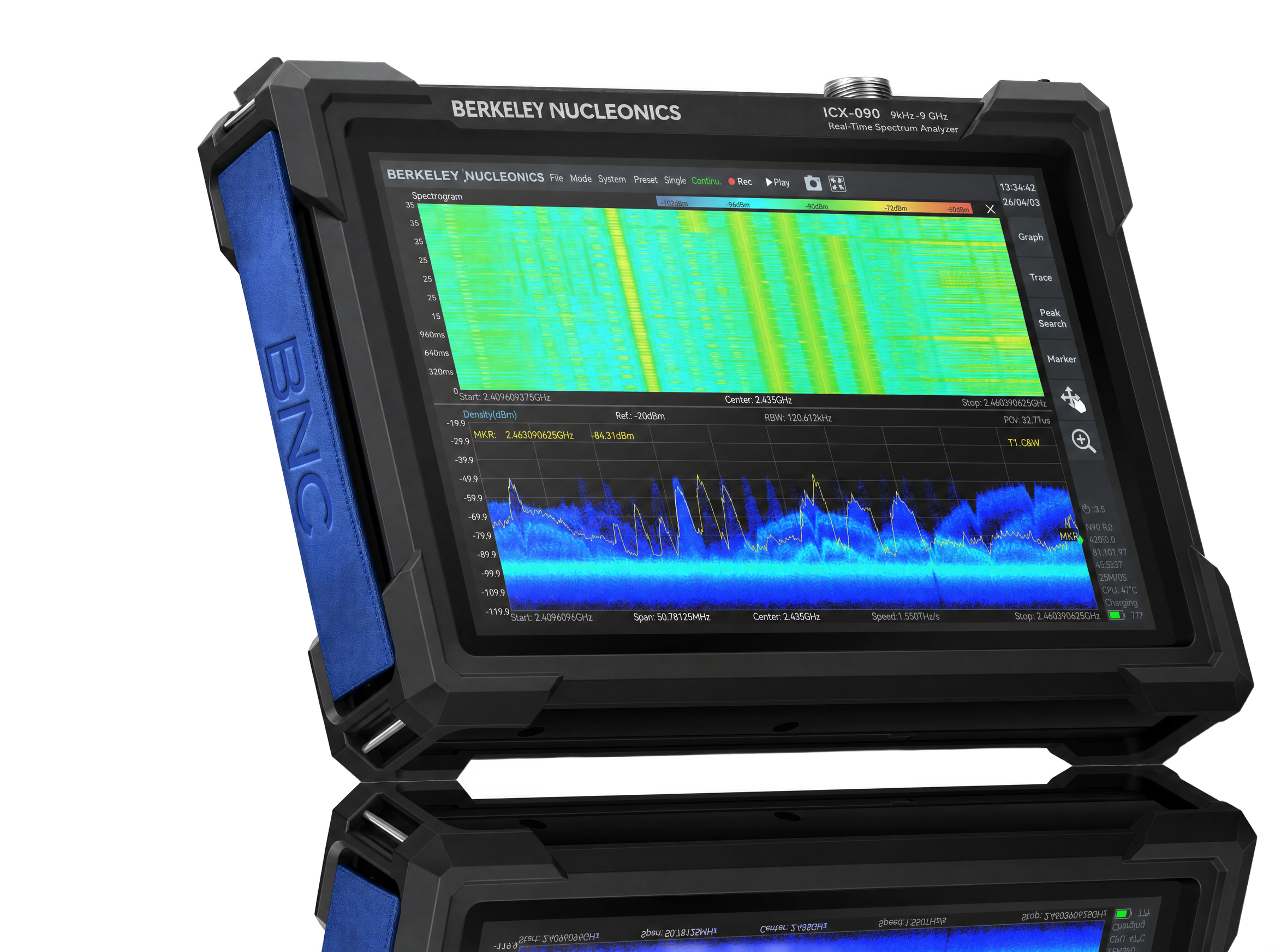
Handheld. Battery-powered and optimized for field test, measurement, and troubleshooting. Modern handhelds can match or beat low-end benchtop units, including real-time analysis, and the best of them offer large multi-touch displays. A handheld that keeps full performance while staying under about 3 kg is the strongest choice for field work, and a good handheld can replace a low-end benchtop to avoid duplicate investment.
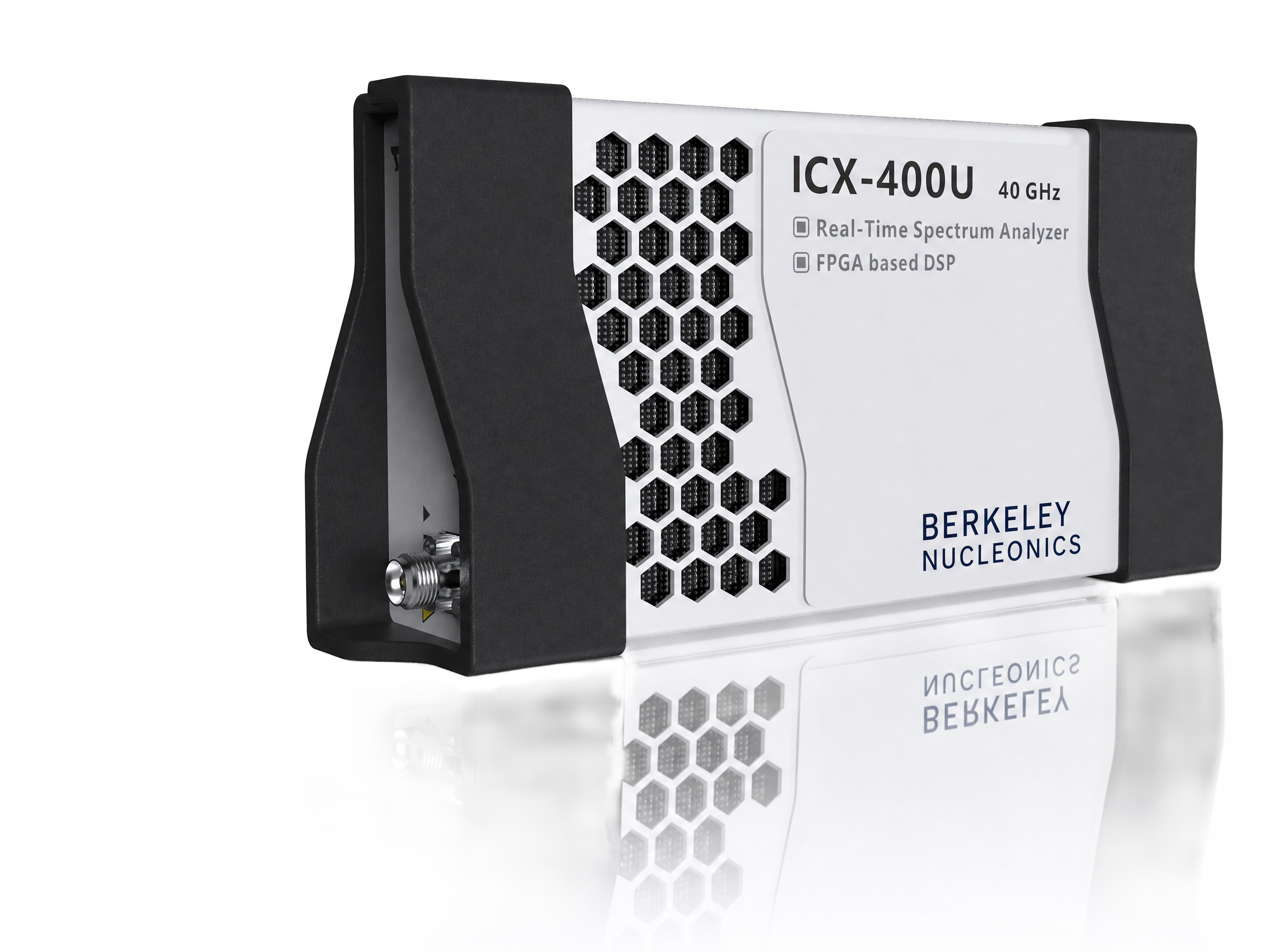
USB (software-defined). A USB analyzer uses a host computer for configuration and display. These modular units can weigh only a few hundred grams, which makes them easy to carry and easy to embed into larger systems. Performance varies widely. Simple USB units fall short of instrument-grade metrics, while advanced USB analyzers reach performance comparable to low- and mid-range benchtop or handheld instruments.
3Frequency Range
Frequency range is the span over which an analyzer can operate, and it is the first hard filter on any selection. The range must cover the signal frequencies for your application. Map your bands before anything else: cellular (sub-6 GHz and millimeter-wave), WLAN (2.4, 5, and 6 GHz), and satellite (L, S, C, and Ku bands among others).
Choosing a range wider than your highest operating frequency is generally the safer call, because the spectrum you need to see is often broader than the spectrum you transmit. A Wi-Fi router developer who only measures channel power needs coverage to about 6.3 GHz. The same engineer checking spectral purity, including third harmonics, needs coverage to at least 18 GHz. Buy for the harmonics and intermodulation you will eventually chase, not just the fundamental.
The ICX-FieldHawk handheld line covers three frequency tiers from a common 9 kHz floor. ICX-045 / ICX-060 / ICX-090 reach 4.5, 6, and 9 GHz. ICX-200 reaches 20 GHz. ICX-400 reaches the full 40 GHz (verify). A 40 GHz ceiling already covers the large majority of field applications, and every tier shares the same measurement suite and interface, so stepping up in frequency does not mean relearning the instrument.
4Swept vs Real-Time Analysis
This is the decision that most affects what you can actually catch in the field. A swept analyzer scans one frequency segment at a time, so any signal that appears while the sweep is looking elsewhere is missed. That blind window is fine for stable carriers and slow drift. It is a liability for frequency hopping, bursting, intermittent interference, and pulsed emissions.
A real-time analyzer processes the IF continuously and produces gap-free spectrum over its analysis bandwidth. Nothing inside that bandwidth slips between frames, which is what lets an RTSA tie spectrum to time precisely and surface signals a swept sweep would never see. If your work includes interference hunting, signal classification, or any transient capture, real-time capability is not a luxury. The ICX-FieldHawk line provides both swept and real-time analysis, so a single instrument covers stable survey work and transient capture.
5Analysis (Real-Time) Bandwidth
Analysis bandwidth is the slice of spectrum an analyzer can capture and process in a single acquisition. For an FFT or real-time instrument it sets two things at once: how much spectrum you see gap-free in one shot, and the widest signal you can demodulate or characterize without stitching multiple captures together.
A wider analysis bandwidth means you can watch a full wideband channel, a frequency-hopping pattern, or a fast burst in one continuous view rather than reconstructing it from sequential sweeps. Strong modern analyzers provide more than 25 MHz of analysis bandwidth as a baseline, and real-time instruments typically push well beyond that. Match the bandwidth to your widest signal of interest. A 100 MHz 5G NR carrier, for example, demands more instantaneous bandwidth than a narrowband two-way radio channel. The ICX-FieldHawk line delivers real-time analysis bandwidth sized for wideband field work (verify exact bandwidth per model against the published datasheet).
6DANL and Sensitivity
Displayed Average Noise Level (DANL) is the analyzer's own noise floor, expressed in dBm/Hz. It sets the smallest signal you can detect, because anything weaker than the noise floor disappears into it. A lower (more negative) DANL means higher sensitivity and the ability to pull weak signals out of the noise, which matters for low-level emissions, distant transmitters, and faint interference.
A preamplifier lowers DANL and improves small-signal sensitivity, but it can degrade the third-order intercept point and reduce the largest signal you can handle cleanly, so it is a trade rather than a free win. Sensitivity also interacts with sweep speed and resolution bandwidth. A narrower RBW lowers the effective noise floor but slows the sweep, which is why fast analyzers give you more usable sensitivity in practice (see Section 9).
Across the ICX-FieldHawk handheld tiers, 1 GHz DANL is specified at -168 dBm/Hz (ICX-045 / ICX-060 / ICX-090), 166 dBm/Hz for the 20 GHz tier (sign per source, verify), and -160 dBm/Hz (ICX-400) (verify). Read DANL alongside phase noise and dynamic range rather than in isolation, because the lowest noise floor is only useful if the rest of the front end can act on it.
7Phase Noise and Spectral Purity
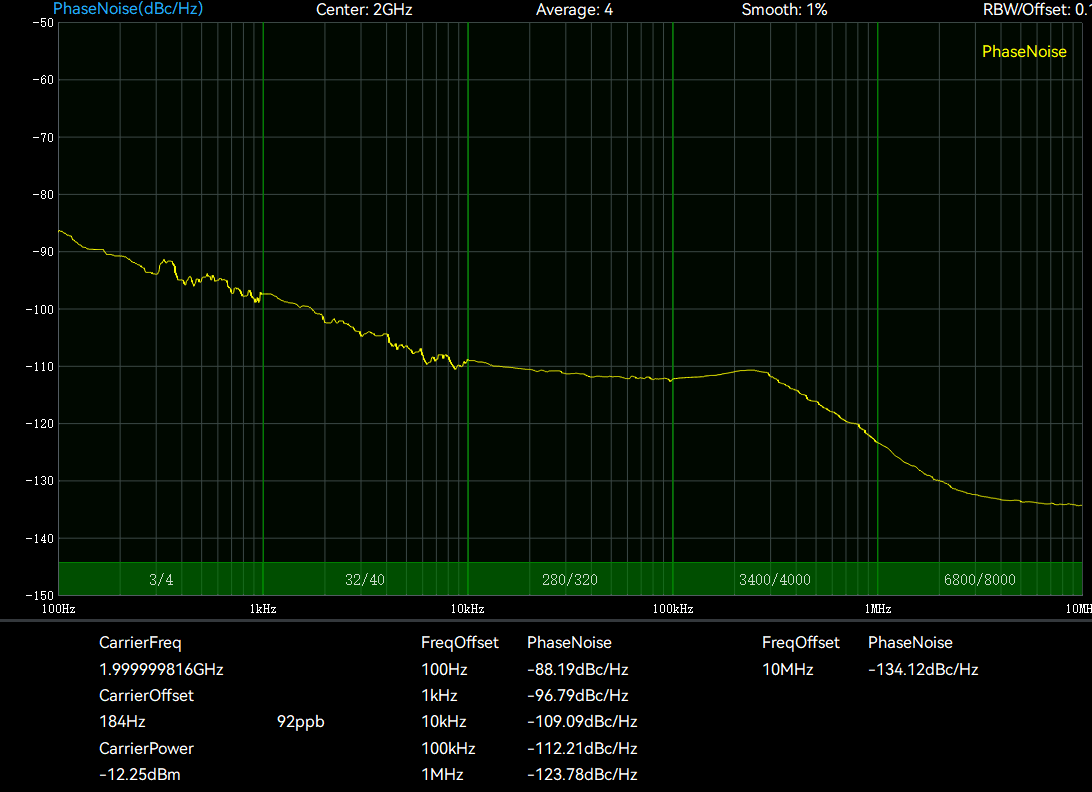
Spectral purity is the analyzer's ability to measure a signal without adding its own phase noise or spurious content. The three components that matter are phase noise, spurious signals, and harmonics. Low phase noise is essential for resolving closely spaced signals, measuring narrowband signals, and evaluating modulation quality such as EVM. Low and infrequent spurious signals matter because a spur generated inside the instrument can be mistaken for a real input signal, which sends you chasing interference that is not there.
The ICX-400 (40 GHz handheld) specifies a typical phase noise of -107 dBc/Hz at 10 kHz offset on a 1 GHz carrier, with typical spurious of <-65 dBc (verify). SpecICX-gen3 includes a standard phase noise measurement mode, so you can run a guided phase noise measurement without building the setup by hand. The plot below is a representative automatic phase noise measurement on a 2 GHz carrier.
8Dynamic Range and Input Power
Dynamic range is the instrument's ability to measure large and small signals at the same time. A wide dynamic range is what lets you find a weak interferer sitting next to a strong carrier, which is one of the most common and most demanding field measurements. It is driven mainly by the noise floor (DANL) at the low end and the third-order intercept point (TOI) at the high end, so look for a low DANL and a high TOI together. A preamplifier helps the small-signal side but can pull down the TOI, so dynamic range is always a balance rather than a single dial.
Maximum input power is the largest signal the RF input can safely handle. Near transmitters and other high-power sources, exceeding it can damage the instrument, so confirm both the maximum continuous input power and the peak power rating, and check whether the analyzer has built-in overload protection. In the field you do not always control the environment, and a damaged front end ends the measurement day.
9Sweep Speed
Sweep speed is one of the most direct influences on the user experience, and it has knock-on effects that reach far past convenience. If an analyzer is slow, you are forced to widen the resolution bandwidth just to keep sweep times tolerable, and a wider RBW raises the noise floor and throws away sensitivity. A theoretical -160 dBm/Hz DANL is wasted if a usable scan takes ten seconds, because in practice you will dial up the RBW and lose the floor you paid for.
The ICX-FieldHawk line is built for high sweep speed, which is what makes its sensitivity and dynamic range usable in the field. It can complete a 10 GHz frequency scan in tens of milliseconds at 100 kHz RBW (verify). Fast sweeps let you keep a narrow RBW across a wide span, which delivers an effective dynamic range beyond what common handhelds and entry-level benchtop instruments reach. When you compare two analyzers with similar DANL figures, the faster one usually wins in real measurements.
10Form Factor: Handheld, Rugged, USB
Form factor decides where the instrument can go and what it can survive. The right choice follows the environment more than the spec sheet.
Handheld
The standard field instrument. Self-contained, battery-powered, with an integrated multi-touch display for fast operation away from a desk. The ICX-FieldHawk handheld line targets this role with a roughly 1.5 kg weight (verify) and full real-time analysis, so a single device handles survey, troubleshooting, and characterization.
Rugged
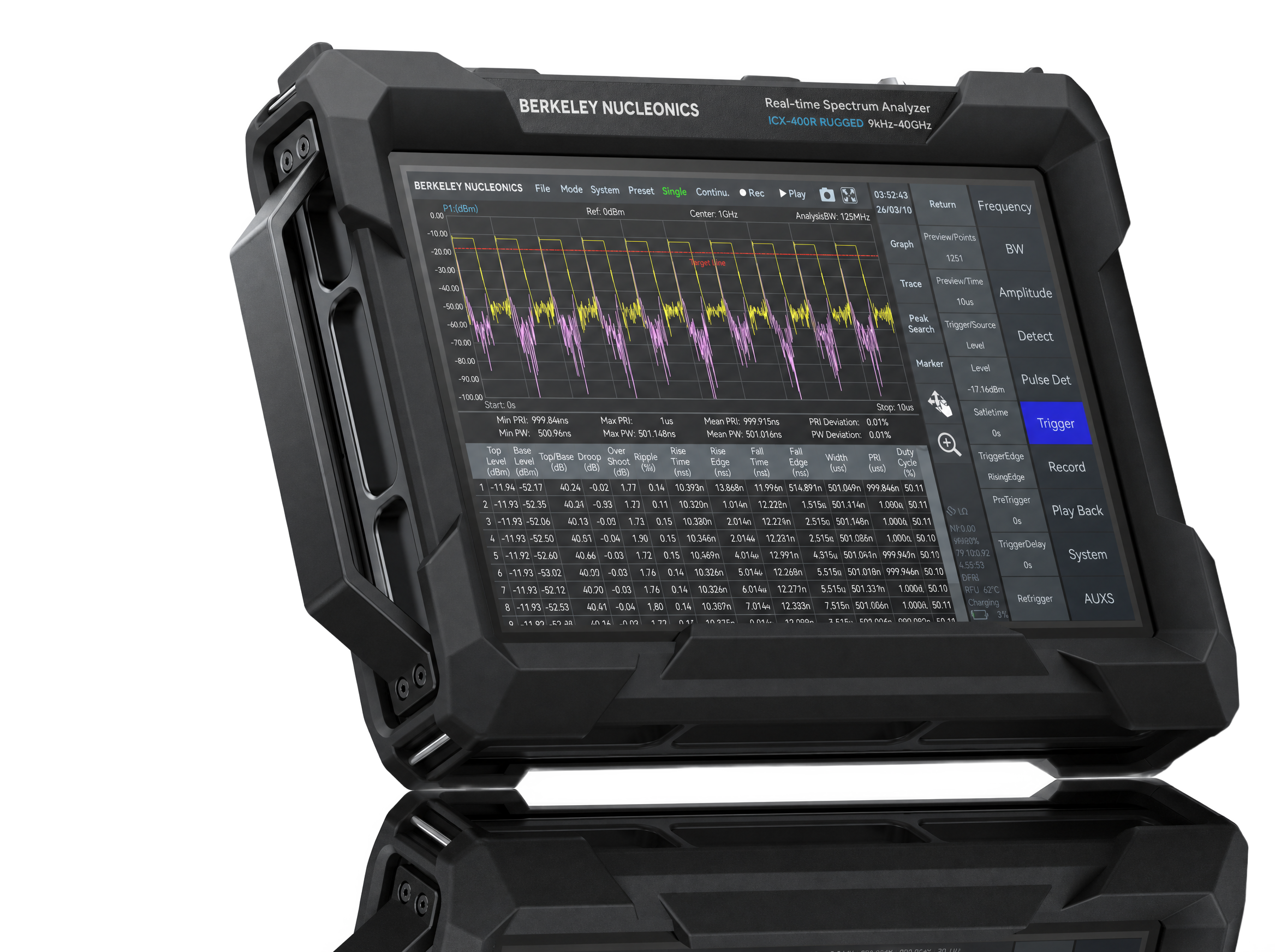
When the environment is harsh, an IP68-rated chassis adds dust and water ingress protection and a larger, more durable enclosure. The ICX-FieldHawk-R rugged platform carries IP68 as standard and offers an optional edge-AI module for autonomous detection and classification, at the cost of more weight and a larger size. Choose rugged when the analyzer rides in vehicles, works outdoors in weather, or runs unattended.
USB / software-defined
When you need the lightest possible package or want to embed an analyzer into a larger system, a USB instrument runs off a host computer and can weigh a few hundred grams. The ICX-FieldHawk-U line fills this role for integration, automated test racks, and space-constrained deployments. A ICX-FieldHawk-N networked variant extends the same engine over Ethernet (verify).
11Battery and Portability
Field and on-site testing happen away from the office, so weight and battery life feed straight into how much you get done in a day. A heavy instrument slows you down across a site survey, and a short battery interrupts the measurement you traveled to make. Aim for an analyzer that supports continuous use across a working block, on the order of 3 to 6 hours, and value a replaceable battery or power-bank support, because either turns a hard stop into a quick swap.
The ICX-FieldHawk handheld weighs about 1.5 kg, which keeps it easy to carry for field measurement, and provides about 3 hours of battery operation as standard with power-bank supply supported for longer sessions (verify). The rugged ICX-FieldHawk-R trades weight for endurance, reflecting its larger enclosure and field-endurance focus.
12Software and Firmware: SpecICX-gen3
The instrument is only as good as the environment that drives it. Beyond raw measurement, the software determines how quickly you reach an answer and how repeatable that answer is across operators. A strong measurement suite built in as standard means you are not making a duplicate investment in options later.
The ICX-FieldHawk line runs on SpecICX-gen3, a single software and firmware environment shared across the handheld, rugged, USB, and networked variants. One environment across the whole line means training transfers, scripts transfer, and a measurement set up on one form factor reproduces on another. SpecICX-gen3 ships the advanced measurement suite as standard, including channel power, occupied bandwidth, automatic phase noise, automatic harmonic analysis, spectrum emission mask, AM/FM and digital demodulation, heat map, and memory scan, so the common field measurements are guided rather than hand-built.
13Connectivity and API
Scalability and customization separate an instrument you operate from a platform you build on. A good handheld lets you develop custom applications for tasks like targeted RF measurement, data acquisition, signal processing, specialized spectrum monitoring, or direction finding. That extensibility is what turns a single analyzer into a building block for a larger system.
The ICX-FieldHawk line exposes a highly compatible Open API designed for secondary development, so you are not limited to the SpecICX-gen3 application. Engineers, researchers, and system integrators can customize the analyzer's behavior or embed it directly into their own RF systems, including autonomous and edge deployments. The same API connects every analyzer in the line to your toolchain, which keeps integration consistent as you scale from one instrument to many.
14Measurement Functions
Beyond basic spectrum parameters, automated measurement functions improve efficiency and standardize testing across operators. Decide which you need based on your application rather than buying every option for its own sake. Common functions include the following.
| Function | What it does |
|---|---|
| Channel Power | Integrates power across a defined channel bandwidth. |
| Occupied Bandwidth (OBW) | Reports the bandwidth containing a set percentage of total power. |
| ACPR | Adjacent channel power ratio, for measuring spillover into neighboring channels. |
| Spectrum Emission Mask (SEM) | Checks emissions against a regulatory or standard mask. |
| Field Strength | Measures received field strength for coverage and compliance work. |
| Interference Analysis | Waterfall diagrams and spectrograms for finding and tracking interference over time. |
| AM/FM Demodulation | Recovers analog modulation for listening and verification. |
| Digital Demodulation | Decodes digitally modulated signals; some instruments add standard-specific analysis. |
The ICX-FieldHawk line includes channel power, OBW, ACPR, AM/FM demodulation, and digital demodulation as standard, so the routine field measurements are available without add-on options.
15Quick Selection Matrix
Use this as a starting map from use case to a recommended ICX-FieldHawk model, then confirm the exact configuration against the published datasheet. Frequency ceilings shown are the deciding factor. All tiers share the same measurement suite, SpecICX-gen3, and Open API.
| Use case | Key driver | Recommended model |
|---|---|---|
| Wi-Fi / WLAN channel power, sub-6 GHz field work | Coverage to 6 GHz | ICX-060 (handheld) |
| Cellular and Wi-Fi with harmonic / spurious checks | Coverage to 9 GHz | ICX-090 (handheld) |
| Satellite (L/S/C/Ku), broadband monitoring | Coverage to 20 GHz | ICX-200 (handheld) |
| Millimeter-wave, EW/SIGINT, full-band survey | Coverage to 40 GHz | ICX-400 (handheld) |
| Outdoor, vehicle-mounted, or unattended field use | IP68 ruggedness, edge AI | ICX-FieldHawk-R (rugged) |
| Embedded / automated test, lightest package | Host-driven, modular | ICX-FieldHawk-U (USB) |
| Networked, remote, multi-node monitoring | Ethernet connectivity | ICX-FieldHawk-N (networked) (verify) |
| Directional signal hunting and geolocation | Directional antenna | ANT-100G / ANT-200G with any ICX-FieldHawk |
16Summary
Choosing the right handheld spectrum analyzer comes down to matching application needs, key performance parameters, ease of use, and long-term support. Start with frequency coverage. Decide whether you need real-time capture. Then weigh DANL, phase noise, and dynamic range as a set rather than as isolated numbers, because a fast sweep is often what makes the rest of the front end usable. Finish with the practical realities, form factor, battery, software, and a programmable API, since those decide how the instrument fits the way you actually work.
The ICX-FieldHawk line is built around that logic: wide frequency coverage from 9 kHz up to 40 GHz, real-time analysis, a high sweep speed that keeps sensitivity usable, one SpecICX-gen3 environment across every form factor, and an Open API for secondary development. It is designed to extend your RF boundaries from a single instrument to an integrated system.
17Talk to Berkeley Nucleonics
For configuration help, a quote, or a demonstration, reach the Berkeley Nucleonics team. We will match the right ICX-FieldHawk model and accessories to your application and confirm specifications against the current datasheet.
Email: info@berkeleynucleonics.com
Phone: 800-234-7858