Aerospace, Defense & Radar Testing
Aerospace and defense RF work has one problem that defines all the others: the signal that matters is usually the one that is hardest to see. A small return sits next to a much larger one. A frequency-hopping radio dwells on a channel for a few milliseconds and then moves on. A radar pulse lasts a fraction of a microsecond and goes quiet. In a dynamic threat environment, several of these happen at once, and the instrument either captures them on the first pass or loses them entirely.
A swept spectrum analyzer cannot keep up with that. It tunes across a band one slice at a time, so anything that appears between sweeps falls through the gap. For steady carriers this is fine. For pulsed radar, agile emitters, and intermittent faults, the gaps are exactly where the answer lives. The classic failure mode is a strong signal masking a weak one. The weak signal is often the threat, the spur, or the unintended emission that the test was designed to find.
The other half of the job is reading the signal once it is caught. Detecting energy tells you something is there. Measuring pulse repetition interval, pulse width, and duty cycle tells you what it is. That distinction, between a blip and a signature, is the entire point of radar and threat test work.
How the ICX-FieldHawk line solves it
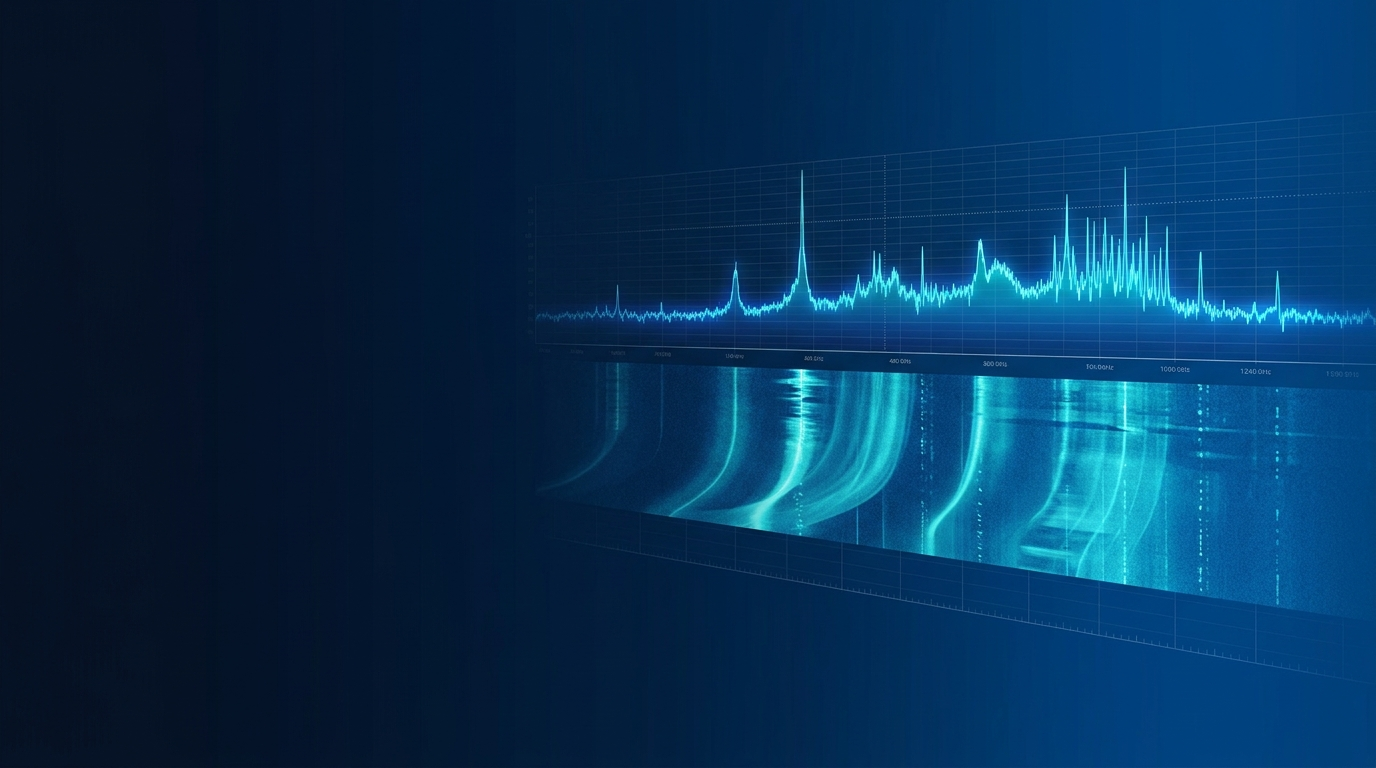
The ICX-FieldHawk receivers are real-time analyzers. Instead of sweeping, they process a wide span continuously, so the instrument sees the whole window all the time. With up to 100 MHz of real-time bandwidth, gap-free capture means a short event does not slip past while the analyzer is looking elsewhere. A persistence display then separates the constant from the rare, surfacing a weak signal sitting under a strong one rather than hiding it.
Frequency Mask Triggering is where this becomes a working tool rather than a curiosity. You draw a mask around the expected spectrum, and the receiver arms itself. When a signal crosses the boundary, even an intermittent burst measured in nanoseconds, the instrument triggers and captures it. Short, unscheduled, and easy-to-miss events become events you can study. For chasing a glitch that fires once a minute, this turns days of watching into an automatic catch.
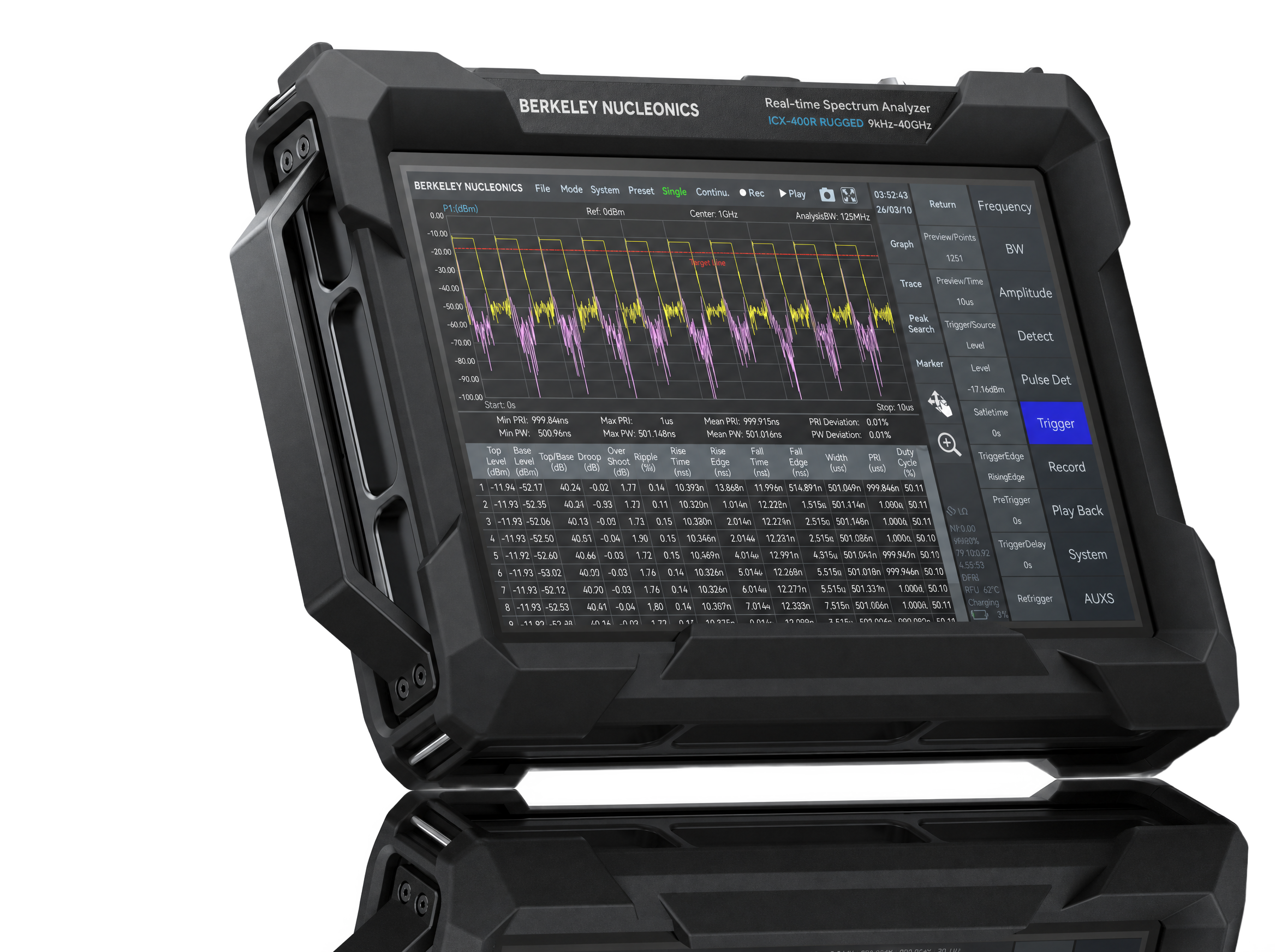
On top of the live view, SpecICX-gen3 firmware adds pulse analysis and vector signal analysis. It measures PRI, pulse width, and duty cycle directly and tracks how they change over time, which is the heart of radar characterization. Vector and digital demodulation handle the communications side, so an operator moves from detection to identification without leaving the screen or the field.
Which models and accessories fit
For dismounted and forward work, the recommended platform is the ICX-FieldHawk-R. It carries an IP68 environmental rating, so dust, rain, and immersion that would stop a benchtop unit do not stop it. Onboard AI assists with classification at the edge, flagging emitters of interest without a constant operator watch. In a field test or a threat-rich environment, that ruggedness is not a comfort feature. It is what keeps the instrument working instead of sitting in its case.
Where the receiver feeds a larger system, the ICX-FieldHawk-U USB core module is the right tool. It integrates into SDR platforms, vehicle racks, automated test stations, and custom processing chains, exposing the same real-time engine through a programmable interface. With coverage extending to 40 GHz, it reaches the microwave radar and satellite bands where modern aerospace work increasingly lives.
For directional work and threat geolocation, pair either receiver with the ANT-100G directional antenna. Its gain and front-to-back ratio help an operator bear in on an emitter, separate it from background traffic, and support angle-of-arrival estimates. Detection confirms a signal exists. The ANT-100G helps you point at it.
| Need | Recommended model | Why |
|---|---|---|
| Field and forward operations | ICX-FieldHawk-R | IP68 rugged build, onboard AI classification, battery operation |
| ATE / SDR / rack integration | ICX-FieldHawk-U | USB core to 40 GHz for test stations and embedded builds |
| Direction finding | ANT-100G | Directional gain for bearing and angle-of-arrival work |
Recommended configuration
A strong two-piece kit starts with the ICX-FieldHawk-R for field operations and an ICX-FieldHawk-U covering to 40 GHz for bench and rack integration, both running SpecICX-gen3 with 100 MHz real-time bandwidth, Frequency Mask Triggering, and pulse analysis enabled. Add an ANT-100G for directional sweeps and bearing. That pairing covers gap-free wideband capture, automatic triggering on short events, pulse fingerprinting, and vector signal analysis across radar and communications work.
For a quick question, chat with an engineer at berkeleynucleonics.com.