1Overview
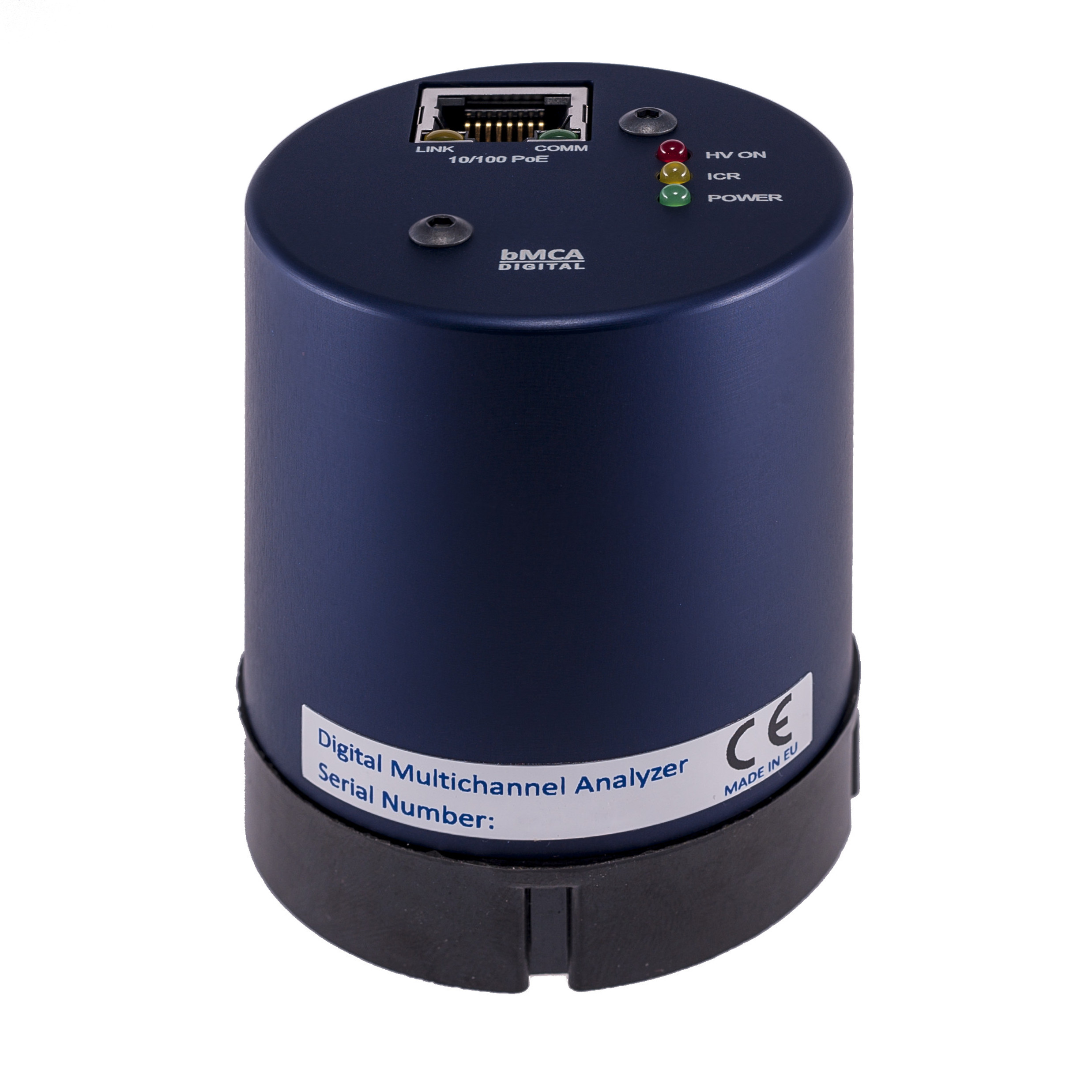
The bMCA-Ethernet is an advanced, fully digital Multi-Channel Analyzer designed to process electronic pulses produced by a photomultiplier tube (PMT) coupled to a scintillation detector. It is built directly into a compact 14-pin PMT base, eliminating the need for an external chassis or NIM bin. The result is a self-contained acquisition node that can be mounted directly on the detector.
Connection is via standard Ethernet (RJ45). The device receives its operating power through the same cable using Power-over-Ethernet (PoE), so a single CAT-5/6 run handles both data and power. The IP address is assignable via DHCP or set to a fixed value, making integration into local networks, distributed monitoring arrays, and laboratory setups straightforward.
Scintillators compatible with the standard 14-pin PMT base include NaI(Tl), LaBr3(Ce), and LaCl3(Ce), as well as other commonly used inorganic scintillator types. The internal miniaturized high-voltage power supply covers the full range of PMT bias voltages needed for both small and large-volume detectors.
2Features
- Fully digital MCA built into a compact 14-pin PMT base
- Pulse-Height Analysis (PHA) and Multi-Channel Scaling (MCS) acquisition modes
- Up to 4096 channels for both PHA and MCS
- Advanced electronic noise-reduction algorithms
- Compact form factor: H 75 mm × D 55 mm
- Ethernet data communications; IP address set via DHCP or fixed
- Lightning-fast data transfer: 1K PHA spectrum delivered to PC in 30 microseconds typical
- Miniature design combining low power consumption with low noise
- Miniaturized embedded HV power supply (0 to 1500 V, 4096 steps)
- Basic spectrum acquisition and device control software included
- Programming libraries available for Windows and Linux (upon request)
- LED indicators for HV power, count rate (ICR), and communications/power status
- Powered via Power-over-Ethernet (PoE); no separate supply required
- CE certified
3Description
Digital Signal Processing
The bMCA-Ethernet uses the latest advances in digital electronics to separate useful signal from noise and to sustain performance at high count rates. Powerful digital processing techniques and algorithms replace traditional analog shaping circuits, yielding more consistent peak positions, lower baseline drift, and better pile-up rejection than analog-chain designs.
Key digital processing parameters are fully user-adjustable: rise time (shaping), flat-top width, detection threshold, baseline restorer, and pile-up rejector. A built-in digital oscilloscope function lets users monitor both the raw input pulse and the filtered output in real time, which simplifies optimization of shaping parameters for a given detector and source geometry.
Acquisition Modes
Pulse-Height Analysis (PHA) is the standard mode for nuclear spectrometry and radiometry. The MCA sorts detected pulses by amplitude into up to 4096 channels, building an energy spectrum stored in on-board memory. Coarse gain settings (x1, x2, x4, x8) and a continuously adjustable fine gain (1 to 2 in steps of 1/4096) provide flexible matching of the detector output to the full ADC range. Upper and lower level discriminators are set in channel units.
Multi-Channel Scaling (MCS) records count rate vs. time in a selected energy window. It is particularly useful for monitoring the appearance or movement of a radioactive source over time, and for industrial and laboratory processes that use radioactive tracers or seek to locate radioactive material. MCS supports dwell times from 0.1 seconds to continuous ("count-forever") operation and can be set up directly from ROI boundaries or nuclide library entries.
Connectivity and Software
The Ethernet interface operates at standard network speeds. Transfer of a full 1024-channel spectrum takes approximately 30 microseconds, making real-time display and data logging practical even at high acquisition rates. A software discovery function automatically locates all bMCA units (USB or Ethernet) visible on the local network, so multi-detector systems require no manual IP entry during initial setup.
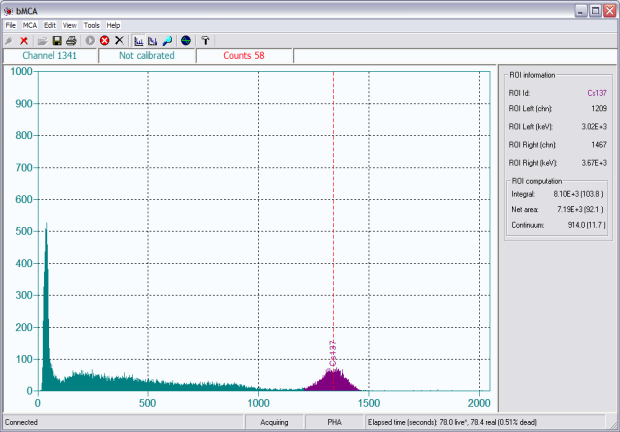
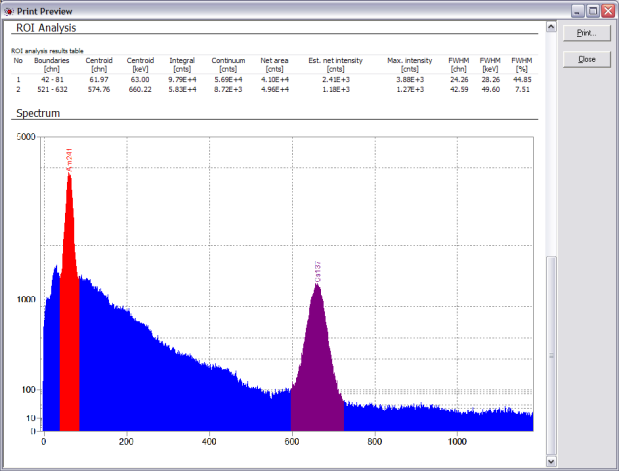
The included basic software package covers device setup and control, spectrum acquisition, live display, digital oscilloscope, energy calibration, region-of-interest (ROI) analysis, and peak search. Programming libraries for both Windows and Linux enable straightforward integration into custom radiation monitoring software, laboratory automation, or industrial control systems.
LED Status Indicators

4Technical Specifications
PHA Acquisition Mode
| Parameter | Value / Range |
|---|---|
| Spectral memory size | 256, 512, 1024, 2048, or 4096 channels |
| Coarse gain | Amplification factors: 1, 2, 4, 8 |
| Fine gain | 1 to 2, adjustable in steps of 1/4096 |
| Upper Level Discriminator (ULD) | Set in channel units |
| Lower Level Discriminator (LLD) | Set in channel units |
MCS Acquisition Mode
| Parameter | Value / Range |
|---|---|
| Spectral memory size | 256, 512, 1024, 2048, or 4096 channels |
| Dwell time | 0.1 s to count-forever |
| Setup method | From ROI boundaries or nuclide library information |
Digital Settings
| Parameter | Value / Range |
|---|---|
| Rise time (shaping) | 0.1 to 12 s in steps of 0.2 s |
| Flat top | 0.1 to 8.0 s in steps of 0.1 s |
| Threshold | 1 to 255 |
| Digital Baseline Restorer (BLR) | Included |
| Pile-Up Rejector (PUR) | Included |
High-Voltage Power Supply
| Parameter | Value |
|---|---|
| Type | Miniature HV power supply embedded in MCA assembly |
| Output voltage range | 0 to 1500 V |
| Voltage resolution | 4096 steps over full range |
Data Communications
| Parameter | Value |
|---|---|
| Interface | Ethernet (RJ45) |
| IP address assignment | Fixed or via DHCP |
| Power source | Power-over-Ethernet (PoE); includes PoE injector and cables |
| Spectrum transfer rate | 30 µs typical for a 1024-channel energy spectrum |
| Accessories included | Set of cables and PoE injector |
Physical
| Parameter | Value |
|---|---|
| Size | Height 75 mm, Diameter 55 mm |
| Weight | Approximately 200 g |
| Connector | Ethernet RJ45 |
| PMT base compatibility | Standard 14-pin photomultiplier tube base |
Software and Certifications
| Item | Detail |
|---|---|
| Included software | Basic spectrum acquisition, device control, digital oscilloscope, energy calibration, ROI analysis, peak search |
| Programming libraries | Available for Windows and Linux (upon request) |
| Discovery function | Automatic detection of all bMCA (USB or Ethernet) units on the local network |
| Certifications | CE compliant |
5Applications
The bMCA-Ethernet is suited for any application requiring networked, self-contained gamma-ray spectroscopy. Its compact PMT-base form factor and PoE connectivity make it especially practical where rack space is limited or where multiple detector nodes must be deployed across a facility.
- Nuclear spectroscopy and radiometry in research laboratories and university settings
- Gamma-ray counting and identification with NaI(Tl), LaBr3(Ce), and LaCl3(Ce) detectors
- Multi-detector monitoring arrays over standard IP networks without external NIM electronics
- Industrial radiation measurement using radioactive tracers or source-based gauging systems
- Environmental and health-physics monitoring requiring networked data logging
- Customs, border security, and portal monitoring systems requiring distributed spectroscopy nodes
- Nuclear medicine and isotope production quality-assurance measurements
- Research and development setups integrating scintillation detectors with custom software via Windows or Linux APIs
6Ordering & Contact
The bMCA-Ethernet is available directly from Berkeley Nucleonics. Standard delivery includes the bMCA-Ethernet unit, a set of Ethernet cables, and a PoE injector, plus the basic acquisition software package. Programming libraries for Windows and Linux are available upon request. Contact Berkeley Nucleonics to discuss detector compatibility, multi-unit configurations, and system integration support.
| Model | Description |
|---|---|
| bMCA-Ethernet | Compact digital MCA, Ethernet/PoE interface, 14-pin PMT base, 0–1500 V HV, up to 4096 channels, CE certified |
Reach the Berkeley Nucleonics ScintIQ team for pricing, compatible detector configurations, and integration assistance.
Email: info@berkeleynucleonics.com
Phone: 800-234-7858
Web: berkeleynucleonics.com
Berkeley Nucleonics has supported the nuclear R&D and radiation measurements community for 60+ years. Comprehensive lines of specialized radiation counting and analysis tools are offered, with the collaboration of key partners worldwide.