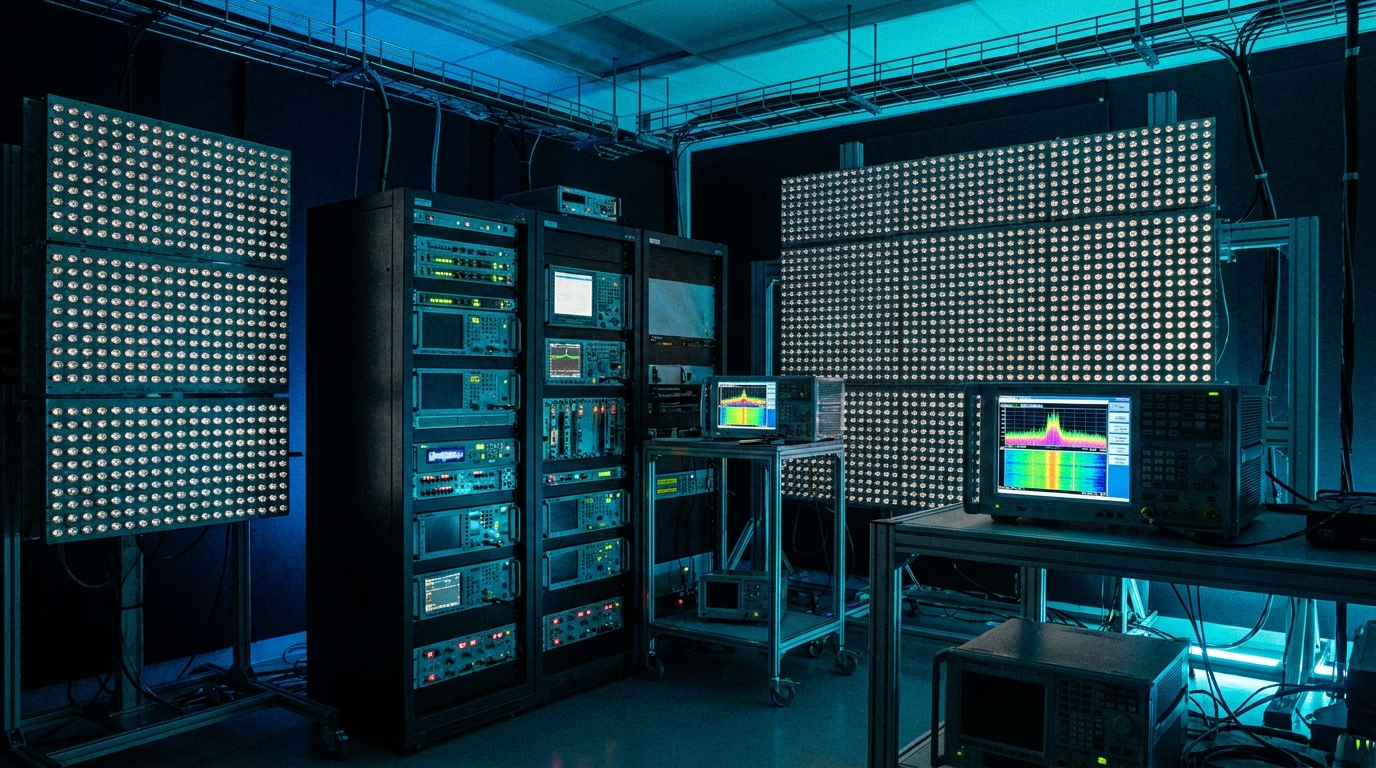
Radar & EW Simulation
Radar target generation and electronic-warfare threat emulation share a hard requirement: the test signal has to look like the real world. A radar receiver under test expects returns that carry the right delay, Doppler, and amplitude for a moving target, and an EW system expects a sky full of emitters that switch, sweep, and hop the way real threats do. Reproducing that in the lab means synthesizing chirps, frequency-agile pulses, complex pulse trains, and multi-emitter scenes with the timing fidelity of the systems they stand in for.
The waveform generator sits at the center of that bench. It feeds the radar receiver, the seeker, or the EW processor a controlled stimulus so engineers can measure detection, tracking, and discrimination against a known truth. When the bench has to recreate a layered threat environment, the generator carries the whole scene, which is why its bandwidth, memory, and channel count set the ceiling on what the lab can test.
The challenge
Modern radar and EW work pushes a waveform generator on several axes at once. Direct or wideband IF and RF synthesis needs a high sample rate and the analog bandwidth to carry it, because a narrow instrument cannot represent a wide chirp or a fast-rising pulse without distorting the very feature under test. Long, non-repeating scenarios need deep memory, since a realistic engagement runs far longer than a short loop and any obvious repeat gives the receiver under test a pattern to lock onto.
Agility is the next demand. Frequency-agile pulses and pulse-to-pulse hopping require fast switching between waveform segments with no settling artifacts between them. Clean edges and low jitter matter because the timing of a pulse defines its range, and any jitter on the generator floor blurs the measurement. Finally, angle-of-arrival and multi-emitter scenes need tight synchronization across channels and across units, so that several phase-coherent outputs can stand in for spatially separated emitters with a known, stable relationship.
Few instruments satisfy all of these at once. A generator that reaches the bandwidth often gives up memory depth, and one with deep memory often cannot switch fast or stay synchronized across a wall of channels. Radar and EW labs need the whole set in one platform, because a scenario is only as credible as its weakest axis, and a single shortfall in bandwidth, memory, agility, or synchronization gives the system under test a tell it can exploit.
How the Model 686 solves it
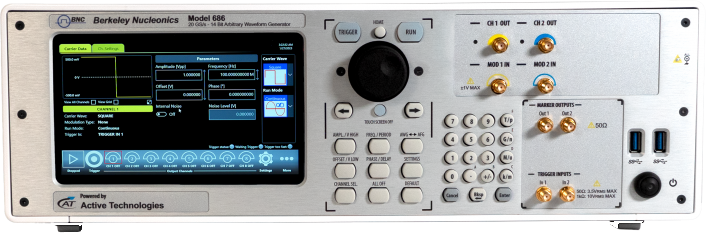
The Berkeley Nucleonics Model 686 is built for exactly this combination of bandwidth, depth, agility, and scale. It samples at 20 GS/s with 10 GHz of analog bandwidth, and it delivers a direct sine output to 6.5 GHz, which lets the bench synthesize wideband IF and a useful range of RF directly rather than relying on an external upconverter for every band. That direct path keeps the signal chain short and the fidelity high.
Memory is sized for real scenarios. With up to 9 Gpts of waveform memory, the Model 686 plays long, non-repeating pulse trains and multi-emitter scenes without the short-loop repeat that betrays a simulator. Edges are fast and clean, with 50 ps rise and fall times and sub-2 ps jitter, so pulse timing reflects the scenario and not the instrument. That timing precision is what makes the difference between a believable threat and an artifact a receiver can reject.
For multi-channel and multi-emitter scenes, the Model 686 synchronizes up to 4 units into a single coherent system, giving 16 analog channels and 128 digital channels. That channel count and tight inter-unit synchronization is what angle-of-arrival emulation and dense multi-emitter scenes demand: several phase-stable outputs that hold a known relationship across the whole bench. Fast switching between waveform segments lets each channel carry frequency-agile and hopping behavior within the scene.
| Requirement | Model 686 capability |
|---|---|
| Wideband IF / RF synthesis | 20 GS/s sample rate, 10 GHz bandwidth, 6.5 GHz direct sine output |
| Long non-repeating scenarios | Up to 9 Gpts waveform memory |
| Pulse timing fidelity | 50 ps rise / fall, sub-2 ps jitter |
| Multi-emitter and AoA scenes | Up to 4 units synchronized: 16 analog + 128 digital channels |
Recommended configuration
For a radar target generator or single-threat EW bench, a single Model 686 driving the wideband IF or direct RF path covers chirp, agile-pulse, and complex pulse-train work with depth to spare. For angle-of-arrival emulation and dense multi-emitter scenes, synchronize multiple Model 686 units so the channel count matches the number of emitters and spatial directions the scenario calls for, up to the full 16 analog and 128 digital channel configuration. Pair the digital channels with the analog outputs to mark events and drive switches in step with the RF.
Talk to an application engineer
Berkeley Nucleonics can help defense and aerospace test labs match a Model 686 configuration to a radar or EW scenario, from a single target generator to a synchronized multi-emitter system. Call 800-234-7858 or email info@berkeleynucleonics.com.
For a quick question, chat with an engineer at berkeleynucleonics.com.