Temperature Sensitivity of Power Sensors
Berkeley Nucleonics Corporation
With almost all electronic devices, temperature impacts performance. This is particularly critical when the device is part of a measuring instrument. RF & µW power sensors are used to ensure the validity of test systems by providing accurate power measurements across a broad frequency range and power levels. However, power sensor measurement accuracy has been very susceptible to minor variations in temperature with errors easily exceeding 50%. These errors are mitigated by requiring the user to manually zero and calibrate the sensor before use. This process has not changed in over 50 years. It must be performed repeatedly or any time ambient temperature changes +/- 5° C.
This obsolete process makes conventional power sensors unusable for a variety of critical applications. These would include embedding power sensors in a rack of test equipment to monitor critical test points. It also includes applications where a remote sensor is used in harsh environments. In general, it includes any situation that requires a constant stream of unattended measurements over an extended time period (such as a strip chart). But things are changing.
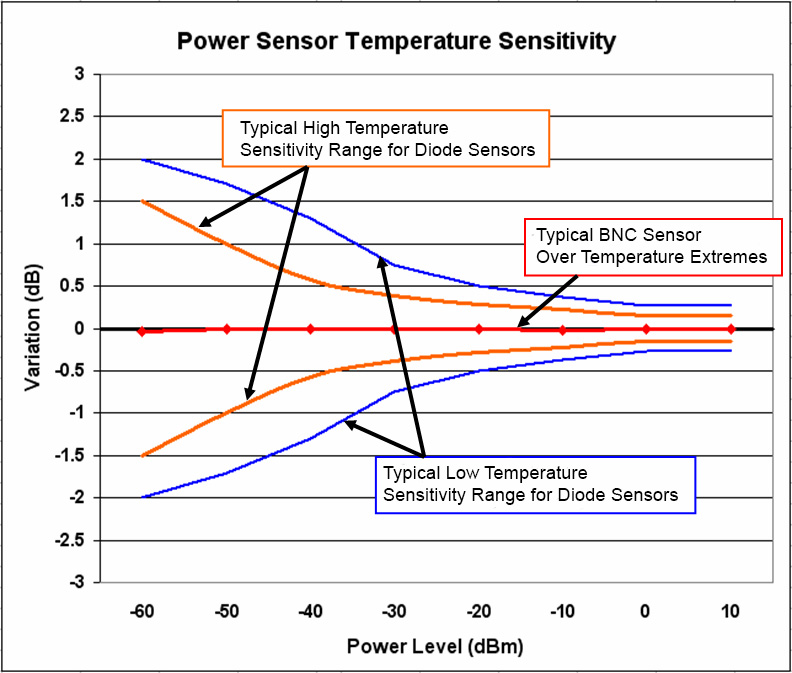
Figure 1 indicates that as the temperature of the sensor moves from 23° C to the high or low temperature extremes, the power measurements of a typical sensor will vary by up to two dB or become non-operational depending on the power level to be measured. Two dB represents a measurement error of nearly 60%. Note that the Model 12100 power sensor shows no variation from a measurement made at room temperature to when the sensor is cooled to 0° C or heated to 55° C and measuring power levels as low as -60 dBm.
Zero and Calibration
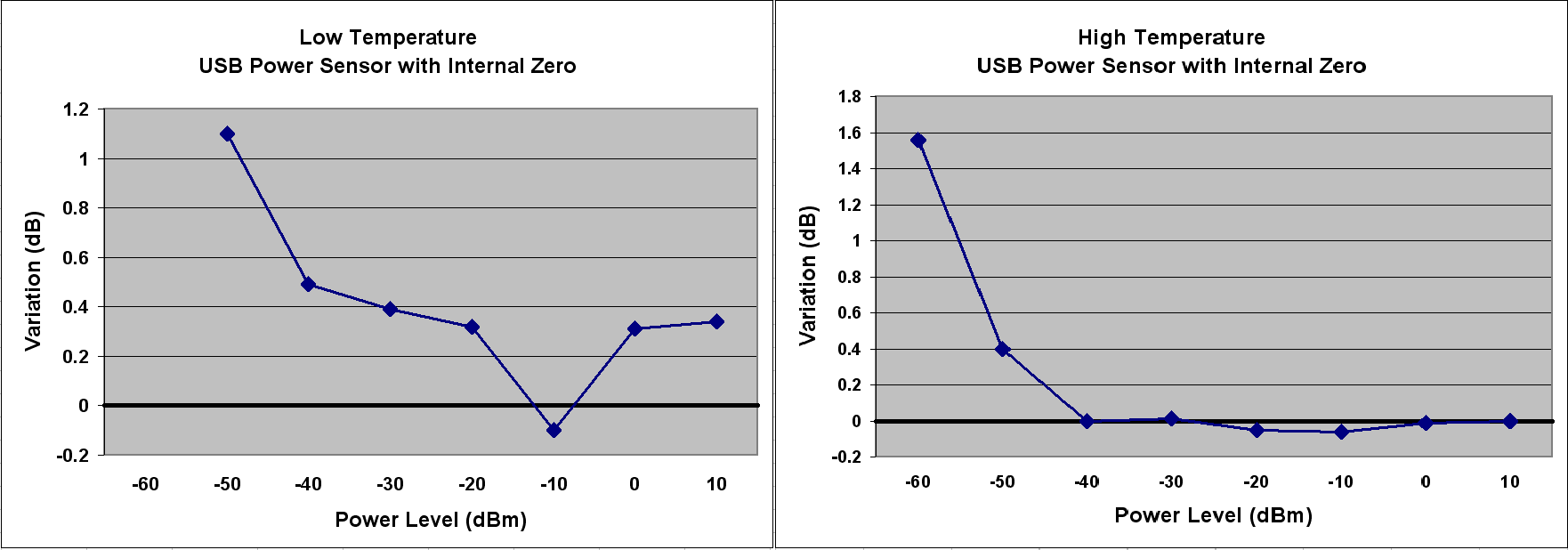
The zero & cal process for traditional power sensors involves multiple disconnections from the test system measurement point or device under test and connections to an external calibration source. By themselves, zero & cal do not provide an accurate power measurement even when executed after each change in temperature. Newer sensors that have an internal zero & cal capability and do not require an external calibration source will also exhibit sensitivity to temperature. In this case, the internal zero & cal is automatically performed periodically and not for each measurement. Additionally, the ability of a power sensor to adapt to changes in temperature is limited to how rigorous of a factory calibration was performed and the ability of the sensor to report its temperature. The sensitivity of a USB sensor with internal zero (no cal required) is shown in Figure 2. Notice that for the lower power levels, the measurement error climbs higher than 1.5 dB and represents a measurement error of over 40%.
RF Average Power Sensors from Berkeley Nucleonics do not require zero & cal and have eliminated the process altogether. They undergo the most robust factory calibration in the industry including a calibration across the full operational temperature range. Then during use, the sensor measures the temperature for each power reading, employing a patented technique to ensure that the correct factory temperature calibration factor is always applied to each measurement. This process makes the Model 12100 virtually immune to temperature changes under any conditions.
| Temperature (°C) | Model 12100 Accuracy |
|---|---|
| 40 – 50 | 1.00% |
| 30 – 40 | 0.75% |
| 20 – 30 | 0.00% |
| 10 – 20 | 0.75% |
| 0 – 10 | 1.00% |
Sensor Design Categories
Most power sensors now available fall into one of three design categories: thermistor, thermocouple, and diode detector. For a thermistor detector, the RF power heats the detector changing its resistance thereby providing the power measurement. For the type using a thermocouple, the microwave power is absorbed by a load within the sensor and the temperature rise of the load is then measured by the thermocouple. The diode detector operates in its square law region where the DC component of the diode output is proportional to the square of the AC input voltage thus providing the power measurement.
Data collected from a thermistor sensor and several different models of diode sensors at hot and cold temperatures indicates that typical sensors of either type exhibit a large sensitivity to temperature that can render the measurement near useless. The temperature extremes of specified operation were used to best illustrate the variability of the measurement from room temperature (23° C).
The thermistor sensor, where the measurement depends on measuring the heat dissipated in the device, is particularly sensitive. Figure 3 shows that for power levels below 0 dBm the measurement is so far offset from the room temperature reading that the sensor should be considered inoperable.
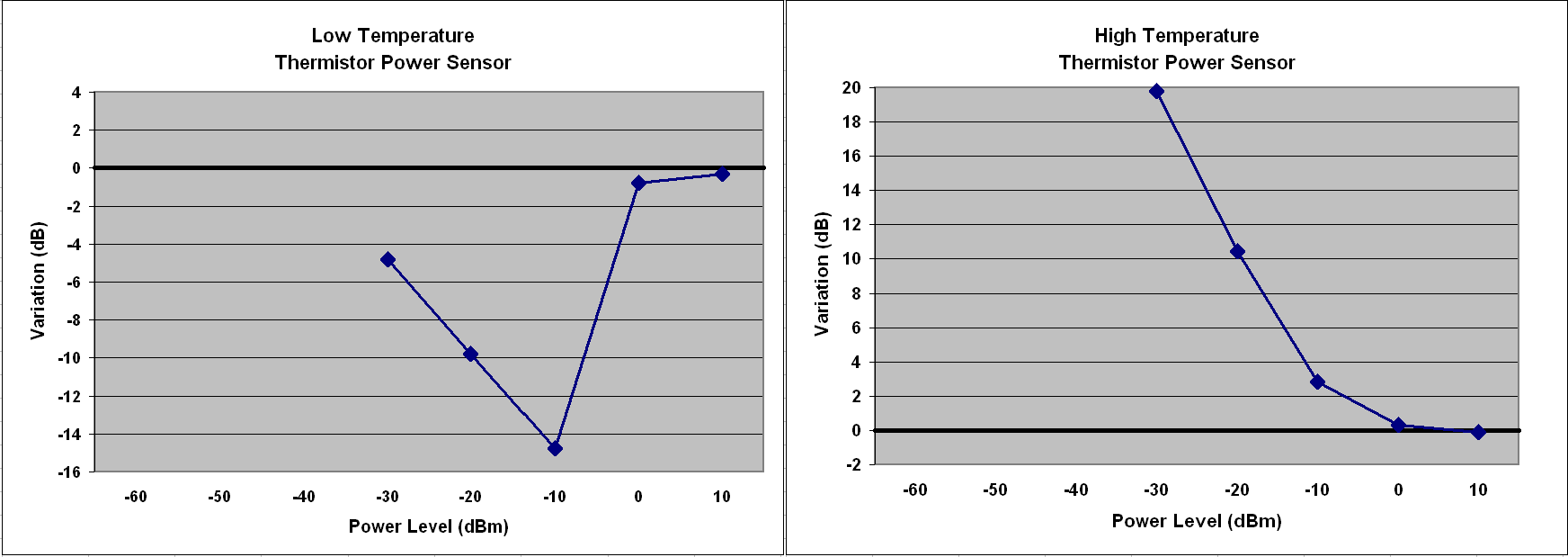
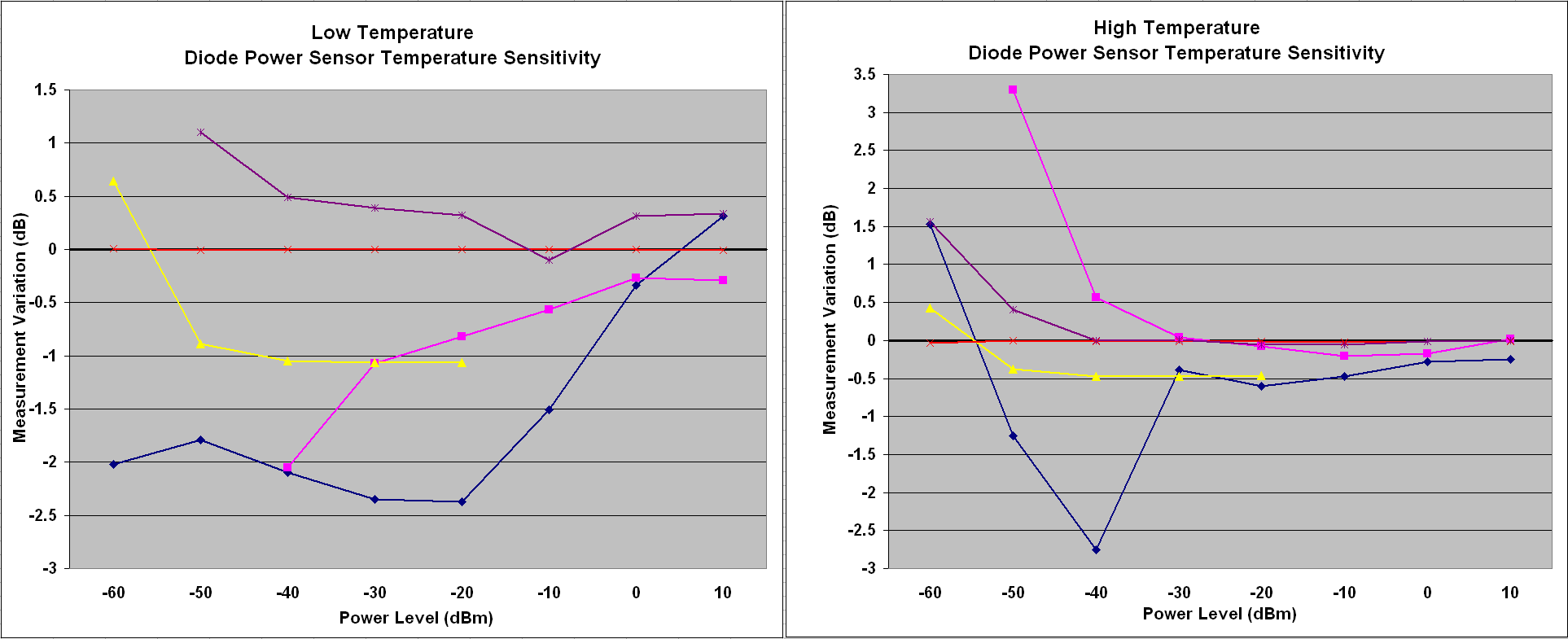
Figure 4 shows a composite of the temperature sensitivity data collected from five different diode sensors. Measurements were made at the extremes of their temperature ranges. Note that some sensors cease to operate at lower power levels of -50 or -60 dBm. The red line (at 0 dB variation) shows the Model 12100 to have no measurement variation even at the extremes of its operating temperature range.
The Model 12100 Advantage
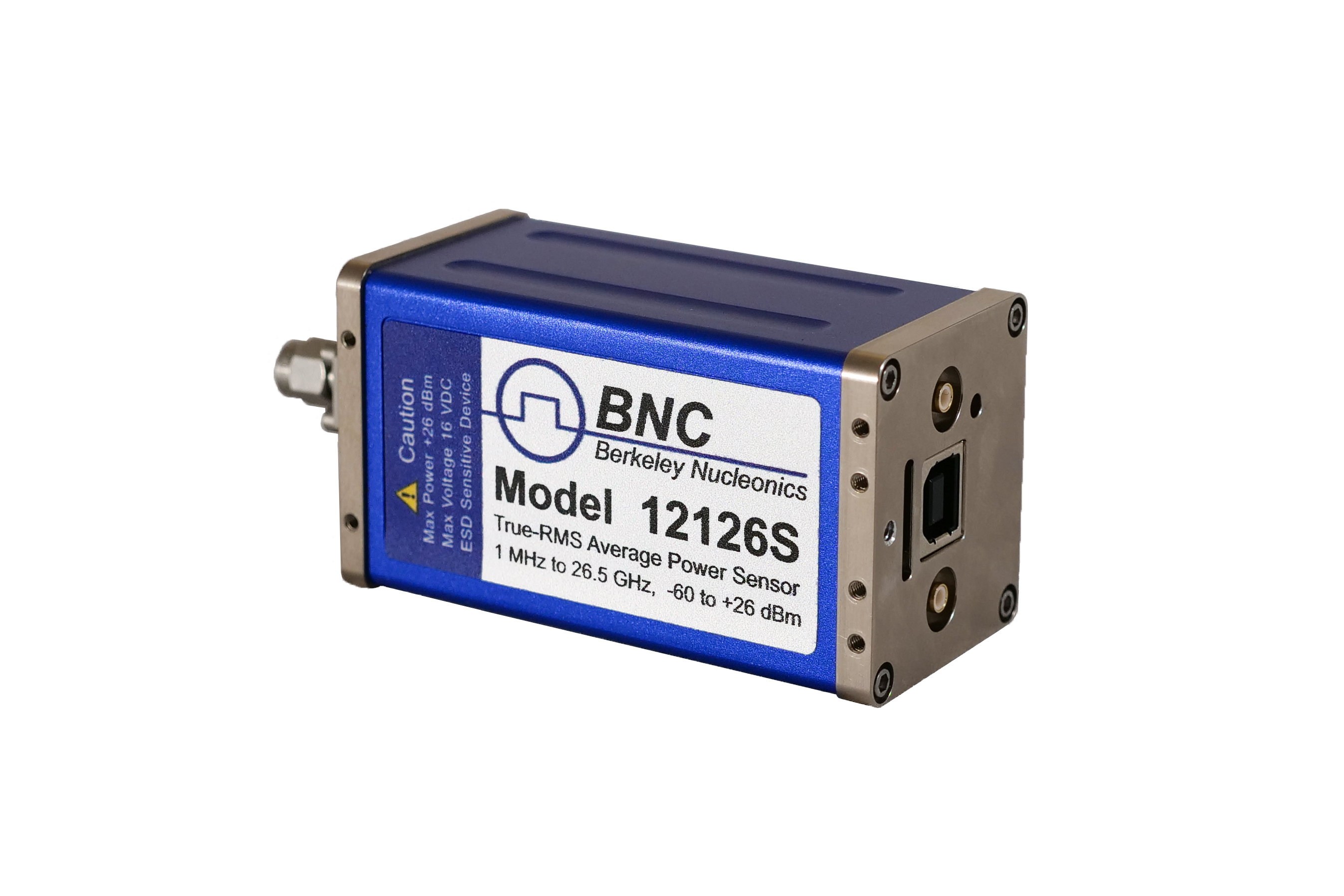
Berkeley Nucleonics provides the only power sensor with virtually no sensitivity to temperature changes. But the advantages of the Model 12100 do not stop there. The most compact sensor available comes with an easy to use software package that will have you making measurements five minutes after you open the box. With available triggering in and out, a variety of connector configurations and competitive pricing, the Model 12100 provides incomparable value.
For more information, visit the Model 12100 Series product page, or contact info@berkeleynucleonics.com or call 800-234-7858.
2955 Kerner Blvd. · San Rafael, CA 94901 · Tel: (415) 453-9955 · info@berkeleynucleonics.com