Radar & Fire-Control (FIRES)
Radar earns its place in fire-control and FIRES work because it sees what the eye cannot. The same sensing principle that lets a phased-array system track an incoming round also lets a wildfire team read the structure of a fast-moving blaze or watch the weather that drives it. As these radar systems grow more capable, the test equipment behind them has to keep pace. An engineer developing a receiver, validating a tracker, or rehearsing a fire-control engagement needs a way to put realistic signals into the system on the bench, before anything flies and before a live event puts the design to the test.
That is the job an arbitrary waveform generator does. Rather than wait for a real target, a real jammer, or a real fire front to appear, the engineer describes the return as a waveform and the generator produces it on demand. A radar target return becomes a delayed, Doppler-shifted, amplitude-scaled copy of the transmitted pulse. A fire-control sequence becomes a timed series of pulses and dwells that exercises the tracker the way a live engagement would. A threat scenario becomes a layered scene of multiple returns, clutter, and interference played back the same way every run. The waveform is the test, and the generator that produces it sits inside the measurement chain, not beside it.
Why an AWG fits the work
Radar and FIRES emulation make demands that few signal sources meet at once. The pulses have to land where the scenario expects them, so timing has to be tight and repeatable from run to run. A target at a given range is a return delayed by a precise interval, and a few picoseconds of slop blurs that range or smears a Doppler bin the tracker depends on. The scenes themselves are long and often layered, with several targets, clutter, and jamming overlapping in time, which calls for deep waveform memory rather than a short repeating loop. When the pattern is too short, it stops looking like the real world and starts looking like a test pattern the system can learn.
Modern radar also reaches well into the microwave bands and switches modes quickly. Generating the wide instantaneous bandwidth of a chirped or agile pulse takes a high sample rate, and emulating an emitter that hops frequency or pulse shape on the fly takes fast switching between waveform segments without a settling delay that gives the trick away. Multi-element and multi-emitter scenes add another requirement: several channels locked to a shared reference so the relative phase and timing across them stay true. None of these stands alone. The same instrument has to deliver wide bandwidth, a high sample rate, fast switching, deep memory, and tight multi-channel synchronization at once, which is what separates a generator built for radar work from a general-purpose one.
The capabilities that matter
Wide bandwidth and high sample rate. Radar returns carry their information in fast edges and wideband chirps, so the generator has to sample fast enough to render them without distortion. A high sample rate is what lets a single instrument synthesize a wideband pulse cleanly rather than rounding off the very features the radar measures.
Fast switching. Agile emitters change frequency, pulse width, and modulation from pulse to pulse. Emulating them means stepping between waveform segments quickly and seamlessly, with no settling tail that would betray the emulation to the system under test.
Deep memory. A realistic scene of multiple targets, clutter, and interference, played without an obvious repeat, needs the full sequence held in memory. Deep waveform memory is what lets a long, varied scenario run end to end instead of looping back to a short pattern.
Multi-channel synchronization. Multi-element arrays and multi-emitter scenes depend on the relative timing and phase between channels. Tight synchronization against a shared reference keeps those relationships true across the system, even when the channels span more than one chassis.
Which model fits
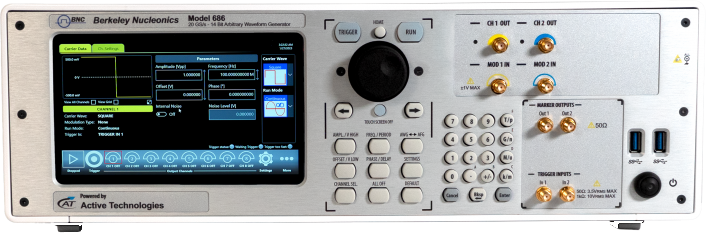
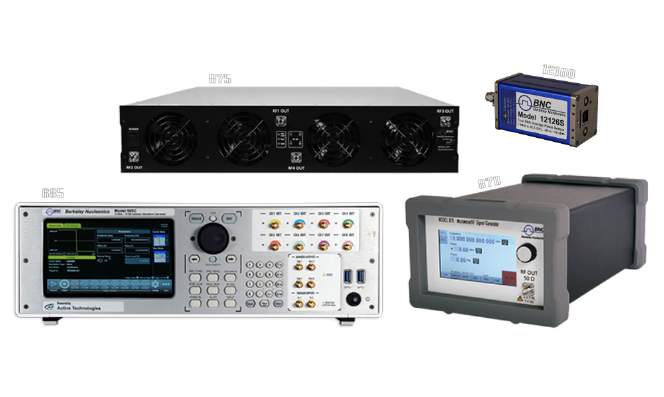
For wideband radar target generation and agile threat emulation, the Model 686 is the right starting point. Its 20 GS/s sample rate renders wideband chirps and fast pulse edges without rounding off the features the radar measures, and its fast segment switching suits agile emitters that change frequency or pulse shape on the fly. Deep waveform memory holds long, layered scenes so a multi-target scenario plays end to end rather than looping. For multi-element or multi-emitter work, multiple Model 686 units synchronize to a shared reference, keeping timing and phase across channels true.
Where amplitude precision matters more than the highest sample rate, the Model 685 is the better fit. Its 16-bit vertical resolution keeps the amplitude steps small and the return faithful, which suits low-observable target emulation, fine clutter modeling, and any scenario where a clean, finely graded envelope carries the information. The 686 and 685 share one architecture and synchronization scheme, so a bench can mix them on a common timebase and lean on each where it is strongest.
Talk to an application engineer
Berkeley Nucleonics can help you match a Model 686 or Model 685 configuration to your radar target generation, fire-control, or FIRES emulation bench. Call 800-234-7858 or email info@berkeleynucleonics.com.
For a quick question, chat with an engineer at berkeleynucleonics.com.