1Overview
The PM1703, the PM1703GNA, and now the PM1703GNA-II MBT mark successive generations of gamma and gamma-neutron pagers built for the homeland security market. The device keeps the rugged, simple interface the field expects, then pairs it with the analytical ability and processing power of a far larger instrument. It operates much like a conventional radiation detection pager, but it also collects and stores spectroscopic data. That added capability turns a personal alarm into a tool for managing and expertly analyzing radiological incidents.
Alarm data downloads from the pager to a Pocket PC, IPAQ, or smartphone for further analysis, isotope identification, or electronic forwarding to back-end support. A team leader can hand staff a detector that alarms sensitively in real time and still stores and transfers what it found. Data transfer is simple. It ties into existing network infrastructure, GPS functionality, or a classified AI protocol without disrupting how the team already works.
2Key Features
- Highly sensitive CsI(Tl) and LiI(Eu) scintillation detection for low-level gamma alarming.
- Simple two-button operation that requires no specialist training to run in the field.
- USB, Bluetooth, and IRDA communication for flexible data download and transfer.
- Shockproof hermetic case rated for rough handling and outdoor use.
- Designed for low EMI susceptibility around portable radios, cell phones, and similar equipment.
- Stores spectroscopic data on alarm, enabling later isotope identification and reachback.
3Detector & Performance
Gamma detection uses a CsI(Tl) scintillator read out by a silicon photomultiplier (SiPM), backed by a GM counter for higher dose rates. Neutron detection uses a LiF/ZnS assembly. The product features also describe the detection chemistry as highly sensitive CsI(Tl) and LiI(Eu) scintillation, well matched to the low count rates seen in early-warning screening.
The combination matters in the field. The scintillator delivers the sensitivity needed to catch weak or shielded sources during a walk-by, the GM tube extends the usable dose rate range, and the LiF/ZnS layer adds neutron sensitivity for special nuclear material that a gamma-only pager can miss. Detailed sensitivity, dose rate, and energy figures are not published on the product page and are flagged for verification in Section 4.
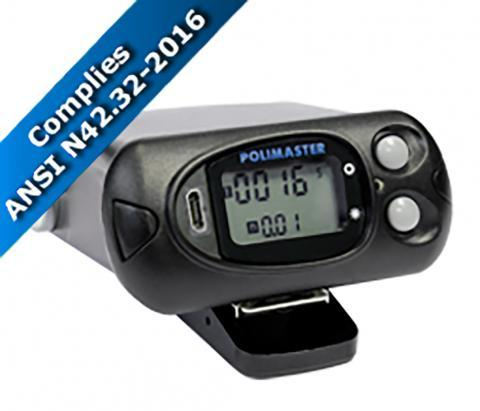
4Specifications
| Parameter | Specification |
|---|---|
| Detector type | CsI(Tl) with SiPM readout; GM counter; LiF/ZnS neutron detector |
| Detection type | Gamma and neutron |
| Gamma energy range | verify |
| Dose rate range | verify |
| Gamma sensitivity | verify (cps per uR/hr) |
| Alarm thresholds | verify |
| Communication | USB, Bluetooth, IRDA |
| GPS | Supported via host device; detail verify |
| Weight | 240 g with battery |
| Size | 98 x 72 x 32 mm |
| Enclosure | Shockproof hermetic case; low EMI design |
| Battery type and life | verify |
| Operating temperature | verify |
| Ingress rating (IP) | verify |
| Certifications | verify |
5Applications
- First responders carrying out radiological screening at scene.
- Customs and border patrol checkpoints.
- Police and fire units needing a wearable early-warning alarm.
- Emergency and HazMat teams managing a radiological incident.
- Security guards screening people and bags at access control.
6Options & Accessories
| Part | Description |
|---|---|
| PM1703MB | Gamma pager with spectroscopic gathering |
| PM1703GNB | Gamma and neutron pager with spectroscopic gathering |
| P/N 6982 | IPAQ PDA 6500 or compatible, with Dose Rate Exposure software |
| P/N 6984 | Poli-Identify-IPAQ software for Model 1703GNB / 1703MOB (installed on IPAQ PDA) |
| P/N 6985 | Poli-Identify-Desktop XP software for Model 1703GNB / 1703MOB (laptop or desktop) |
| P/N 6986 | Nylon 1703 case with 3 belt clip |
Software options cover dose rate exposure tracking and full isotope identification through Poli-Identify, in both IPAQ and Desktop XP versions. Data downloads to a Pocket PC, IPAQ, or smartphone for analysis and forwarding.
7Ordering
To configure a PM1703GNA-II MBT, select the gamma-only or gamma-neutron variant, then add the analysis software and accessories your workflow needs. For a quote, a demonstration, or help matching the detector to a screening protocol, contact Berkeley Nucleonics at info@berkeleynucleonics.com or 800-234-7858.