1Overview
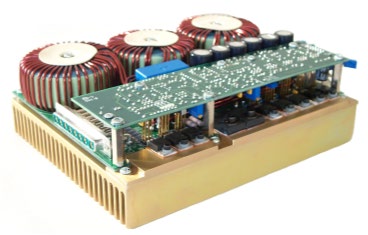
The PCO-6131 is a compact, OEM-style high-power pulsed current source designed to drive diode lasers, bars, and arrays in pulsed, QCW, or CW modes. It delivers output current variable from 1 A to 125 A, pulse widths variable from under 100 ns to DC, and pulse repetition frequencies variable from single-shot to 500 kHz at duty cycles up to 100%.
Like its lower-current sibling, the PCO-6131 features a user-adjustable variable rise-time control. A PCB-mounted potentiometer adjusts the rise time within a range of under 30 ns to over 2.5 us, so the driver edge can be optimized for the diode and the application rather than locked at the factory. The result is a single module that adapts across a wide span of high-current pulse requirements.
Directed Energy, Inc. is now a division of Berkeley Nucleonics. The PCO-6131 is the same design, built in California, with one support path. Its rugged, compact form and high-power capability make it a strong OEM choice for driving high-power laser diodes.
2How It Works
The PCO-6131 is based on a hysteretic, average-current, switch-mode regulator. This is a variable-frequency, variable-pulse-width design that maintains current in an energy-storage inductor between a minimum and a maximum level, with ripple limited to the band set by the hysteretic controller. The regulator starts when the TTL enable line goes high and runs as long as enable is held high. The architecture provides a large input range and high efficiency.
A shunting switch shorts the regulator output until output current is needed. The pulse is generated by opening the shunt switch for the length of the input gate pulse. Pulse rise and fall times are then limited only by the stray and parasitic capacitance and inductance of the shunting switch and output leads, so lead layout and the rise-time trimpot both shape the edge.
No power is dissipated in the driver until it is enabled. When enabled at 125 A maximum output, roughly 75 W is dissipated continuously to maintain current in the storage inductor. At 125 A output the stored energy in the driver is about 7 joules, dramatically lower than comparable linear current sources, which limits fault energy delivered to the diode.
3Output Specifications
Specifications are subject to change without notice.
| Pulse amplitude | Specification |
|---|---|
| Output current range | 0 A to 125 A |
| Means of adjustment | Trimpot mounted on PCB, or external 0–5 V or 0–10 V analog voltage, jumper-selectable |
| Output polarity | Positive |
| Pulse rise time | Variable, under 30 ns to over 2.5 us (10% to 90%), user-adjustable PCB trimpot |
| Pulse width | Under 100 ns to DC |
| Pulse frequency range | Single-shot to 500 kHz |
| Maximum duty cycle | 100% |
| Output pulse ripple/droop | Approximately 2 A, less than 2% at 125 A output |
| Jitter | Less than 3 ns, first sigma |
| Efficiency | Greater than 75% at 50% duty cycle, 125 A output |
| Output connector | High-current DSUB, PCB-mounted |
| Diode forward voltage amplitude | 20 V maximum |
| Gate input & monitor | Specification |
|---|---|
| Gate input type | Positive edge trigger |
| Gate input | +5 V CMOS |
| Current monitor (optional PCA-9155) | 1000 A/V terminated into 50 ohm; plus or minus 3% of actual current |
| Current monitor connector | BNC |
| Output enable/disable | TTL input, high = enabled |
4General & Power
| Parameter | Specification |
|---|---|
| Input power | +24 VDC plus or minus 10%, unregulated |
| Operating temperature | 0 C to 40 C |
| Cooling | Air cooled |
| Dimensions (H × W × D) | 8.4 cm × 20.3 cm × 16.5 cm |
5Output Protection & Safety
To protect the laser diode and the driver, circuitry disables the output if the +24 VDC support power drops below 18 V. This undervoltage cutout keeps the regulator from running without sufficient headroom, a common path to uncontrolled current at high output levels.
Clamp diodes are incorporated into the output network to protect the laser diode against reverse-voltage conditions. The low stored energy of the hysteretic design, roughly 7 joules even at 125 A, limits the energy that can reach the diode during a fault, which is a meaningful advantage over comparable linear current sources at this current level.
6Control & Interfaces
The PCO-6131 requires a user-supplied +24 VDC support power input, a CMOS (+5 V) gate signal, and a TTL-level enable/disable signal. The high-current output is derived from the +24 VDC input. Output pulse width and frequency are controlled by the gate signal, and output current amplitude is set by a PCB-mounted potentiometer or, jumper-selectable, by an external 0–5 V or 0–10 V analog voltage.
The optional PCA-9155 current monitor is a 0.002 ohm resistor with a 50 ohm series termination. Terminated into 50 ohm, it presents the equivalent of a 0.001 ohm resistor with scaling of 1000 A/V, viewable on an oscilloscope through a BNC connector. The resistor sits in the negative lead, and the BNC shield is connected to the negative output, giving a direct, real-time view of the diode current waveform at high current.
7Applications
The PCO-6131 targets OEM systems that need very high pulsed current in a compact module with a tunable edge.
- Diode bars and arrays. Drive high-power bars and stacked arrays up to 125 A in pulsed, QCW, or CW modes.
- LiDAR and rangefinding. Generate high-amplitude current pulses with adjustable rise time and low jitter for long-range time-of-flight systems.
- Materials processing. Supply high-current pulses for marking, drilling, and high-power illumination at duty cycles up to 100%.
- High-energy laser and pump sources. Embed a compact, efficient, low-stored-energy driver into solid-state and fiber laser pump chains.
8Ordering Information
| Part number | Description |
|---|---|
| PCO-6131 | Diode Driver Module |
| PCA-9160 | 1-Meter Output Stripline Cable |
| PCA-9155 | Optional Current Monitor Board (1000 A/V into 50 ohm) |
The PCO-6131 is provided with a mating I/O connector and sockets, and a 1-meter output stripline cable assembly.
Contact
For a quote, configuration help, or OEM integration support, reach the Berkeley Nucleonics team.
Email: info@berkeleynucleonics.com
Phone: 800-234-7858