1Overview
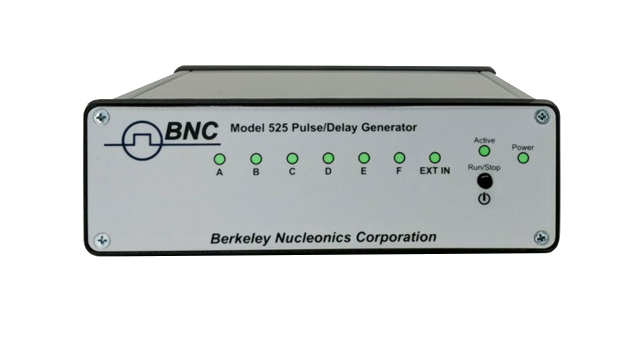
The Model 525 is a portable digital delay and pulse generator built for engineers who need real timing performance without a benchtop instrument. Six independent channels fit inside a case measuring 7.125″ × 5.1″ × 1.5″. It runs entirely from a USB connection, so a laptop, a phone charger, or a battery pack is enough to power a full six-channel timing setup in the field.
That combination is what sets the 525 apart. It offers the highest channel density in its class, and it does so at a price point aimed at value-conscious labs, classrooms, and integrators. Berkeley Nucleonics positions the Model 525 as a direct upgrade and replacement for the discontinued Picosecond Pulse Labs PSPL2600C, carrying over the portability while adding channels and precision.
Each channel produces trigger, gate, or pulse signals with 4 ns resolution and jitter under 50 ps RMS on the internal rate generator. A PC-based graphical interface handles setup. For research, event synchronization, and device triggering, the 525 delivers full pulse/delay functionality in a package you can carry in one hand.
2Key Features
- Six independent channels, each selectable as trigger, gate, or pulse output
- 20 MHz maximum repetition rate
- 4 ns timing resolution on width and delay
- Internal rate generator jitter below 50 ps RMS
- Pulse width from 10 ns to 1000 s
- Delay range up to 1000 s from the trigger event
- Per-channel modes: single pulse, continuous, burst, duty cycle, cycle counting
- External trigger to 30 V peak, rising or falling edge selectable
- USB powered from a laptop, charger, or battery pack
- PC-based graphical user interface for full control
3Channels & Timing Architecture
The Model 525 organizes timing around an internal rate generator and six independent pulse-and-delay channels. The rate generator establishes the master T0 period. Each channel then references that period and applies its own delay and width, so a single trigger can fan out into six precisely staggered events.
Internal rate generator
A 100 MHz low-jitter PLL drives the timebase, locked to a 50 MHz, 50 ppm crystal oscillator. The period range spans 0.001 Hz to 20 MHz, which is 1000 s down to 50 ns. Burst and duty-cycle operation counts from 1 to 1,000,000 pulses, tracked by a 32-bit pulse and period counter.
Per-channel flexibility
Each channel can run at the full T0 rate or at an integer division of T0, giving every output its own effective frequency. A multiplexer lets any or all channels combine onto any or all output connectors. Negative delay references one channel to another in positive or negative time increments, which is useful when one event must precede the nominal trigger.
| Capability | Detail |
|---|---|
| Channels | 6 independent outputs |
| Channel multiplexing | Combine timing of any/all channels to any/all outputs |
| Individual rates | Each channel at T0 or an integer division of T0 |
| Negative delay | Reference one channel to another, positive or negative increments |
| Clock reference | User-selectable 10 MHz to 100 MHz input/output reference |
| Gating | Gate individual channels or gate all channels together |
4Specifications
Core specifications
| Specification | Value |
|---|---|
| Number of channels | 6 independent outputs |
| Resolution | 4 ns |
| Width / delay accuracy | 10 ns + 0.0001 × settings |
| Channel-to-channel jitter | < 250 ps RMS |
| Output pulse amplitude | TTL |
| Power source | Standard USB |
Internal rate generator
| Parameter | Specification |
|---|---|
| Frequency (period) range | 0.001 Hz to 20 MHz (1000 s to 50 ns) |
| Resolution & accuracy | 4 ns |
| Jitter | < 50 ps RMS |
| Burst / duty cycle mode | 1 to 1,000,000 pulses |
| Timebase | 100 MHz, low-jitter PLL |
| Oscillator | 50 MHz, 50 ppm crystal oscillator |
| Pulse control modes | Internal rate generator, external trigger / gate |
| System output modes | Single, continuous, burst, duty cycle, cycle counts |
| Pulse & period counter | 32 bit |
Pulse & delay generation
| Parameter | Specification |
|---|---|
| Width / delay resolution | 4 ns |
| Width range | 10 ns to 1000 s |
| Width accuracy | 10 ns + 0.0001 × (width + delay settings) |
| Delay range | ±1000 s |
| Delay accuracy | 5 ns + (0.0001 × delay setting) |
| Multiplexer | Any or all channels combined to any/all outputs |
| Channel output modes | Single shot, normal, burst, duty cycle |
| Channel control modes | Internally triggered or externally gated |
| Jitter (channel to channel) | < 250 ps RMS |
Physical
| Parameter | Value |
|---|---|
| Dimensions | 7.125″ × 5.1″ × 1.5″ |
| Shipping dimensions | 12 × 10 × 5″ |
| Shipping weight | 5 lbs |
5Triggering & I/O
The 525 operates from its internal rate generator in free-run, or from an external trigger or gate. The external trigger accepts up to 30 V peak with a minimum width of 20 ns, and the active edge is selectable rising or falling.
Clock reference and gating
A user-selectable clock reference accepts or supplies a frequency from 10 MHz to 100 MHz, which lets the 525 lock to an external timebase or serve as the reference for other instruments. Gating works at two levels: individual channels can be gated independently, or every channel can be gated together as a group.
| Parameter | Specification |
|---|---|
| External trigger amplitude | Up to 30 V peak |
| External trigger width | ≥ 20 ns |
| External trigger edge | Rising or falling, selectable |
| Clock reference range | 10 MHz to 100 MHz, user selectable |
| Output amplitude | TTL |
6Options & Configurations
The Model 525 ships as a single six-channel configuration. Power and control come through standard USB, and the PC-based graphical interface handles all setup, including per-channel modes, rates, and multiplexing.
- USB power from a laptop, charger, or battery pack
- PC-based graphical user interface, included
- Selectable clock reference, 10 MHz to 100 MHz
Service and support
- In-stock same-day shipping
- No-risk demo for 14 days
- Full two-year warranty
- Integration assistance and full customer support by phone or web
7Applications
- Research and laboratory timing
- Event synchronization across multiple instruments
- Device and circuit triggering
- Portable and field test setups where no wall power is available
- Classroom and teaching environments needing a low-cost multi-channel source
Because the 525 powers from USB and carries six channels in a book-sized case, it suits any setting where bench space, mains power, or budget is limited but real timing precision still matters.
8Ordering
The Model 525 is a six-channel portable digital delay and pulse generator, USB powered, with the PC interface included. To request a quote, a configuration review, or a no-risk demo, contact Berkeley Nucleonics.
| Item | Description |
|---|---|
| Model 525 | Six-channel portable digital delay / pulse generator, USB powered, PC GUI included |
Berkeley Nucleonics Corporation · info@berkeleynucleonics.com · 800-234-7858