1Overview
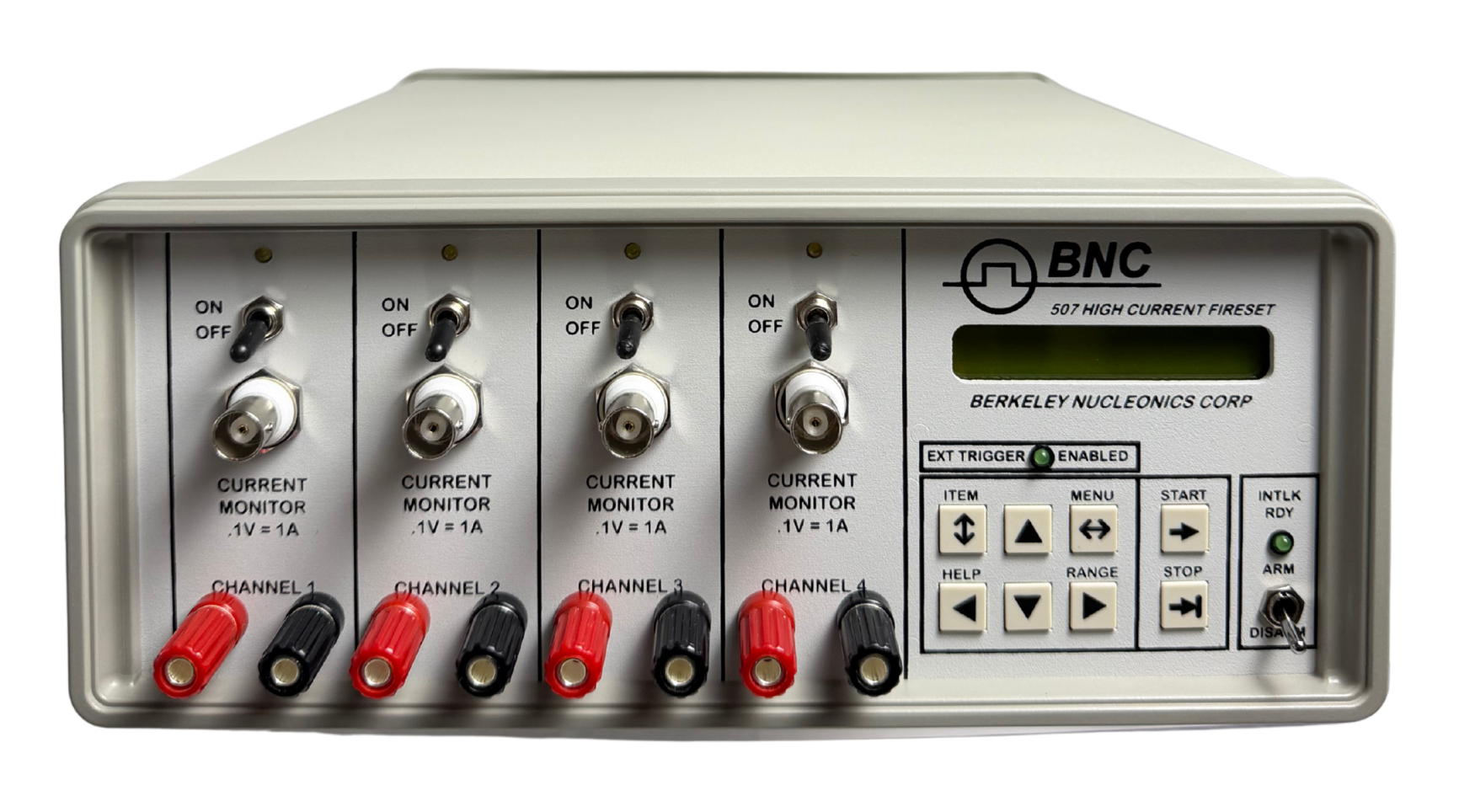
The Model 507 is a high current pulse generator built to act as a fireset for high-energy initiator testing. It produces adjustable current signals up to 25 amps, the value that sets it apart from lower-current laboratory pulsers. Each output drives demanding loads such as airbag squibs, detonators, and pyrotechnic igniters where the device under test needs a large, well-shaped current pulse rather than a voltage step.
Two or four digitally controlled, load-resistant outputs work independently. Pulse widths and delays are unique to each channel and are controlled with fine resolution, so a single instrument can sequence several initiators in one shot. A TTL Sync output referenced to T0 gives test engineers a clean reference for triggering high-speed cameras, oscilloscopes, or other diagnostic equipment.
The instrument stores up to twelve test configurations, runs from standard line power, and weighs about 10 lb, making it a practical bench fixture for repeated airbag and ballistics work.
2Key Features
- High current to 25 A. Adjustable current output up to 25 amps for fireset and squib initiation testing.
- 2 or 4 independent channels. Each output carries its own digitally controlled delay and pulse width.
- Fine timing resolution. Delay and pulse width set in 200 ns steps with 100 ns + 0.0001 x delay accuracy.
- Load-resistant outputs. Output amplitude holds across loads from roughly 1 to 10 ohm.
- TTL Sync to T0. Reference output for cameras and instrumentation.
- 12 memory storage slots. Recall full test setups quickly between shots.
- RS-232 control. Remote programming over a standard serial interface.
3Channels & Timing Architecture
The Model 507 ships in a 2-channel or 4-channel configuration. Every channel is independent: it holds its own delay from the T0 reference and its own pulse width, both digitally controlled. That independence lets a single unit fire a sequence of initiators at programmed intervals, which matters when a test article contains several squibs that must deploy in a defined order.
Timing is derived from a 5 MHz, 25 PPM crystal oscillator. Delays span from 0 to just under 100 seconds with 200 ns resolution. Pulse widths run from 100 microseconds to 100 milliseconds, also in 200 ns steps. RMS jitter is 100 ns, and the internal rate generator can run single-shot or wait for an external trigger.
Outputs are current sources rather than voltage sources. With a bank voltage of 44 V minimum, each channel delivers 0 to 25 A into the load, with a slew rate greater than 2.5 A/microsecond and overshoot held below 100 mA plus 10 percent of the pulse amplitude.
4Specifications
| Parameter | Specification |
|---|---|
| Channels | 2 or 4 independent outputs, digitally controlled delay and pulse width |
| Current output | 0 to 25 A (44 V minimum bank voltage); loads 1 to 10 ohm |
| Current resolution | 10 mA |
| Current accuracy | 50 mA |
| Output impedance | 1.405 ohm |
| Output slew rate | > 2.5 A/µs |
| Output overshoot | < 100 mA + 10% of pulse amplitude |
| Peak current per channel | (verify) |
| DC current limit (per channel) | 150 mA |
| Delay range | 0 to 99.9999998 s |
| Delay resolution | 200 ns |
| Delay accuracy | 100 ns + 0.0001 x delay |
| Pulse width | 100 µs to 100 ms |
| Pulse width resolution | 200 ns |
| RMS jitter | 100 ns |
| Timebase | 5 MHz, 25 PPM crystal oscillator |
| Internal rate generator | Single shot or external trigger; 100 ns jitter |
| External trigger/gate rate | DC to 1/(75 ms + largest delay + period) |
| External trigger delay | < 10 µs |
| External trigger/gate threshold | 3 VDC (3 mA into optoisolator) |
| External trigger/gate impedance | 1000 ohm |
| Computer interface | RS-232, 9600 baud |
| Storage bins | 12 |
| Power | < 100 W at 120 or 220 VAC |
| Weight | 10 lb |
| Dimensions | (verify) |
5Triggering & I/O
The internal rate generator runs in single-shot mode or waits on an external trigger. External trigger and gate inputs respond to a 3 VDC threshold, drawing 3 mA into an optoisolator at a 1000 ohm input impedance, which keeps the trigger path isolated from the high current output stage. External trigger insertion delay is under 10 microseconds.
A TTL Sync output is referenced to T0 and is intended as a trigger source for high-speed cameras, oscilloscopes, and other test equipment that needs to start in step with the current pulse. Remote control runs over RS-232 at 9600 baud, and twelve storage bins hold complete instrument setups for fast recall between shots.
6Options & Configurations
The Model 507 is ordered as a 2-channel or 4-channel instrument. Channel count is the primary configuration choice. Additional options and accessories are not detailed in the current source and are marked below for confirmation.
7Applications
- High current airbag (squib) testing
- Airbag deployment testing, squib detonation
- Detonator and pyrotechnic initiator testing
- Igniter triggering
- Explosive testing and ballistics work
- General high current pulse generation
8Ordering
To configure a Model 507, specify the channel count (2 or 4 independent outputs). For pricing, lead time, and the current option list, contact Berkeley Nucleonics.
| Model | Description |
|---|---|
| Model 507 (2-channel) | High Current Pulse Generator, two independent 25 A outputs |
| Model 507 (4-channel) | High Current Pulse Generator, four independent 25 A outputs |
Berkeley Nucleonics Corporation · info@berkeleynucleonics.com · 800-234-7858