1Overview
YAP:Ce is Yttrium Aluminum Perovskite (YAlO₃) activated with cerium. Scintillation light arises from 5d→4f dipole transitions of the Ce³⁺ ion. Because these transitions are fully allowed, the decay is fast: 25–30 ns, with a typical value of 27 ns. That speed, combined with a density of 5.55 g/cm³ and a Mohs hardness of 8.5, positions YAP:Ce as a rugged, high-throughput alternative to NaI(Tl) for low-to-medium energy X-ray work.
The defining advantage over NaI(Tl) is the absence of hygroscopicity. YAP:Ce crystals are absolutely non-hygroscopic. They require no hermetic enclosure, and thin Mylar entrance windows are sufficient, which improves transmission at very low X-ray energies compared to the beryllium windows needed by NaI(Tl) housings. Optically polished surfaces eliminate "dead layers," so soft X-ray detection efficiency is not compromised by surface absorption.
The tradeoff is light output. Relative photoelectron yield is 35–40% of NaI(Tl) (roughly 3.5–4 photoelectrons per keV with a bialkali PMT at 25% quantum efficiency at 400 nm). Energy resolution is therefore broader than NaI(Tl), and the effective atomic number (Zavg = 36) limits detection efficiency for gamma rays above approximately 100 keV. Within its intended range, below 100 keV, YAP:Ce delivers reliable spectroscopy at count rates that would cause significant pile-up in slower crystals.
When to Choose YAP:Ce
- Count rates exceed several hundred kHz and NaI(Tl) pile-up is a problem
- The application targets low-energy X-rays (soft X-ray spectroscopy below 100 keV)
- A hermetically sealed housing is impractical or adds unacceptable cost
- Thin-window detection of soft X-rays demands minimum absorbing material at the crystal face
- A rugged, hard crystal (Mohs 8.5) is needed in demanding environments
2Specifications
The table below lists physical and scintillation properties of YAP:Ce alongside NaI(Tl) for direct comparison. All YAP:Ce values are taken verbatim from the source datasheet.
| Parameter | YAP:Ce | NaI(Tl) (reference) |
|---|---|---|
| Density (g/cm³) | 5.55 | 3.67 |
| Effective atomic number (Zavg) | 36 | 50 |
| Relative photoelectron yield (%) | 35–40 | 100 |
| Refractive index | 1.94 | 1.85 |
| Emission maximum (nm) | 350 | 410 |
| Decay time (ns) | 27 | 230 |
| Hardness (Mohs) | 8.5 | 2 |
| Hygroscopic | No | Yes |
| Maximum diameter (mm) | 50 | 500 |
| Scintillation mechanism | 5d→4f (Ce³⁺) | Tl⁺ luminescence |
3Energy Resolution
The lower light output of YAP:Ce compared to NaI(Tl) means energy resolution is predominantly limited by photon statistics, particularly at low energies. Table 2 below lists measured energy resolution (FWHM) for a 1 mm thick YAP:Ce crystal across a range of X-ray sources. Values are taken verbatim from the source datasheet.
| Source | Energy (keV) | Energy Resolution FWHM |
|---|---|---|
| Fe-55 | 5.9 | 69% |
| Co-57 | 14.4 | 45% |
| I-129 | 30.0 | 32% |
| Am-241 | 59.5 | 20% |
The lowest detectable energy above PMT noise is approximately 1 keV. Resolution improves steadily with increasing energy through the 5.9 to 59.5 keV range shown. For gamma applications requiring tighter resolution (below 10% FWHM at 662 keV), materials such as LaBr₃(Ce) or CeBr₃ are recommended. YAP:Ce is selected when speed and non-hygroscopicity outweigh resolution requirements.
4Typical Applications
- Fast X-ray spectroscopy: Detection of low-energy X-rays and gamma rays in high-throughput instruments where count rates exceed NaI(Tl) capability (greater than 100 kHz, up to several MHz)
- X-ray diffraction instruments: 1–3 mm thick crystal configurations common in XRD systems requiring simultaneous speed and adequate detection efficiency
- Industrial gauging: Thickness, density, and composition measurement applications using X-ray transmission where fast response and ruggedness are priorities
- Positron lifetime spectroscopy: Fast coincidence timing measurements in materials research, leveraging the sub-30 ns decay time
- Electron microscopy: Beam-induced X-ray and secondary-electron detection where thin-window access and fast response are required
- Medical X-ray imaging: Research and OEM detector modules where compact, fast, non-hygroscopic crystals are preferred over sealed assemblies
- Security screening: Compact, rugged X-ray detection in field-deployed or portable instruments operating at elevated count rates
- Nuclear physics experiments: Timing reference detectors and coincidence systems requiring a faster scintillator than NaI(Tl) in the low-Z regime
5Available Configurations
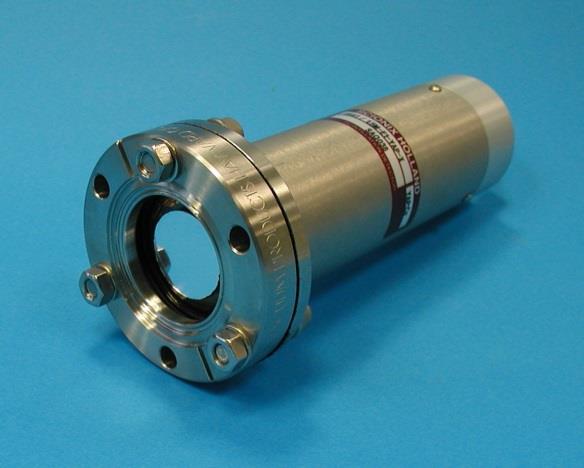
Berkeley Nucleonics ScintIQ YAP:Ce detectors are available in custom configurations to match specific instrument requirements. Standard formats are listed below. Contact our engineering team for sizes or assemblies outside the ranges shown.
| Parameter | Standard Range | Notes |
|---|---|---|
| Crystal diameter | Up to 50 mm | Per source datasheet specification |
| Crystal thickness | 0.1 mm to verify | 1–3 mm common for X-ray applications; thicker for higher energy (verify) |
| Entrance window | Mylar (thin) | Non-hygroscopic crystal enables thin-window designs; Be window available on request (verify) |
| Optical coupling | PMT (primary) | Bialkali PMT standard; SiPM coupling available (verify) |
| Housing material | Aluminum / stainless (verify) | Custom flanged or threaded mounting on request (verify) |
| Surface finish | Optically polished | No dead layers; direct soft X-ray coupling |
| Hermetic sealing | Not required | Crystal is non-hygroscopic; simplifies assembly and reduces cost |
| Operating temperature | verify | Consult factory for high-temperature or cryogenic requirements |
6Request a Quote
Configure Your YAP:Ce Detector
ScintIQ detectors are built to order. Specify crystal dimensions, entrance window, readout (PMT or SiPM), housing, and quantity, and Berkeley Nucleonics will provide a formal quotation and lead-time estimate.
Email: info@berkeleynucleonics.com
Phone: 800-234-7858
Online: Use the ScintIQ Configurator