Calibration & Metrology HV Reference
A calibration laboratory lives or dies by the quality of its references. When a technician verifies an electrostatic voltmeter, a high-voltage divider, or a kilovolt meter against a source, that source has to be more stable, more repeatable, and better characterized than the instrument under test. The reference is the foundation. If it drifts, every measurement built on top of it drifts with it, and the lab cannot defend its numbers.
Three properties decide whether a high-voltage supply belongs on a metrology bench. The first is setting resolution. A reference that can only be dialed in coarse steps cannot exercise an instrument across its full range with the granularity calibration work demands. The second is short-term stability. Over the hours a calibration run takes, the output must hold its value without creeping. The third is environmental immunity. A laboratory is climate controlled, but small temperature shifts still happen, and a reference whose output tracks the room temperature is a reference that needs constant re-checking.
The harder, quieter requirement is low ripple and noise. High-voltage measurements at the parts-per-thousand level are easily corrupted by a source that hums. A clean, low-ripple output lets the lab see the device under test rather than the artifacts of its own supply.
How the BNC PVP-Series line solves it
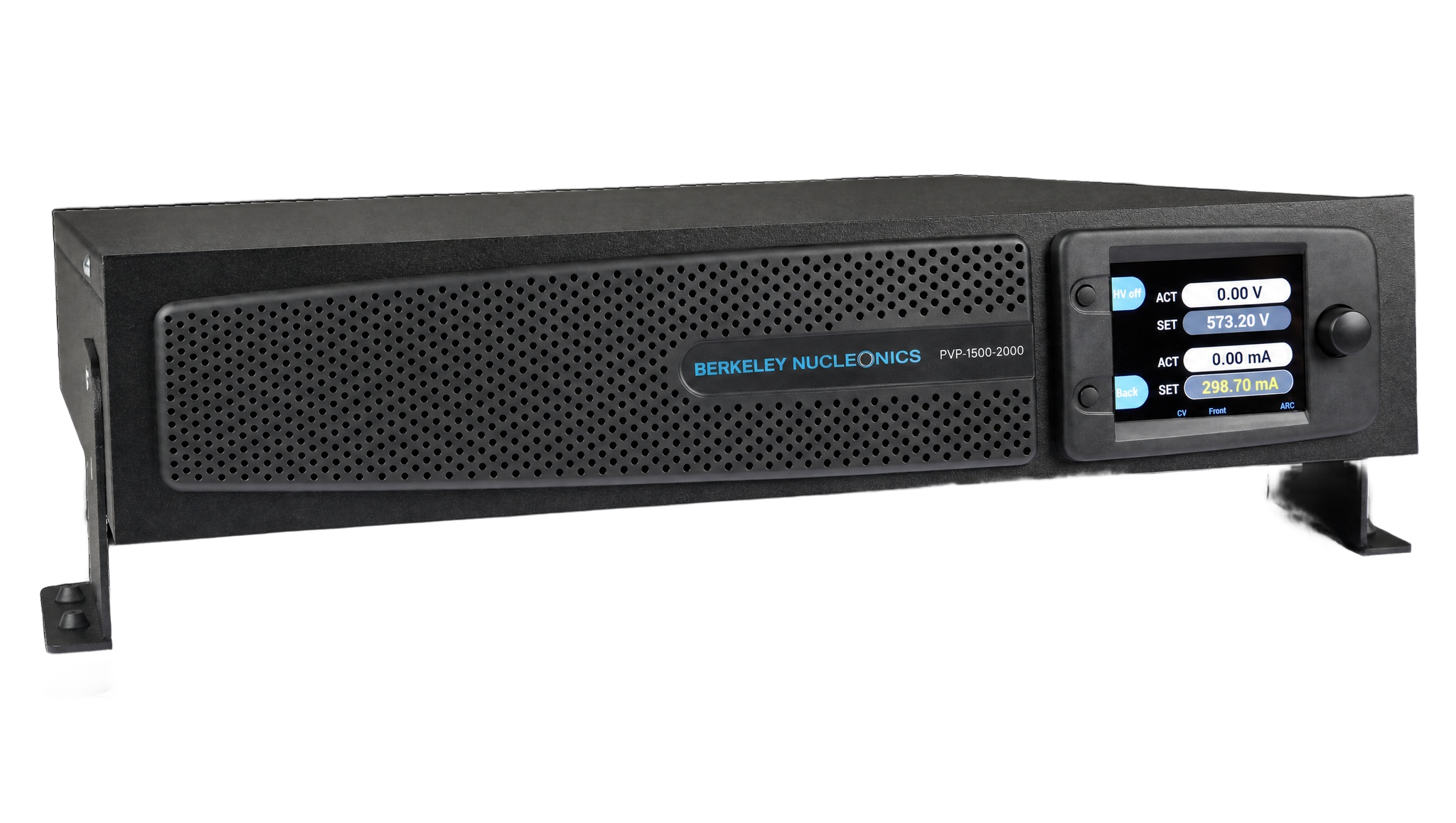
The Berkeley Nucleonics PVP-Series is a fully digitally regulated DC high-voltage supply built around a microcontroller and FPGA control core. That digital regulation is what gives the line its metrology-grade behavior. The output is set with 16-bit resolution across roughly 0.01 to 100 percent of nominal voltage, so a technician can place the reference precisely where a calibration point requires rather than settling for the nearest coarse step.
Short-term stability is specified at 0.01 percent of nominal voltage or better over eight hours, which covers a full calibration shift without a mid-run re-zero. Line regulation holds tighter than 0.01 percent of nominal even with the mains swinging plus or minus 10 percent, and the temperature coefficient is 0.01 percent of nominal per Kelvin or better, so the normal small movements of a controlled lab do not show up at the output. Ripple is held to 0.01 percent of nominal plus 100 mV, keeping the noise floor low enough for parts-per-thousand work.
Operation matches the way a metrology bench runs. A 3.5-inch color display with a structured menu handles manual setpoints, while on-board Ethernet and RS232 with a SCPI command set let the supply drop into an automated calibration sequence. The error and event log time-tags every action, which supports the traceability and record-keeping a calibration lab has to maintain. Configurable code protection guards a validated setup from accidental change.
Which PVP-Series models and options fit
For calibration work the choice of model follows the voltage range the lab needs to cover. The reversible-polarity models are the natural fit because a single unit can present both positive and negative references, which halves the number of supplies a bench has to stock and characterize.
| Coverage | Recommended PVP-Series model | Output |
|---|---|---|
| Low-voltage divider and meter checks | PVP-5000-400 | 5 kV, 400 mA, reversible |
| Mid-range HV instrument calibration | PVP-10000-200 | 10 kV, 200 mA, reversible |
| High-range electrostatic and kV meters | PVP-20000-25 | 20 kV, 25 mA, pos/neg |
| Extended high-range references | PVP-30000-17 | 30 kV, 17 mA, pos/neg |
The reversible-polarity suffix code is 5, while positive-only is 1 and negative-only is 9, so a part number such as 00.210.143.5 specifies a reversible PVP-5000-400. Where a single fixed polarity is all the lab needs, the positive or negative variant keeps the order simple. For pure reference duty the standard low ripple is sufficient, and the lab rarely needs the higher-current power classes, since calibration loads draw very little current.
Recommended configuration
A practical calibration reference for most high-voltage labs is the reversible PVP-10000-200 (order ref 00.210.163.5). At 10 kV with both polarities in one chassis, it covers the bulk of divider, meter, and electrostatic-instrument calibration with the full 16-bit setting, eight-hour stability, and low temperature coefficient the line is known for. Run it from the on-board Ethernet and SCPI interface into your calibration automation so every setpoint and reading is logged and repeatable.
Where the lab also certifies instruments above 10 kV, pair it with a PVP-30000-17 (order ref 00.210.191.x) for the high-range points. Both units mount in a standard 19-inch rack at 2U, or sit on the bench with the integrated adapter, and both ship with a 10 ft high-voltage cable and HV connector. The result is a two-supply reference bank that covers roughly 0.1 kV through 30 kV with metrology-grade stability.
For a quick question, chat with an engineer at berkeleynucleonics.com.