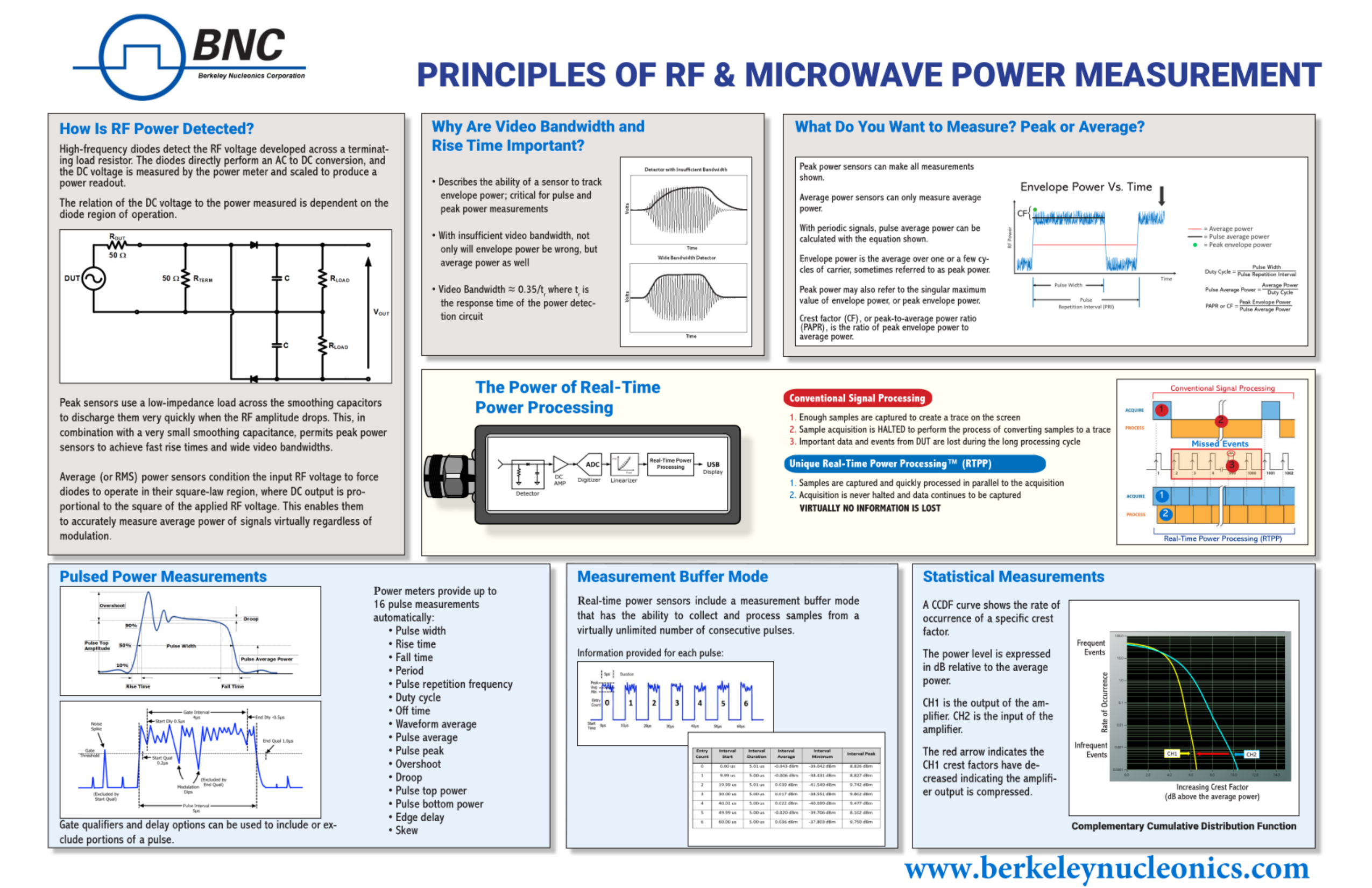
How Is RF Power Detected?
High-frequency diodes detect the RF voltage developed across a terminating load resistor. The diodes directly perform an AC to DC conversion, and the DC voltage is measured by the power meter and scaled to produce a power readout.
The relation of the DC voltage to the power measured is dependent on the diode region of operation.
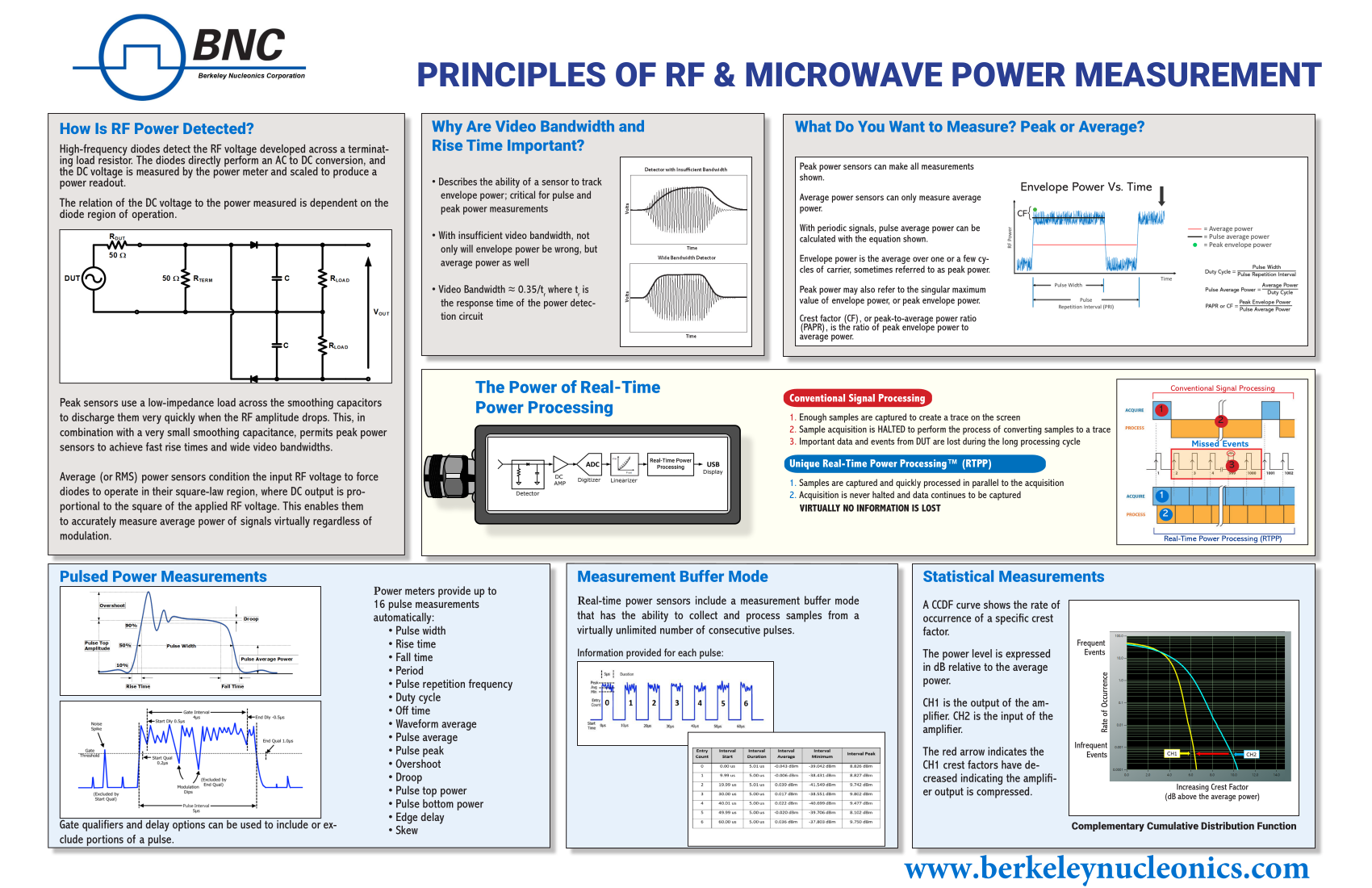
Peak sensors use a low-impedance load across the smoothing capacitors to discharge them very quickly when the RF amplitude drops. This, in combination with a very small smoothing capacitance, permits peak power sensors to achieve fast rise times and wide video bandwidths.
Average (or RMS) power sensors condition the input RF voltage to force diodes to operate in their square-law region, where DC output is proportional to the square of the applied RF voltage. This enables them to accurately measure average power of signals virtually regardless of modulation.
Why Are Video Bandwidth and Rise Time Important?
- Describes the ability of a sensor to track envelope power; critical for pulse and peak power measurements.
- With insufficient video bandwidth, not only will envelope power be wrong, but average power as well.
- Video Bandwidth ≈ 0.35 / tr, where tr is the response time of the power detection circuit.
What Do You Want to Measure? Peak or Average?
- Peak power sensors can make all measurements shown.
- Average power sensors can only measure average power.
- With periodic signals, pulse average power can be calculated with the equation shown.
- Envelope power is the average over one or a few cycles of carrier, sometimes referred to as peak power.
- Peak power may also refer to the singular maximum value of envelope power, or peak envelope power.
- Crest factor (CF), or peak-to-average power ratio (PAPR), is the ratio of peak envelope power to average power.
| Quantity | Definition |
|---|---|
| Duty Cycle | Pulse Width / Pulse Repetition Interval |
| Pulse Average Power | Average Power / Duty Cycle |
| PAPR or CF | Peak Envelope Power / Pulse Average Power |
The Power of Real-Time Power Processing
Conventional Signal Processing
- Enough samples are captured to create a trace on the screen.
- Sample acquisition is HALTED to perform the process of converting samples to a trace.
- Important data and events from the DUT are lost during the long processing cycle.
Unique Real-Time Power Processing (RTPP)
- Samples are captured and quickly processed in parallel to the acquisition.
- Acquisition is never halted and data continues to be captured.
- Virtually no information is lost.
Pulsed Power Measurements
Power meters provide up to 16 pulse measurements automatically:
- Pulse width
- Rise time
- Fall time
- Period
- Pulse repetition frequency
- Duty cycle
- Off time
- Waveform average
- Pulse average
- Pulse peak
- Overshoot
- Droop
- Pulse top power
- Pulse bottom power
- Edge delay
- Skew
Gate qualifiers and delay options can be used to include or exclude portions of a pulse.
Measurement Buffer Mode
Real-time power sensors include a measurement buffer mode that has the ability to collect and process samples from a virtually unlimited number of consecutive pulses.
Information provided for each pulse:
| Entry Count | Interval Start | Interval Duration | Interval Average | Interval Minimum | Interval Peak |
|---|---|---|---|---|---|
| 0 | 0.00 us | 5.01 us | -0.043 dBm | -39.042 dBm | 8.826 dBm |
| 1 | 9.99 us | 5.00 us | -0.006 dBm | -38.431 dBm | 8.827 dBm |
| 2 | 19.99 us | 5.01 us | 0.039 dBm | -41.549 dBm | 9.742 dBm |
| 3 | 30.00 us | 5.00 us | 0.017 dBm | -38.551 dBm | 9.862 dBm |
| 4 | 40.01 us | 5.00 us | 0.022 dBm | -40.699 dBm | 9.477 dBm |
| 5 | 49.99 us | 5.00 us | -0.020 dBm | -39.706 dBm | 8.102 dBm |
| 6 | 60.00 us | 5.00 us | 0.036 dBm | -37.803 dBm | 9.750 dBm |
Statistical Measurements
A CCDF curve shows the rate of occurrence of a specific crest factor.
The power level is expressed in dB relative to the average power.
CH1 is the output of the amplifier. CH2 is the input of the amplifier.
The red arrow indicates the CH1 crest factors have decreased, indicating the amplifier output is compressed. This is a Complementary Cumulative Distribution Function.
Learn More
Contact info@berkeleynucleonics.com or call 800-234-7858. Visit the Model 12100 Series RF power sensor product page for more information.