The Measurement Challenge
Environmental gamma spectroscopy operates at the margins. Samples arrive with low specific
activity, and the detector itself must not mask what you are trying to find. Any scintillator
containing lanthanum carries a known contaminant: La-138, a naturally occurring radioactive
isotope that produces a 1.436 MeV peak and a 788 keV X-ray that can overlap with environmental
lines of interest. The same concern applies, at lower levels, to other materials with natural
radioactive chains.
Resolution matters too. Common environmental nuclides cluster together in energy. Cs-137 sits
at 662 keV. Ba-133 peaks near 356 keV. Ra-226 and its daughters span several lines between
186 keV and 609 keV. A detector with poor resolution smears these into a single unresolved
mound. A detector with intrinsic background adds phantom peaks that take statistical effort to
subtract. The ideal material is bright, clean, and capable of separating lines only a few
tens of keV apart.
Three ScintIQ materials cover this application well, each with its own place in the design
space.
Recommended ScintIQ Materials
Best resolution, zero La-138
CeBr3
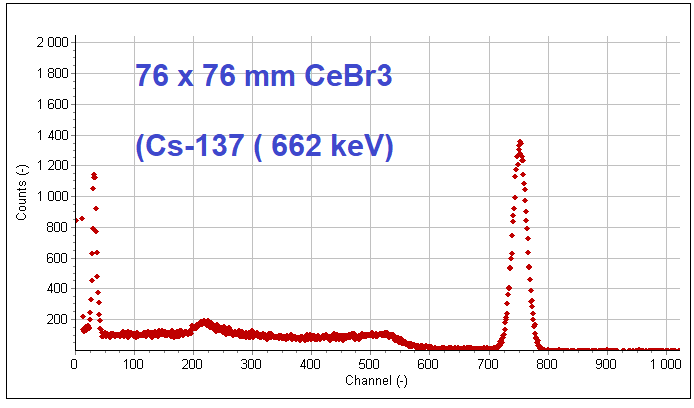
CeBr3 delivers approximately 4% energy resolution at 662 keV, roughly half the width
of a typical NaI(Tl) peak at the same energy. Because it contains no lanthanum, it
carries no La-138 background line. Light yield is approximately 60,000 photons per MeV
(relative yield ~130 vs NaI = 100), and the fast 18-25 ns decay constant supports high
count-rate work without pulse pile-up. Density is 5.18 g/cm3. It is hygroscopic and
requires hermetic encapsulation, which ScintIQ housings provide as standard. For
laboratories or field stations where the La-138 interference of LaBr3(Ce) is
unacceptable, CeBr3 is the preferred choice.
CeBr3 Data Sheet
High throughput, proven workhorse
NaI(Tl)
NaI(Tl) remains the reference material for environmental counting. Its light yield
(defined as 100 on the relative scale) is very high, density is 3.67 g/cm3, and
emission peaks at 415 nm for straightforward PMT or SiPM coupling. Resolution at
662 keV is approximately 7%, adequate for most regulatory monitoring tasks. Large
crystal sizes are achievable, which matters when sample geometry requires a wide
detection solid angle. For standard gamma-spec counting of soil and water samples
against established regulatory frameworks, NaI(Tl) offers the best combination of
cost, availability, and validated methodology.
NaI(Tl) Data Sheet
Highest light yield, excellent resolution
SrI2(Eu)
SrI2(Eu) achieves energy resolution in the range of 2.7-3.5% at 662 keV (verify
against current production specification) with a relative light yield of 120-140 and
density of 4.60 g/cm3. Its slower decay (1-5 microseconds) makes it unsuitable for
very high count rates, but for low-background counting applications where sample
throughput is secondary to spectral clarity, SrI2(Eu) separates lines that NaI(Tl)
cannot resolve. It is hygroscopic and requires the same sealed housing approach as
CeBr3 and NaI(Tl). SrI2(Eu) is the choice when the measurement question demands
the highest achievable resolution from a non-lanthanum, non-HPGe detector.
SrI2(Eu) Data Sheet
| Property |
CeBr3 |
NaI(Tl) |
SrI2(Eu) |
| Density (g/cm3) | 5.18 | 3.67 | 4.60 |
| Emission peak (nm) | 370 | 415 | 450 |
| Decay constant | 18-25 ns | 0.23 us | 1-5 us |
| Relative light yield (NaI = 100) | ~130 | 100 | 120-140 |
| Energy resolution at 662 keV | ~4% | ~7% | ~2.7-3.5% (verify) |
| Intrinsic radioactivity | None (no La) | None | None |
| Hygroscopic | Yes | Yes | Yes |
| Refractive index | 2.09 | 1.85 | 1.85 |
Typical Measurement Scenarios
ScintIQ environmental detectors are deployed across a range of monitoring contexts. Regulatory
compliance surveys use NaI(Tl) because the methodology is established and large crystal sizes
improve sensitivity for diffuse sources. Research programs measuring trace cosmogenic
radionuclides or post-incident fallout at sub-Bq/kg levels typically use CeBr3, where the
cleaner spectrum reduces the uncertainty budget introduced by background subtraction. Precision
isotopic ratio measurements of natural uranium or thorium series nuclides are where SrI2(Eu)
earns its place.
Common use cases for these detectors include:
- Soil and sediment gamma surveys for Cs-137, Sr-90 (via Bremsstrahlung), and naturally occurring
radioactive materials (NORM)
- Water sampling for Ra isotopes, I-131, and other fission products
- Air filter analysis for particulate radioactivity after nuclear events or routine stack
monitoring
- Food and agricultural commodity assay under international regulatory standards (Codex
Alimentarius and EU food safety limits)
- Marine sediment and seawater surveys for oceanographic tracer studies
- Low-background laboratory counting systems using underground or shielded detector arrangements
Detector Configuration Notes
All three materials are hygroscopic and are supplied in hermetically sealed aluminum or
stainless steel housings with optical coupling to the readout device. ScintIQ crystals are
available with PMT or SiPM readout. SiPM readout suits compact field-deployable systems
and low-voltage operation. PMT readout provides established performance and direct
compatibility with existing spectroscopy electronics.
For underground or heavily shielded laboratory installations, radiopure construction options
are available. Contact Berkeley Nucleonics for housing material specifications and low-background
options (verify availability). Crystal dimensions are configurable; state your geometric
constraints and detection efficiency target when requesting a quote.
ScintIQ readout electronics: Berkeley Nucleonics offers matched MCA and preamplifier
electronics including the bMCA (Ethernet and USB variants) and the TOPAZ-HR digital MCA.
These integrate directly with ScintIQ detector assemblies for a complete measurement system.
Talk to an Engineer
Environmental monitoring applications vary widely in geometry, shielding, count rate, and
required sensitivity. Berkeley Nucleonics engineers work with customers to specify crystal
dimensions, housing materials, readout electronics, and calibration standards appropriate
for the measurement objective.
Contact us at info@berkeleynucleonics.com
or call 800-234-7858 to discuss your application.
Additional material and detector data sheets:
CeBr3 Data Sheet ·
NaI(Tl) Data Sheet ·
SrI2(Eu) Data Sheet
ScintIQ crystals are grown and finished with our long-standing scintillation partner in the
Netherlands (Scionix Holland).