Quantum: QKD & Sensing
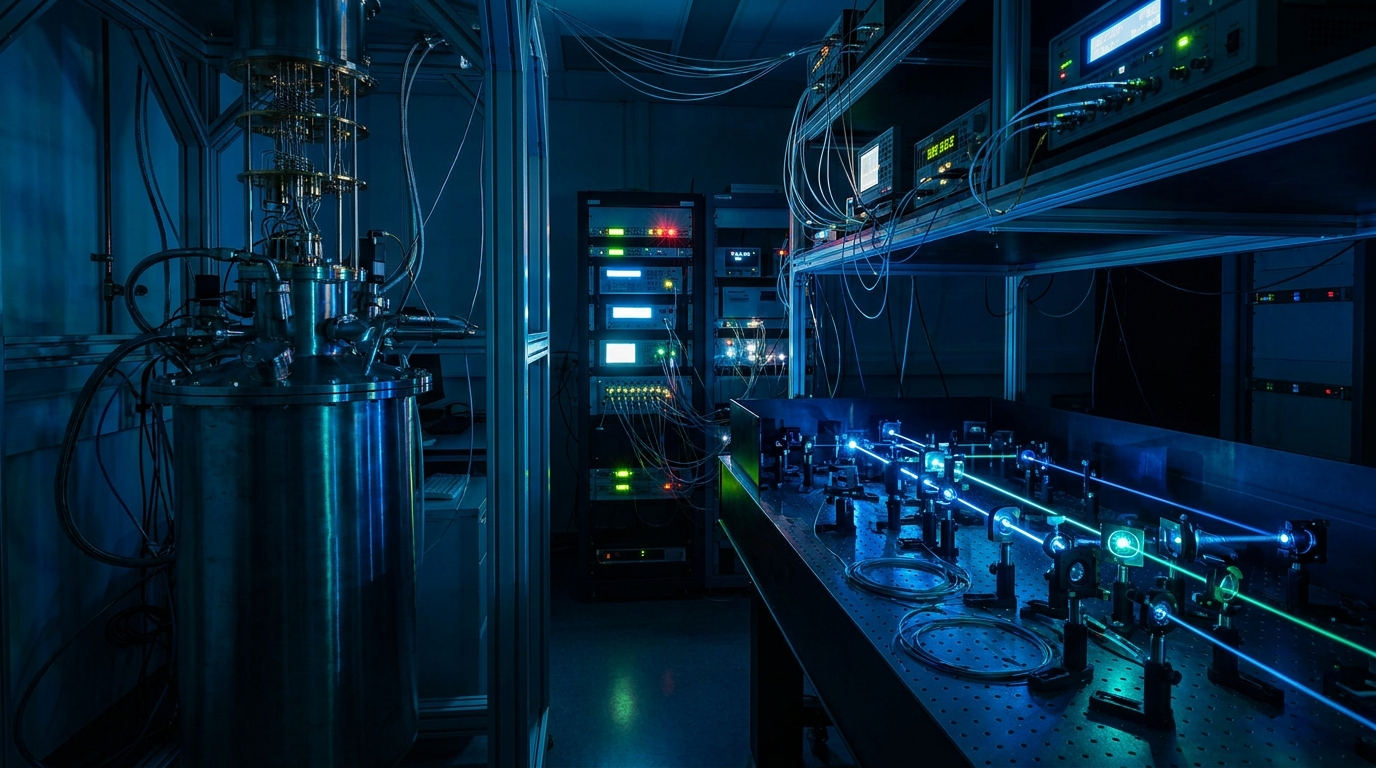
Quantum key distribution (QKD), quantum sensing, and qubit-control experiments all turn on the quality of the signal that reaches the device. In a QKD transmitter, an arbitrary waveform generator drives the intensity and phase modulators that encode each optical pulse, and the same instrument generates the weak-coherent or decoy states that carry the protocol. In a quantum sensor, shaped waveforms set the interrogation sequence that prepares and reads out the atomic or spin ensemble. In qubit control, the generator supplies the baseband or IF envelopes that define each gate. Across all three, the waveform is the experiment, and the generator that produces it is part of the measurement chain rather than an accessory to it.
That places hard demands on the instrument. The pulses have to land where the protocol expects them, so timing jitter has to be very low and timing resolution fine enough to place an edge with confidence. A few picoseconds of uncertainty on a pulse edge can blur the boundary between two encoded states or smear the interrogation window a sensor depends on, and it accumulates over a long run. The sequences themselves are long and often randomized, which means a security-relevant QKD run or an extended sensing interrogation needs deep waveform memory rather than a short repeating pattern. A loop that is too short becomes a pattern an adversary or a systematic error can exploit, so the generator has to hold the full sequence in memory and play it through without repeating.
Many setups also span more than one channel and more than one modulator. A QKD transmitter may drive an intensity modulator and a phase modulator together, and a multi-qubit experiment drives several control lines at once, so the channels have to stay tightly synchronized against a shared reference rather than drifting apart over the experiment. And the amplitude has to be clean and faithful, because a distorted envelope shows up directly as a degraded quantum state or a noisier measurement. None of these requirements stands alone. The same instrument has to deliver low jitter, fine resolution, deep memory, tight multi-channel synchronization, and clean amplitude at the same time, which is what separates a generator suited to quantum work from a general-purpose one.
How the Model 686 solves it
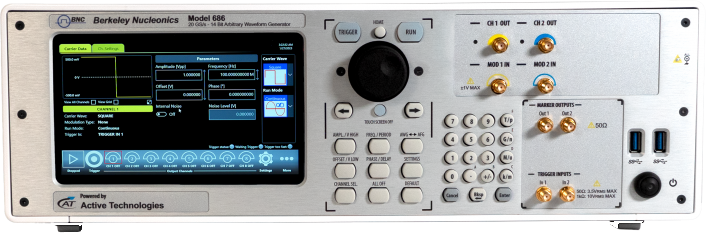
The Model 686 is built for exactly this kind of work. Its trigger jitter is below 2 ps against an external master clock, so each waveform fires in a fixed, known relationship to the experiment timebase. Across multiple units the synchronization holds to better than 100 fs, which is what a distributed quantum setup needs when separate channels drive separate modulators or separate qubits and have to agree on when "now" is.
Timing resolution is 50 ps, fine enough to position pulse edges and set inter-pulse spacing for the encoding and interrogation patterns these protocols use. Waveform memory runs up to 9 Gpts, deep enough to hold the long randomized sequences a decoy-state QKD run or an extended sensing schedule calls for without looping back to a short pattern. Vertical resolution is 14 bits, which keeps the amplitude steps small and the envelope faithful through the modulator. The output delivers 5 Vpp into 50 ohms, enough to drive many electro-optic modulators directly without an external amplifier in the path adding its own noise and delay.
For experiments that outgrow a single chassis, up to 4 units synchronize together, giving 16 analog channels and 128 digital channels under one timebase. That is the headroom a multi-qubit register or a multi-channel sensing array needs, and the sub-100 fs cross-unit synchronization means the added channels stay aligned rather than drifting apart over a long run.
Where amplitude resolution matters more than top speed, the 16-bit Model 685 is the better fit. It trades the highest sample rate for finer vertical resolution, which suits sensing and control work that leans on a very clean, finely graded envelope rather than the fastest possible edges. The 686 and 685 share the same architecture and synchronization scheme, so a setup can mix them on a common timebase.
Recommended configuration
For most QKD transmitters and multi-channel sensing benches, a single Model 686 is the right starting point. Its sub-2 ps trigger jitter, 50 ps resolution, 9 Gpts of memory, and 5 Vpp output cover direct modulator drive and long randomized sequences in one instrument, locked to the experiment's external master clock. Where the work spans several modulators or qubits, synchronize up to four Model 686 units for 16 analog and 128 digital channels under one timebase, holding sub-100 fs alignment across the set.
Choose the Model 685 instead, or alongside, when the priority is the cleanest possible envelope and 16-bit vertical resolution outweighs the need for the highest sample rate, as is often the case in precision sensing and qubit-control readout. Lock every unit to the same external reference so the full system shares one definition of time.
Talk to an application engineer
Berkeley Nucleonics can help you match a Model 686 or Model 685 configuration to your QKD, sensing, or qubit-control setup. Call 800-234-7858 or email info@berkeleynucleonics.com.
For a quick question, chat with an engineer at berkeleynucleonics.com.