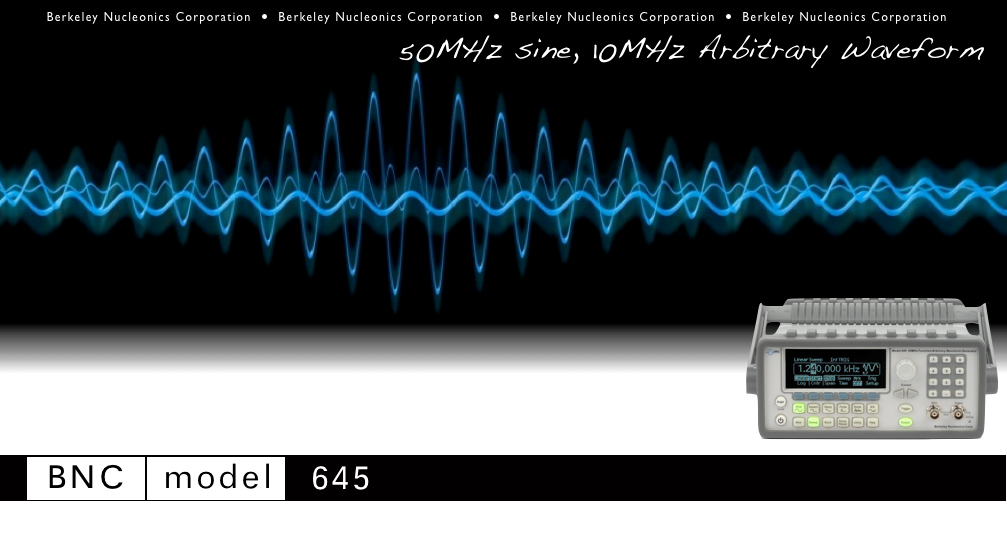
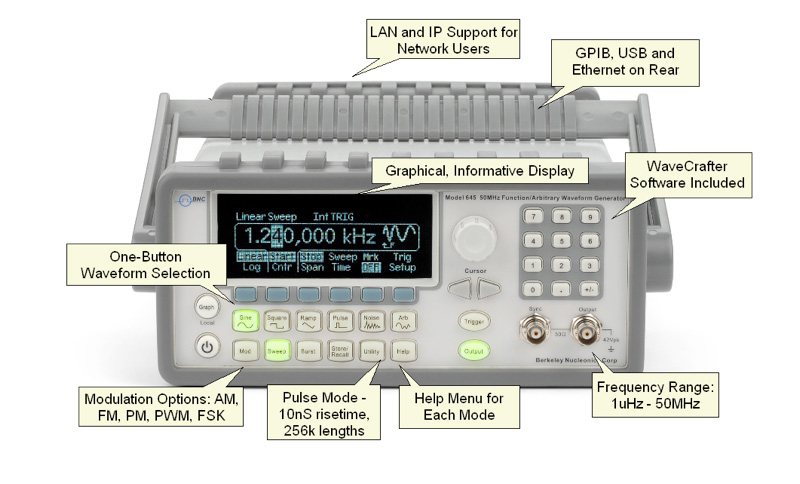
A proven single-channel function and arbitrary waveform generator built for the everyday bench. The Model 645 pairs a 125 MS/s sample rate and 16-bit data handling with a 20 MHz operating bandwidth, a graphical display, and the WaveCrafter editing suite, all at an entry-level price.
Model 645 · Document rev. A · Specifications verify against published Berkeley Nucleonics datasheet
1Overview
The Berkeley Nucleonics Model 645 is a single-channel function and arbitrary waveform generator designed to be the box for every bench. It delivers standard and complex functions through DDS+ technology, generating sine, square, ramp, triangle, pulse, noise, and DC waveforms, along with custom arbitrary waveforms created on a computer and downloaded to the instrument.
The Model 645 offers a 125 MS/s sample rate, 16-bit data handling, and a 20 MHz operating bandwidth on a single output channel. A graphical display shows the active waveform and current settings at a glance, and tactile front-panel controls keep local operation simple. Built-in IP support lets a web browser control the instrument over a LAN, and multiple units can be synchronized together or locked to an external clock.
This is a long-established, proven entry-level generator. It remains an excellent value for general-purpose signal generation, education, and R&D benches where cost matters. For new high-speed or multi-channel work, the faster Model 685 and Model 686 generators are recommended. Talk to a Berkeley Nucleonics engineer about matching the right generator to your application.
Model 645 front panel, annotated. One-button waveform selection, a graphical display, modulation modes (AM, FM, PM, PWM, FSK), pulse mode, LAN and IP support, and rear-panel GPIB, USB, and Ethernet.
2Key Features
Single-channel arbitrary and function output. Sine, square, ramp, triangle, pulse, noise, DC, and downloaded custom arbitrary waveforms from one output.
125 MS/s sample rate. Enough sampling control for most general-purpose waveform applications, with a 20 MHz operating bandwidth.
16-bit data handling. Create and store 16-bit data for later retrieval, transmitted via the rear-panel "Pattern Out" as a source of control signals for an experiment.
Graphical display. Graph mode lets users visually verify signal settings, with the selected function always shown in the upper-left corner.
Variable-edge pulses. Variable-edge-time pulses up to 10 MHz, with period, pulse width, and amplitude set from the front panel or remotely.
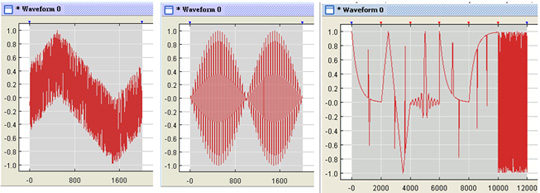
WaveCrafter software included. Create, edit, and download complex waveforms, store them on a PC, share them with colleagues, or capture waveforms from a supported oscilloscope.
Networked control. Built-in IP support for browser control over a LAN, plus standard USB and LAN interfaces and an optional GPIB.
Synchronizable. Sync multiple units together or lock to an external clock for coordinated multi-instrument setups.
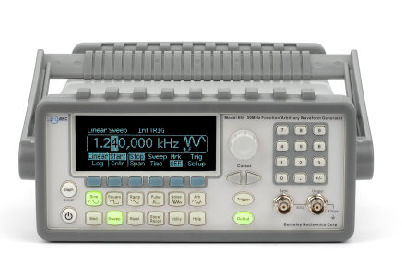
Model 645 function and arbitrary waveform generator, front view, with graphical display and tactile control panel.
3Common Characteristics
Frequency reference, amplitude, DC offset, main output, and phase offset specifications apply across waveform types.
Parameter
Specification
Frequency resolution
1 uHz
Amplitude range
10 mVpp to 10 Vpp in 50 ohm; 20 mVpp to 20 Vpp in Hi-Z
Amplitude accuracy (at 1 kHz)
+/-1% of setting +/- 1 mVpp
Amplitude units
Vpp, Vrms, dBm
Amplitude resolution
4 digits
DC offset range (peak AC + DC)
+/-5 V in 50 ohm; +/-10 V in Hi-Z
DC offset accuracy
+/-2% of offset setting; +/-0.5% of amplitude setting
DC offset resolution
4 digits
Main output impedance
50 ohm typical
Main output isolation
42 Vpk maximum to earth
Main output protection
Short-circuit protected; overload automatically disables main output
Internal frequency reference accuracy
+/-10 ppm in 90 days; +/-20 ppm in 1 year
External frequency reference
Standard
External frequency input lock range
10 MHz +/- 500 Hz
External frequency input level
100 mVpp to 5 Vpp
External frequency input impedance
1 kohm typical, AC coupled
External frequency input lock time
Less than 2 s
External frequency output lock range
10 MHz
External frequency output level
632 mVpp (0 dBm) typical
External frequency output impedance
50 ohm typical, AC coupled
Phase offset range
-360 deg to +360 deg
Phase offset resolution
0.001 deg
Phase offset accuracy
8 ns
4Waveform Characteristics
Sine, square, ramp, and triangle waveform specifications. Spurious and harmonic figures are referenced as noted in the footnotes below.
Sine
Parameter
Specification
Frequency
1 uHz to 50 MHz
Amplitude flatness (relative to 1 kHz)
0.1 dB (<100 kHz); 0.15 dB (<5 MHz); 0.3 dB (<20 MHz); 0.5 dB (<50 MHz)
Harmonic distortion, DC to 20 kHz
-70 dBc (<1 Vpp); -70 dBc (≥1 Vpp)
Harmonic distortion, 20 kHz to 100 kHz
-65 dBc (<1 Vpp); -60 dBc (≥1 Vpp)
Harmonic distortion, 100 kHz to 1 MHz
-50 dBc (<1 Vpp); -45 dBc (≥1 Vpp)
Harmonic distortion, 1 MHz to 20 MHz
-40 dBc (<1 Vpp); -35 dBc (≥1 Vpp)
Harmonic distortion, 20 MHz to 50 MHz
-35 dBc (<1 Vpp); -30 dBc (≥1 Vpp)
Total harmonic distortion
DC to 20 kHz, output ≥0.5 Vpp, THD+N ≤0.06%
Spurious (non-harmonic)
-70 dBc (DC to 1 MHz); -70 dBc + 6 dB/octave (1 MHz to 50 MHz)
Phase noise (10 kHz offset)
-115 dBc/Hz typical when f ≥ 1 MHz, V ≥ 0.1 Vpp
Square
Parameter
Specification
Frequency
1 uHz to 25 MHz
Rise / fall time
Less than 10 ns
Overshoot
Less than 2%
Variable duty cycle
20% to 80% (to 10 MHz); 40% to 60% (to 25 MHz)
Asymmetry
1% of period + 5 ns (at 50% duty)
Jitter (RMS)
200 ps when f ≥ 1 MHz, V ≥ 0.1 Vpp
Ramp and Triangle
Parameter
Specification
Frequency
1 uHz to 200 kHz
Linearity
Less than 0.1% of peak output
Symmetry
0.0% to 100.0%
Published waveform characteristic table, reproduced from the Model 645 datasheet.
Footnotes. Add 1/10th of output amplitude and offset spec per deg C for operation outside 64 to 82 F (18 to 28 C). Autorange enabled. DC offset set to 0 V. Spurious output at low amplitude is -75 dBm typical. Add 1 ppm per deg C average for operation outside 64 to 82 F (18 to 28 C).
5Pulse, Noise & Arbitrary
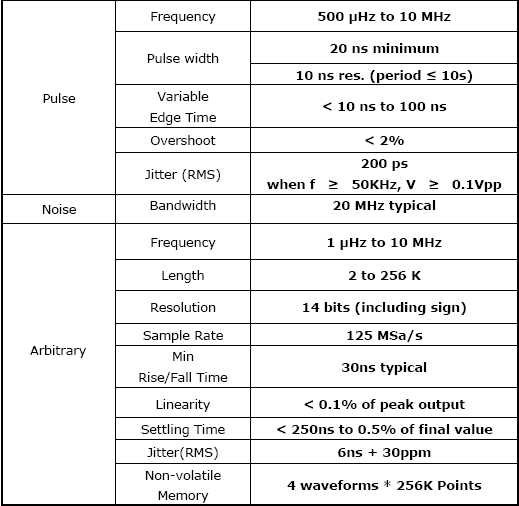
The Model 645 generates variable-edge pulses at rates up to 10 MHz, with period, pulse width, and amplitude adjustable locally or remotely. Custom arbitrary waveforms are created in software and downloaded to the instrument. Up to 5 waveforms can be stored concurrently: 4 waveforms (4 x 256K points) in nonvolatile memory and 1 waveform in volatile memory.
Pulse
Parameter
Specification
Frequency
500 uHz to 10 MHz
Pulse width
20 ns minimum; 10 ns resolution (period ≤ 10 s)
Variable edge time
Less than 10 ns to 100 ns
Overshoot
Less than 2%
Jitter (RMS)
200 ps when f ≥ 50 kHz, V ≥ 0.1 Vpp
Noise
Parameter
Specification
Bandwidth
20 MHz typical
Arbitrary
Parameter
Specification
Frequency
1 uHz to 10 MHz
Length
2 to 256 K
Resolution
14 bits (including sign)
Sample rate
125 MSa/s
Minimum rise / fall time
30 ns typical
Linearity
Less than 0.1% of peak output
Settling time
Less than 250 ns to 0.5% of final value
Jitter (RMS)
6 ns + 30 ppm
Non-volatile memory
4 waveforms x 256K points
Custom arbitrary waveforms built and edited in WaveCrafter, then downloaded to the Model 645.
6Modulation
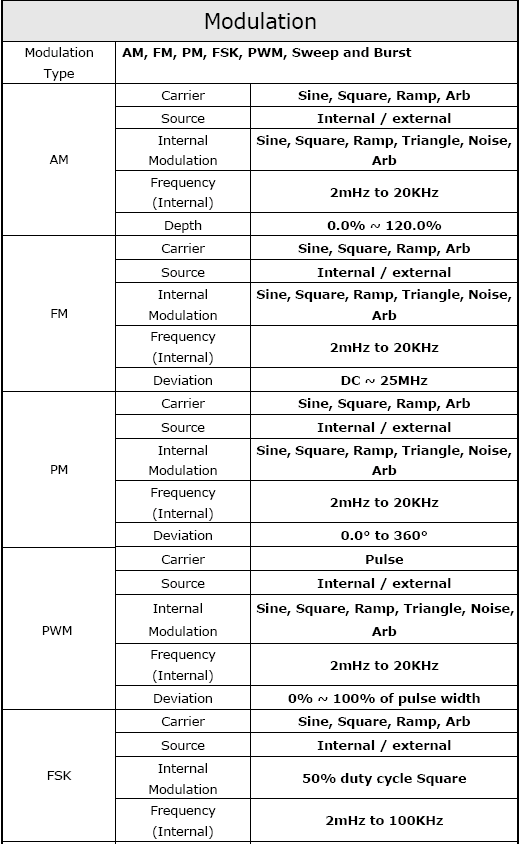
Modulation types include AM, FM, PM, FSK, PWM, sweep, and burst, with internal or external sources.
Mode
Specification
AM
Carrier: sine, square, ramp, arb. Source: internal / external. Internal modulation: sine, square, ramp, triangle, noise, arb. Frequency (internal): 2 mHz to 20 kHz. Depth: 0.0% to 120.0%.
FM
Carrier: sine, square, ramp, arb. Source: internal / external. Internal modulation: sine, square, ramp, triangle, noise, arb. Frequency (internal): 2 mHz to 20 kHz. Deviation: DC to 25 MHz.
PM
Carrier: sine, square, ramp, arb. Source: internal / external. Internal modulation: sine, square, ramp, triangle, noise, arb. Frequency (internal): 2 mHz to 20 kHz. Deviation: 0.0 deg to 360 deg.
PWM
Carrier: pulse. Source: internal / external. Internal modulation: sine, square, ramp, triangle, noise, arb. Frequency (internal): 2 mHz to 20 kHz. Deviation: 0% to 100% of pulse width.
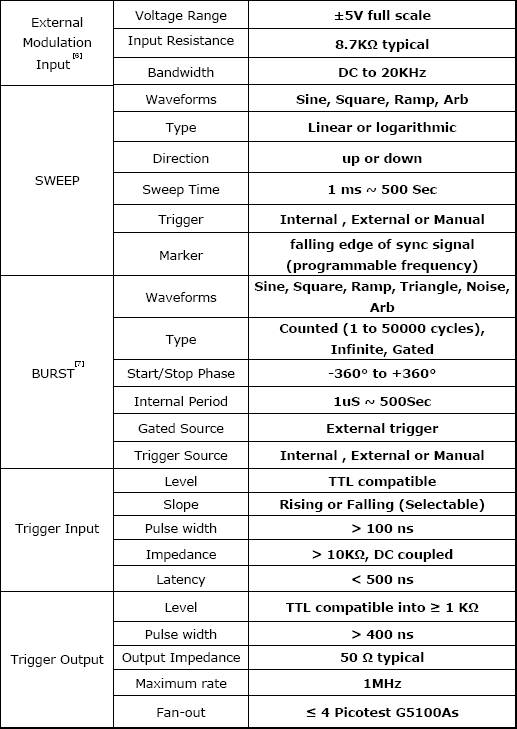
Published modulation table, reproduced from the Model 645 datasheet.
Note. Sine and square waveforms above 10 MHz are allowed only with an infinite burst count.
7Sweep, Burst & Triggers
Sweep
Specification
Waveforms
Sine, square, ramp, arb
Type
Linear or logarithmic
Direction
Up or down
Sweep time
1 ms to 500 s
Trigger
Internal, external, or manual
Marker
Falling edge of sync signal (programmable frequency)
Burst
Specification
Waveforms
Sine, square, ramp, triangle, noise, arb
Type
Counted (1 to 50000 cycles), infinite, gated
Start / stop phase
-360 deg to +360 deg
Internal period
1 us to 500 s
Gated source
External trigger
Trigger source
Internal, external, or manual
Trigger Input
Specification
Level
TTL compatible
Slope
Rising or falling (selectable)
Pulse width
Greater than 100 ns
Impedance
Greater than 10 kohm, DC coupled
Latency
Less than 500 ns
Trigger Output
Specification
Level
TTL compatible into ≥ 1 kohm
Pulse width
Greater than 400 ns
Output impedance
50 ohm typical
Maximum rate
1 MHz
Fan-out
Up to 4 loads
Published pulse, noise, and arbitrary specification table, reproduced from the Model 645 datasheet.
8General & Physical
Parameter
Specification
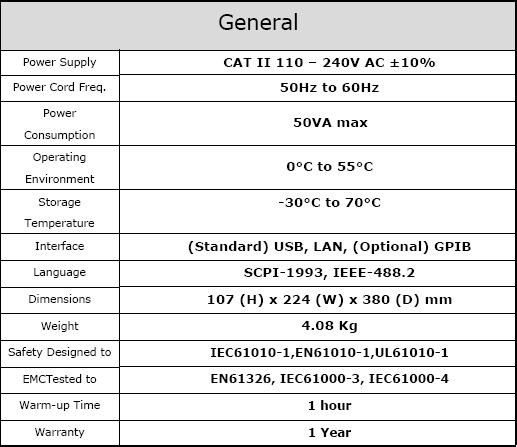
Power supply
CAT II 110 to 240 V AC +/-10%
Power cord frequency
50 Hz to 60 Hz
Power consumption
50 VA max
Operating environment
32 to 131 F (0 to 55 C)
Storage temperature
-22 to 158 F (-30 to 70 C)
Interface
Standard USB, LAN; optional GPIB
Language
SCPI-1993, IEEE-488.2
Dimensions
4.2 in H x 8.8 in W x 15.0 in D (107 x 224 x 380 mm)
Weight
9.0 lb (4.08 kg)
Safety designed to
IEC 61010-1, EN 61010-1, UL 61010-1
EMC tested to
EN 61326, IEC 61000-3, IEC 61000-4
Warm-up time
1 hour
Warranty
1 year
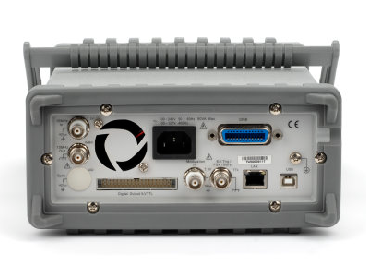
Model 645 rear panel. AC inlet, GPIB, USB, LAN, Pattern Out, and reference connections.
9Applications
The Model 645 suits a broad range of bench activities where flexible, custom waveforms are needed at an accessible price:
Research and development. Generate complex custom pulses and arbitrary waveforms for variable test sequences, then store and recall setups across multiple units.
Education and teaching labs. A graphical, one-button interface makes the instrument approachable for students learning signal generation.
Pulse generation. Variable-edge pulses to 10 MHz with adjustable period, pulse width, and amplitude for timing and stimulus work.
Control signal sourcing. 16-bit data transmitted via Pattern Out from the rear panel as a source of control signals for an experiment.
Multi-instrument setups. Synchronize multiple Model 645 units or lock to an external clock for coordinated stimulus.
Model 645 on the bench, a capable general-purpose generator for everyday signal work.
Choosing a generator. The Model 645 is an established entry-level instrument and a strong value for general-purpose use. For new high-speed or multi-channel programs, the Model 685 and Model 686 generators are recommended. Contact Berkeley Nucleonics for help matching the right model to your application.
10Software & Support
The Model 645 ships with WaveCrafter, the Berkeley Nucleonics waveform editing suite. WaveCrafter lets users create, edit, and download complex waveforms quickly. Waveforms can be stored on a PC or shared with colleagues, and the software can retrieve waveforms from supported digital and mixed-signal oscilloscopes in capture mode.
The WaveCrafter SDK is available for download: WaveCrafter SDK.
Each Model 645 includes a 30-day trial program so a buyer can evaluate the instrument on their own bench before committing.
Contact
For a quote, configuration help, or application support, reach the Berkeley Nucleonics team.