1Overview
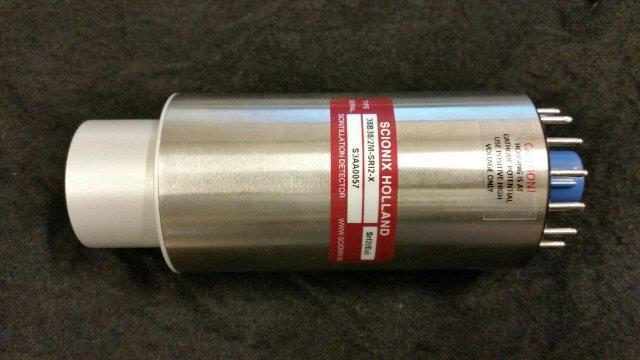
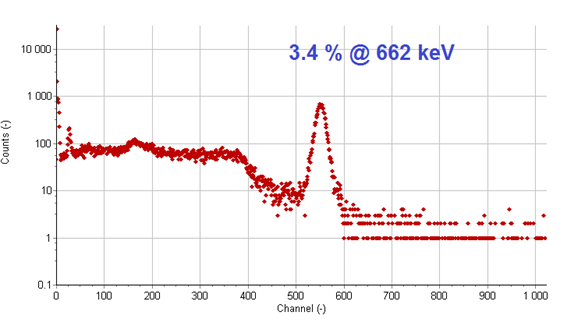
SrI2(Eu) is a europium-doped strontium iodide scintillator grown from melt. It combines an exceptionally high light yield (80 photons/keV, or 120–140% relative to NaI(Tl)) with outstanding proportionality. Proportionality is the key differentiator: when the number of scintillation photons produced is closely proportional to the absorbed gamma-ray energy, peak broadening from statistical fluctuations is minimized. The result is energy resolution near 3.5% FWHM at 662 keV, roughly twice as sharp as conventional NaI(Tl).
The trade-off is speed. Decay time runs 1–5 microseconds and varies with crystal size. This makes SrI2(Eu) unsuitable for very high count-rate environments or applications requiring fast timing coincidences. For moderate-rate spectroscopy where peak separation is the priority, few commercially available materials compete with it.
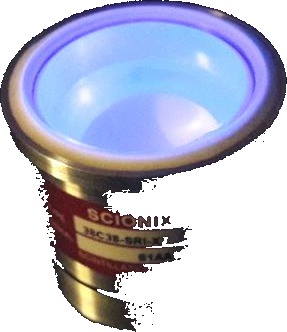
SrI2(Eu) is hygroscopic and must be hermetically sealed. Special surface treatment techniques are also required during crystal processing to preserve proportionality and resolution in finished detector assemblies.
When to choose SrI2(Eu)
- High-resolution gamma spectroscopy where count rates are moderate and peak separation is critical
- Low-background applications requiring intrinsically clean crystal material (no La-138 contamination, unlike LaBr3)
- Environmental and radiological monitoring where identifying closely spaced isotope signatures matters
- Laboratory and field instruments where a hermetically sealed, ruggedized housing is feasible
2Specifications
| Parameter | Value |
|---|---|
| Density | 4.6 g/cm³ |
| Hygroscopic | Yes (hermetic sealing required) |
| Wavelength of emission | 400–480 nm |
| Refractive index at emission maximum | 1.85 |
| Decay time | 1–5 µs (size dependent) |
| Light yield | 80 photons/keV (gamma) |
| Photoelectron yield (relative to NaI(Tl)) | 120–140% |
| Europium concentration | 2 mol % |
| Energy resolution at 662 keV | Approx. 3.5% |
| Maximum crystal size (cylindrical) | 38×38 mm |
3Energy Resolution & Performance
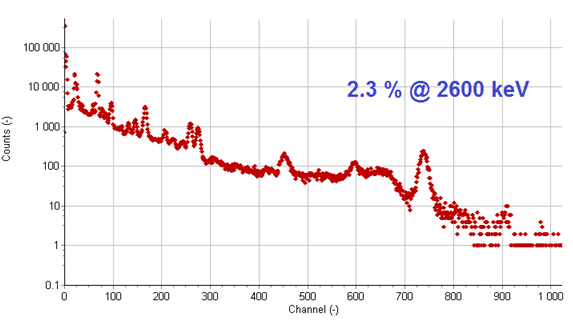
The table below lists typical energy resolution values for a 38×38 mm SrI2(Eu) detector. Resolution improves at higher energies as counting statistics and Fano-like effects favor narrower peaks. Values are FWHM percentages measured under standard conditions.
| Energy (keV) | Energy Resolution (% FWHM) |
|---|---|
| 59.5 keV | 10% |
| 122 keV | 6% |
| 356 keV | 5% |
| 662 keV | 3.5% |
| 1332 keV | 3% |
| 2600 keV | 2.5% |
For comparison, NaI(Tl) typically achieves 7–8% at 662 keV. SrI2(Eu) resolves nearby isotope peaks that NaI(Tl) cannot cleanly separate, making it a strong choice for radioisotope identification where PMT-based SiPM assemblies in portable packages are practical.
4Typical Applications
- High-resolution gamma spectroscopy in field, portable, and laboratory instruments
- Radioisotope identification (RIID) where close isotope signature separation is required
- Environmental and low-background monitoring (air, soil, water, food safety)
- Homeland security and customs inspection portal and handheld RIID systems
- Nuclear safeguards and non-proliferation field measurement programs
- Medical radioisotope assay and quality control in pharmaceutical production
- Research and calibration laboratories requiring reference-quality peak positions
5Available Configurations
SrI2(Eu) detectors are supplied as hermetically sealed assemblies. Crystal dimensions up to 38×38 mm (cylindrical) are available; other geometries are possible on request (verify). Readout options include photomultiplier tube (PMT) and silicon photomultiplier (SiPM) coupling. Housing styles range from standard aluminum cans to ruggedized field-deployable enclosures (verify specific housings with Berkeley Nucleonics).
| Configuration Option | Details |
|---|---|
| Crystal size (cylindrical) | Up to 38×38 mm; other sizes available on request (verify) |
| Readout | PMT (bialkali photocathode) or SiPM (verify availability per size) |
| Housing | Hermetically sealed aluminum; ruggedized options (verify) |
| Window material | Borosilicate glass standard; other optical windows on request (verify) |
| Integrated electronics | Preamplifier, shaping amplifier, HV module options (verify) |
| MCA readout | Compatible with ScintIQ bMCA, TOPAZ-HR, and third-party MCAs |
Standard catalog sizes and complete pricing are available from Berkeley Nucleonics. Custom sizes, integration into existing housings, and OEM detector modules can be quoted on inquiry.
6Request a Quote
Talk to a Berkeley Nucleonics engineer
SrI2(Eu) detector selection depends on crystal size, readout type, housing, and count-rate requirements. Our applications team can recommend the right configuration, confirm availability, and provide a formal quotation.
Request a Quote