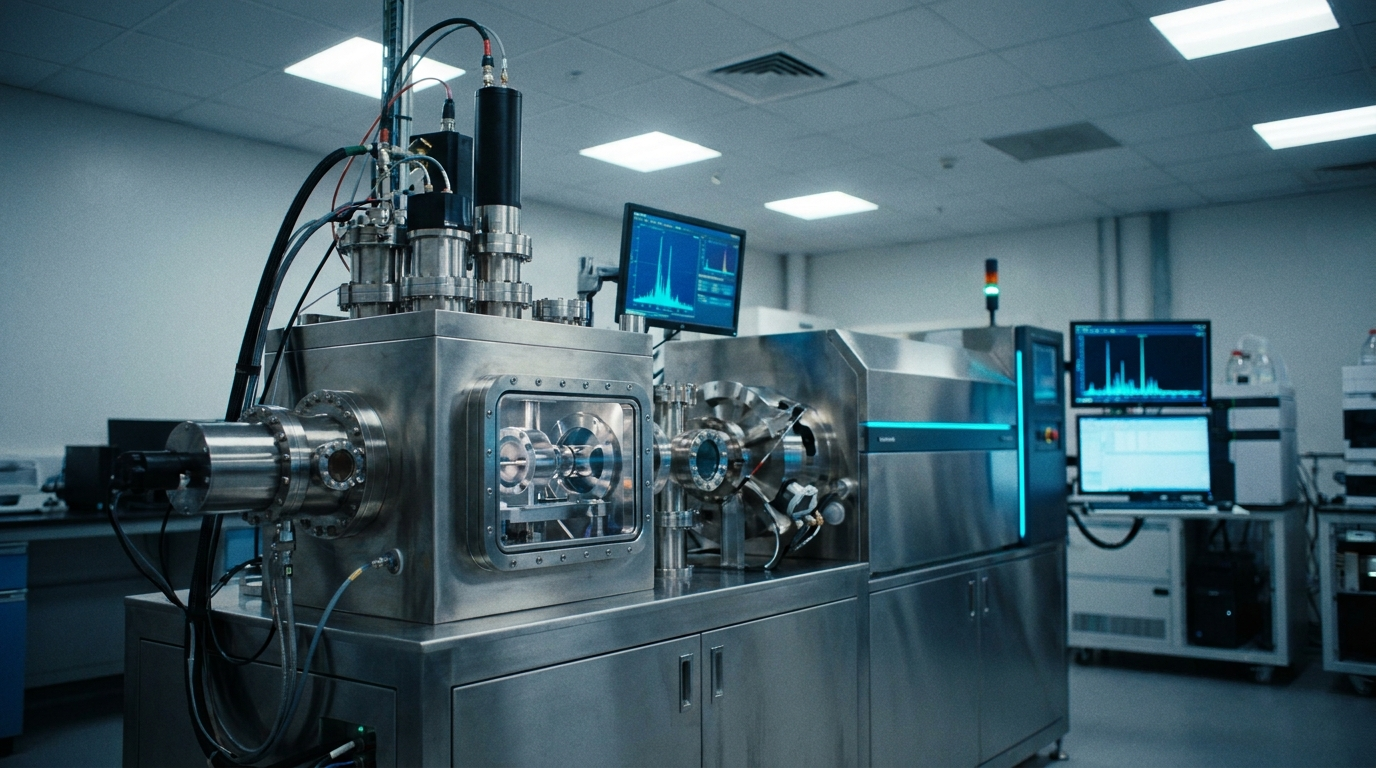
Mass Spectrometry
A mass spectrometer is a chain of electric fields. High voltage biases the ion source, shapes the beam through the ion optics and lenses, drives the quadrupole or the time-of-flight accelerating stage, and powers the detector at the end, whether that is an electron multiplier or a conversion dynode. Every one of those stages depends on a voltage that is set accurately and held steady. The quality of the high-voltage supply is not a background detail. It sets the floor on what the instrument can resolve.
The reason is direct. Ripple and noise on a bias rail modulate ion energy and trajectory, which smears peaks and pulls signal down into the baseline. A few millivolts of ripple on a lens or an accelerating stage shows up as lost mass resolution and degraded signal-to-noise. Slow drift is just as damaging over a long acquisition: a rail that wanders with temperature moves calibration out from under the method and forces re-tuning. The supply also has to set fast and land accurately, because modern instruments step many electrodes through a method and cannot wait on a rail to settle. Many designs need reversible polarity to run positive-ion and negative-ion modes from the same hardware, and some stages sit at a potential well away from earth and need a floating, potential-free output.
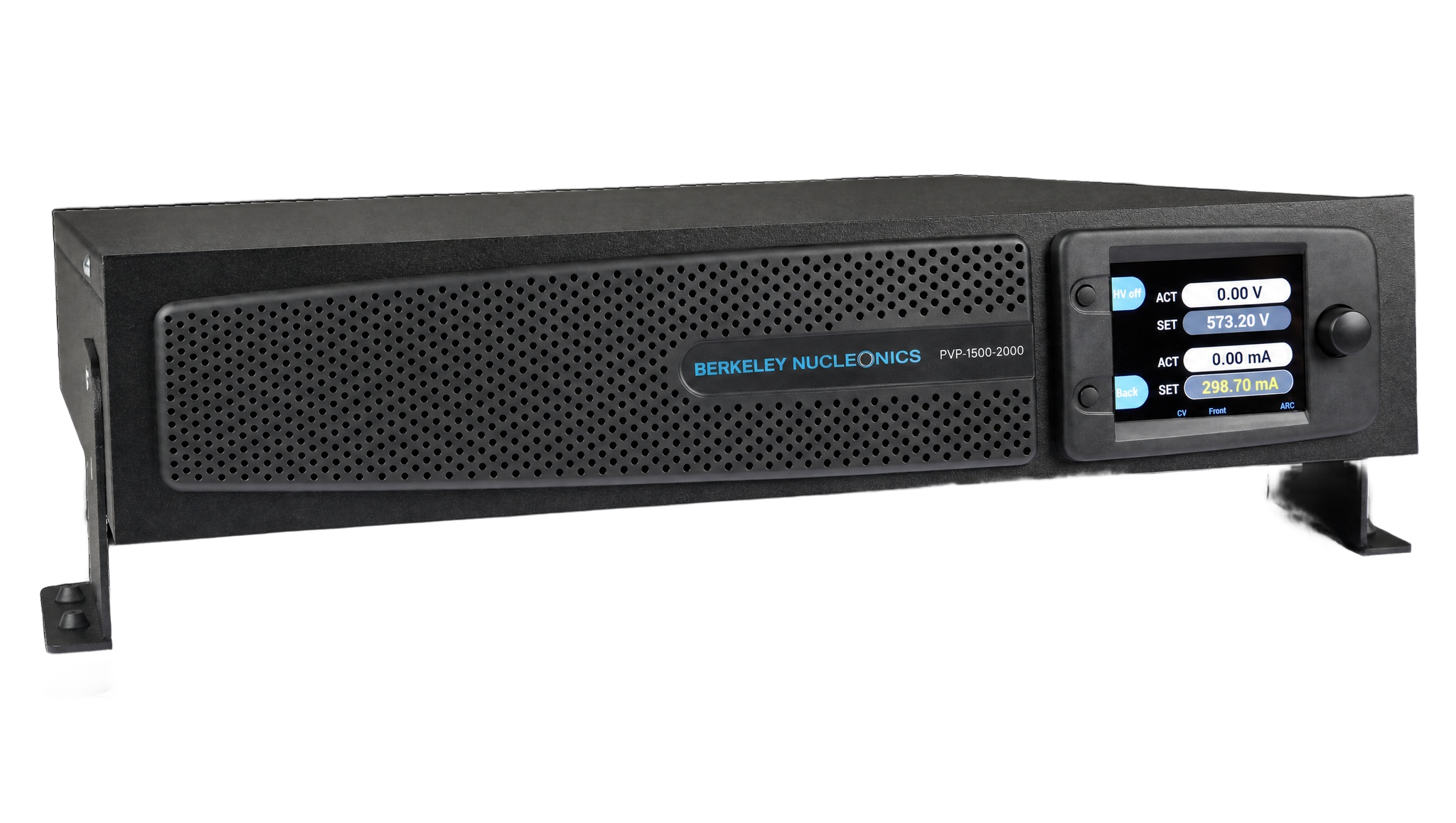
How the PVP-Series solves it
The PVP-Series is a fully digitally regulated DC high-voltage supply built around a microcontroller and an FPGA, and the regulation numbers map straight onto what a mass spectrometer asks for. Ripple is specified at 0.01 percent of nominal plus 100 mV, low enough that the rail contributes little to peak width or baseline. Line regulation is tighter than plus or minus 0.01 percent of nominal across a 10 percent mains swing, and stability holds within 0.01 percent of nominal over an eight-hour session, with a temperature coefficient of 0.01 percent of nominal per degree. A bench can hold calibration across a full working day instead of re-tuning between runs.
Setting is digital and fine-grained. The 16-bit setting resolution spans roughly 0.01 to 100 percent of nominal, so a lens or accelerating voltage can be placed precisely and reproduced exactly on the next run. Response is under 1 millisecond to within 0.1 percent of nominal, which lets a method step electrode voltages and move on without waiting. Polarity is electrically reversible, so a single supply switches between positive-ion and negative-ion operation, and floating-output variants serve stages that must sit potential-free above ground.
Control is automation-ready. Ethernet and RS232 with a standard SCPI command set let the instrument software set every bias from the same sequence that runs the acquisition and drives mode switching, and the time-tagged event log records the run. Arc Detection watches for flashover and can shut the output off, which protects sensitive ion optics and the detector multiplier from a discharge event. The supply ships in a 2U enclosure (3.5 inches high, 19.7 inches deep) that racks into the instrument cabinet, with a rear HV connector and a roughly 10 ft HV cable.
Which PVP-Series models and options fit
Mass-spectrometry bias rails span a wide range. Source and ion-optic potentials usually live below a few kilovolts, while time-of-flight accelerating stages reach higher. Match the model to the stage.
| Need | Recommended PVP-Series model | Rating |
|---|---|---|
| Ion source and ion-optic bias, high current headroom | PVP-1500-2000 | 1.5 kV, 2000 mA, reversible |
| Source and lens bias, potential-free stage | PVP-1500-2000 flo | 1.5 kV, 2000 mA, floating output |
| Lens stacks and detector bias to 5 kV | PVP-5000-400 | 5 kV, 400 mA, reversible |
| Higher-current 5 kV bias rails | PVP-5000-600 | 5 kV, 600 mA, reversible |
| Time-of-flight and accelerating stages | PVP-10000-200 | 10 kV, 200 mA, reversible |
For positive-ion and negative-ion work on one bench, choose the reversible variant so a single supply flips polarity under software control between methods. Where a stage must float above ground, the floating-output PVP-1500-2000 flo keeps the rail potential-free. Two options matter most here. Arc Detection with output shut-off guards the electron multiplier and the fine ion optics against a flashover, which is the failure that most often ends a detector. Ramp Control brings a rail up at a defined gradient rather than an inrush step, a gentler way to energize high-impedance optics and a repeatable startup. Low ripple and long-term stability are the throughline for every choice.
Recommended configuration
For a typical quadrupole instrument, a PVP-1500-2000 in the reversible configuration covers source and ion-optic bias with generous current headroom, and its reversible polarity handles both ion modes from one unit. Where a lens or source stage must sit potential-free, substitute the PVP-1500-2000 flo floating-output variant. Add Arc Detection with output shut-off as the first line of protection for the optics and detector, and Ramp Control for a controlled, repeatable energizing of high-impedance electrodes.
Instruments with detector or lens rails up to 5 kV should center on a PVP-5000-400, stepping to the PVP-5000-600 where the rail needs more current. Time-of-flight benches that drive accelerating stages near 10 kV use the PVP-10000-200. In every case, set each bias over Ethernet with SCPI from the instrument software so polarity changes and voltage steps follow the method automatically, and rack the 2U units into the cabinet. The low ripple and tight stability keep mass resolution and signal-to-noise where the rest of the instrument can use them.
Talk to an application engineer
Berkeley Nucleonics can help you match a PVP-Series model and option set to the bias rails in your mass spectrometer. Call 800-234-7858 or email info@berkeleynucleonics.com.
For a quick question, chat with an engineer at berkeleynucleonics.com.