1Overview / Introduction
Gamma-ray spectrometry demands more than a peak search. Accurate analysis must contend with overlapping elemental emissions, sum and escape peak artifacts, complex continuum shapes, and the need to quantify radionuclide activity independently of measurement geometry and sample matrix. bGamma is Berkeley Nucleonics' answer: a general-purpose, comprehensive software package built from the ground up for gamma-ray spectrum analysis, radionuclide identification, and quantification.
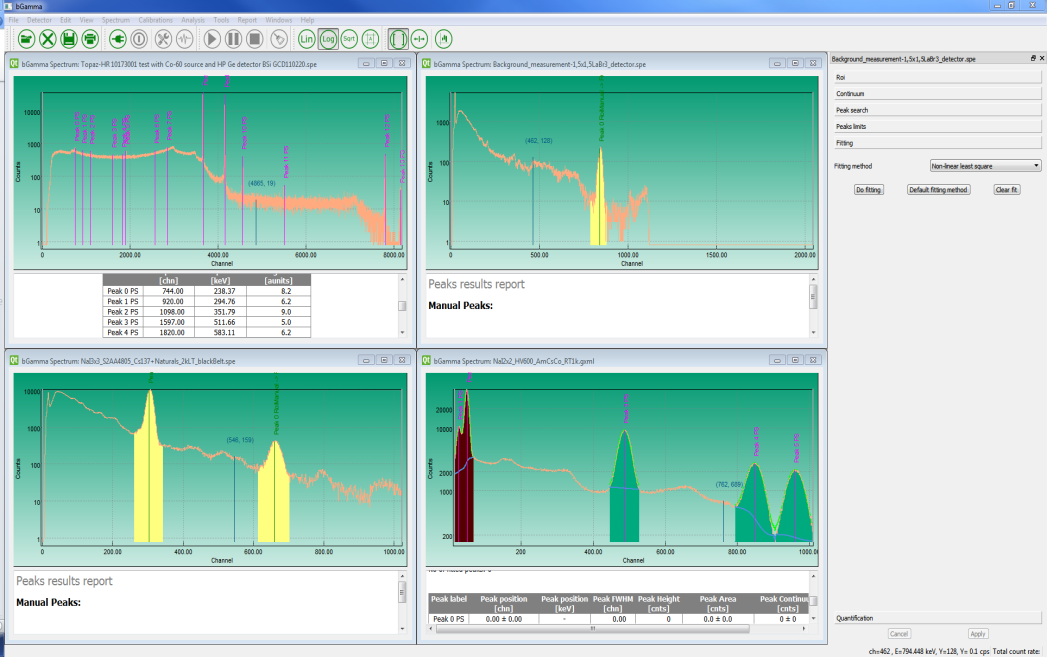
bGamma connects directly to detector-MCA setups for live data acquisition. It also imports spectra from external file formats, so archived measurements and third-party instruments are equally well served. The modern graphical user interface provides immediate visual feedback at every stage of the analysis, making complex workflows accessible without sacrificing depth. The multi-document design lets analysts work on several spectra simultaneously or monitor data from multiple connected detectors in a single session.
The calculation engine suite covers the full range of gamma-ray spectra, from high-resolution germanium measurements to medium-resolution scintillator spectra from LaBr3, NaI(Tl), and other materials. bGamma runs natively on MS Windows, macOS, and Linux, requiring no virtualization or platform compromise.
2Features
- Connects and controls data acquisition via detector-MCA setups
- Controls and visualizes live data acquisition in real time
- Imports spectra from other file formats
- Energy, shape, and efficiency calibration for gamma-ray spectra
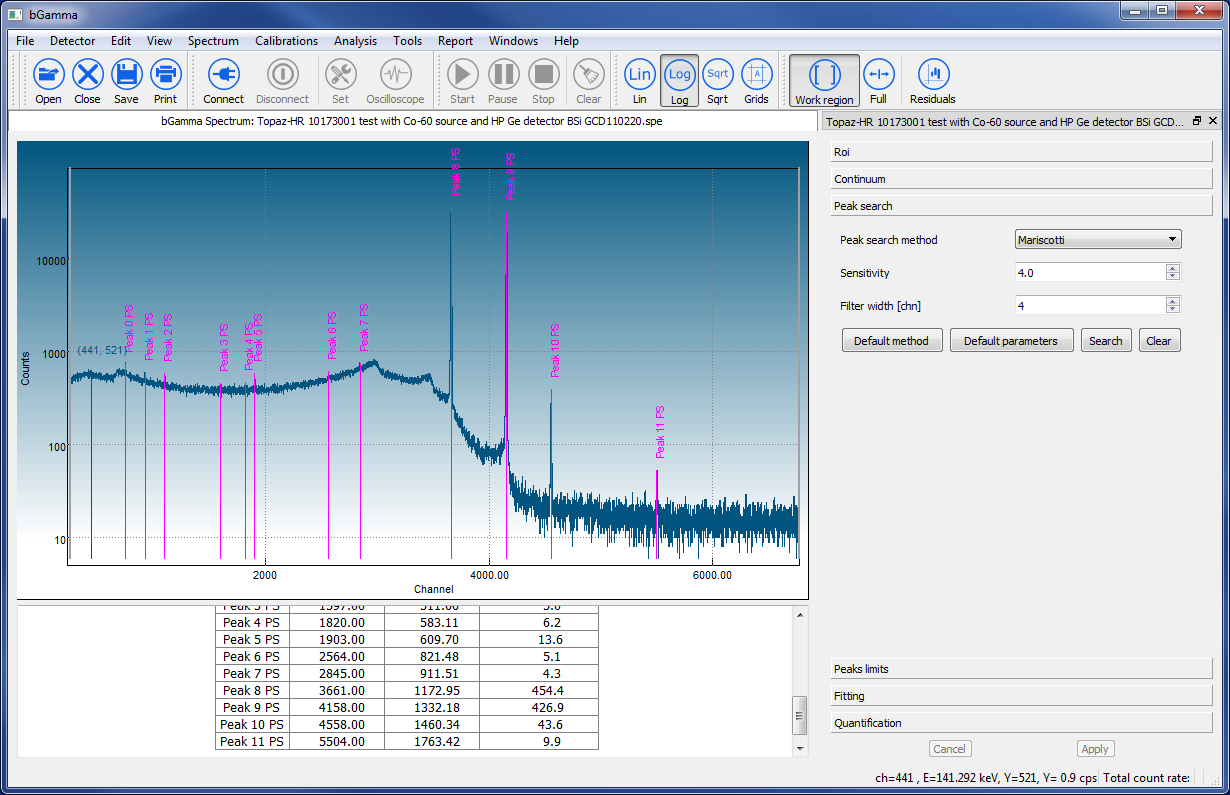
- Automatic peak search and peak class identification (singlets, multiplets)
- ROI analysis and calculations with automatic and manual marking
- Fitting of experimental data to mathematical models
- Background subtraction and peak interference correction
- Nuclide identification with separation from spectrum artifacts and structures
- Radionuclide activity calculations via multiple quantification methods
- Multiple peak labelling implementation
- Implements different automatic peak search methods
- Provides multiple methods for peak continuum subtraction
- Spectrum analysis fitting methods including Bayesian fitting
- Fitting and mathematical model parameters adjustable for quick optimization
- Visual distinction and marking of ROIs and peaks
- Advanced GUI configurable to user preferences
- Advanced spectrum cursor showing satellite peaks and artifacts
- Multi-document design with automatic updates for currently selected spectrum
- Full traceability: all information saved in XML-formatted files (*.gxml)
- Customizable analysis reports, including fully colored and HTML-formatted tables
- Full radionuclide library based on internationally maintained NuDat nuclear data files
- Multi-platform: runs on MS Windows, macOS, and Linux
- bGamma Programming Libraries available as a separate product
3Description
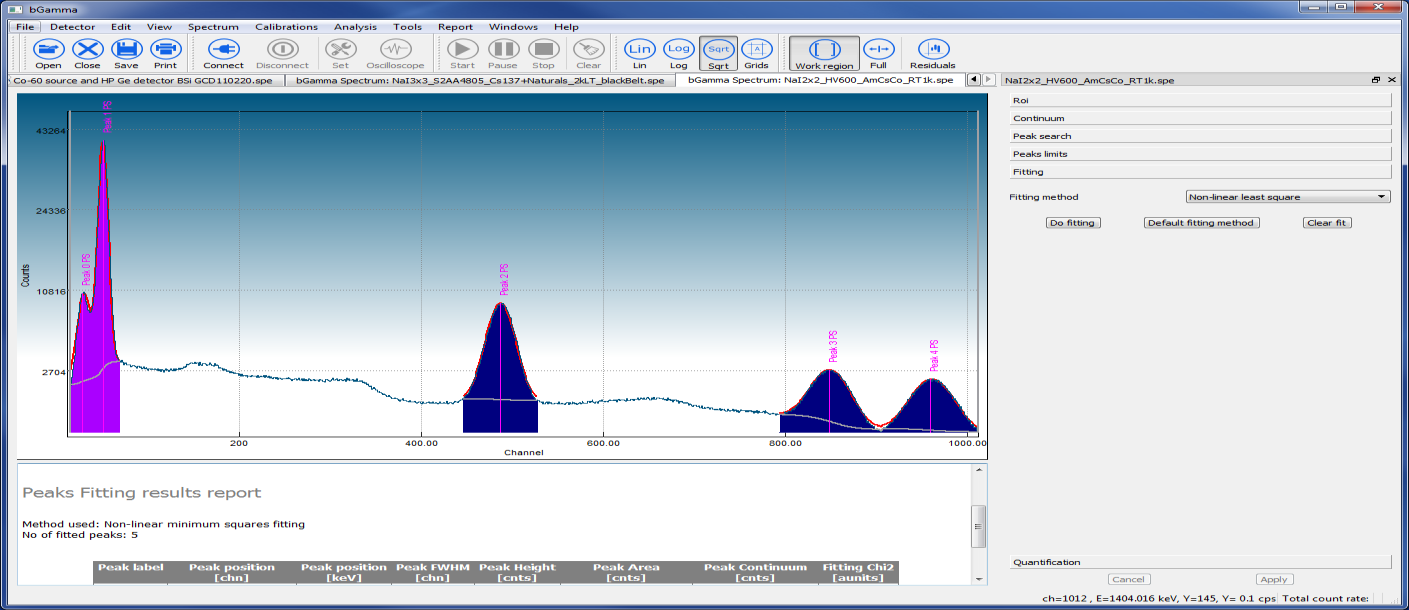
bGamma is designed for the professional analyst who needs both depth and flexibility. The GUI is the central workflow surface: spectrum visualization, peak labeling, ROI marking, and calibration dialogs all provide immediate visual feedback so the analyst stays oriented throughout a complex analysis session.
Spectrum Analysis Engine
The spectrum analysis engine incorporates a comprehensive set of calculation modules covering every stage of the analysis pipeline:
- ROI computations with automatic and manual marking
- Continuum calculation methods for accurate background subtraction
- Peak search engines with multiple automatic methods
- Peak qualification methods and automatic ROI location
- Peak fitting algorithms including Bayesian fitting
- Energy calibration methods and FWHM calibration methods
- Efficiency calibration methods using a versatile polynomial fitting engine
- Nuclide identification techniques with artifact rejection
- Activity calculation algorithms supporting multiple quantification methods
The wide choice of analysis methods ensures suitability for any kind of gamma-ray spectrum and analysis need. Fitting and mathematical model parameters are available at hand for quick changes and optimization, so the analyst is not locked into a single approach when spectra are complex or ambiguous.
Multi-Document and Multi-Detector Support
bGamma is a multi-document application. Several spectra can be analyzed concurrently, and data can be acquired simultaneously from multiple connected detectors. Automatic updates keep the currently selected spectrum current without manual refresh. This design is especially valuable in laboratory environments where throughput matters and sequential analysis would create bottlenecks.
File Formats and Reporting
All analysis information is saved into XML-formatted files with the .gxml extension, providing full traceability and long-term archivability. Analysis reports are fully customizable and can be output as colored, HTML-formatted tables, suitable for direct inclusion in regulatory submissions or client deliverables.

4Calibrations
Calibrations are an essential step in correctly analyzing any gamma-ray spectrum. bGamma provides all the necessary tools and functionalities to complete any calibration in gamma-ray spectrometry.
Energy and Shape (FWHM) Calibration
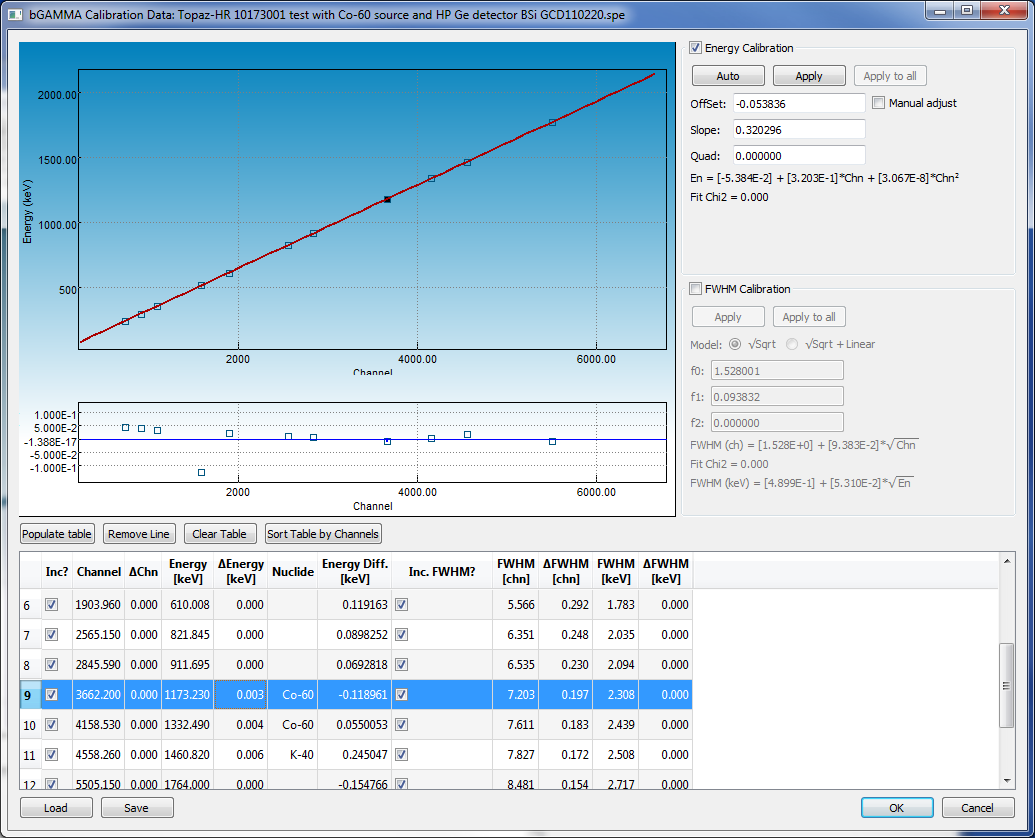
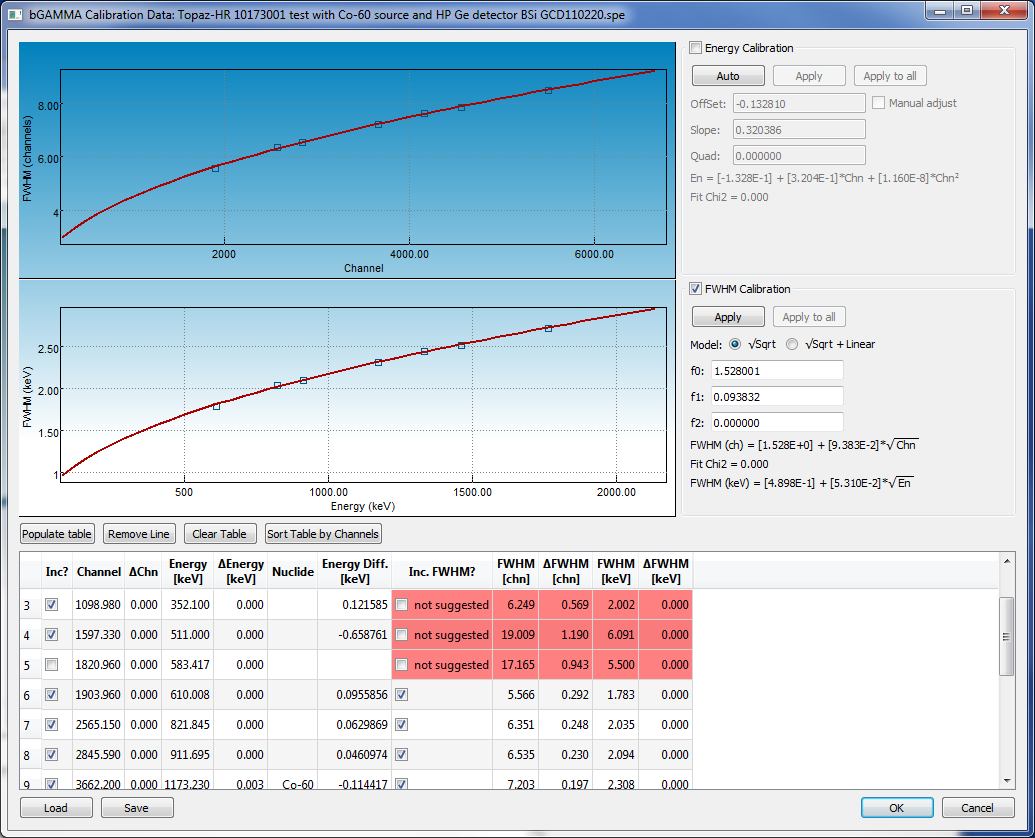
Energy and shape calibrations are unified into a single dialog. The dialog contains embedded expert knowledge for suggesting calibration lines appropriate to the spectrum type and detector in use. A powerful GUI provides visual feedback on calibration results, showing the fit quality and residuals so the analyst can immediately identify and correct any problem peaks.
Efficiency Calibration
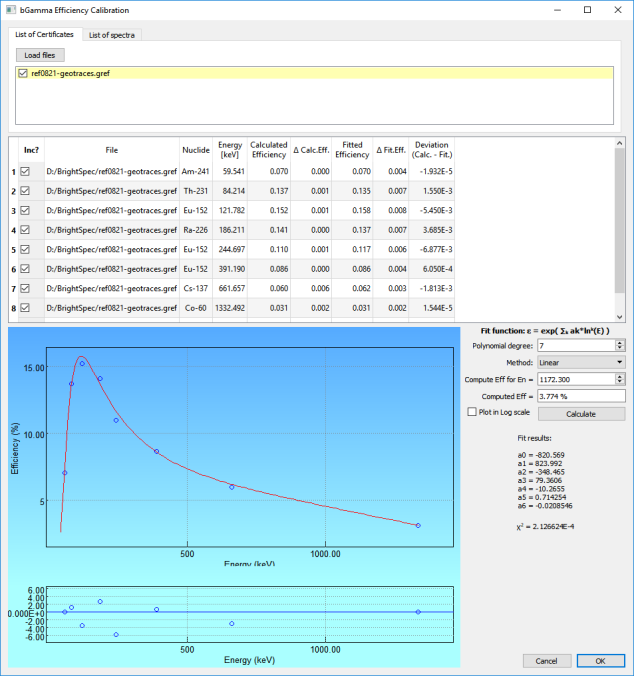
Efficiency calibration uses a versatile fitting engine to derive complex calibration coefficients in a polynomial of the logarithm of energy. The calibration dialog provides a simple but comprehensive GUI with immediate, visual feedback of the obtained efficiency calibration results. Both point-source and extended-source geometries are supported through the flexible coefficient model.
5Nuclide Library
bGamma incorporates the complete radionuclide decay emissions database. All nuclide data are available at any point during spectrum analysis and data visualization. The nuclide decay data are taken from NuDat, the internationally recognized nuclear data file produced, certified, and maintained by the International Nuclear Data Committee. Using NuDat as the authoritative source ensures that identifications and activity calculations are grounded in the same reference data used by nuclear regulatory bodies worldwide.
6Technical Specifications
Software Platform
| Parameter | Specification |
|---|---|
| Operating Systems Supported | Microsoft Windows XP, Windows 7, Windows 8 (32-bit and 64-bit); macOS; Linux |
| Processor Architecture | 32-bit or 64-bit processors |
| Multi-Platform | Runs seamlessly on MS Windows, macOS, and Linux without virtualization |
| Application Design | Multi-document: multiple spectra open simultaneously; multiple connected detectors |
| File Format | XML-formatted spectrum and analysis files (*.gxml) |
| Report Output | Customizable, HTML-formatted and fully colored tables |
| Nuclide Library Source | NuDat (International Nuclear Data Committee) |
Spectrum Analysis Capabilities
| Capability | Details |
|---|---|
| Peak Search Methods | Multiple automatic peak search engines selectable by the analyst |
| Peak Classification | Automatic identification of singlets and multiplets |
| Continuum Subtraction | Multiple background/continuum calculation methods |
| Peak Fitting | Multiple algorithms including Bayesian fitting; fitting parameters adjustable for optimization |
| ROI Analysis | Automatic and manual ROI marking; ROI computations with visual distinction in spectrum display |
| Artifact Handling | Separation of sum peaks, escape peaks, and other spectrum artifacts from genuine nuclide lines |
| Nuclide Identification | Full NuDat library; identification against all decay emissions; artifact-rejection logic |
| Activity Calculation | Multiple quantification methods; geometry-independent; sample-characteristic-independent |
| Detector Compatibility | High-resolution Ge detectors; medium-resolution scintillators (LaBr3, NaI(Tl), CeBr3, and others) |
| Spectrum Import | Imports spectra from multiple third-party file formats |
| Hardware Control | Connects to and controls MCA hardware for live data acquisition |
Calibration Modules
| Calibration Type | Details |
|---|---|
| Energy Calibration | Unified energy and shape (FWHM) calibration dialog; expert line suggestions; visual residual feedback |
| Shape (FWHM) Calibration | Integrated with energy calibration; detector-type aware suggestions |
| Efficiency Calibration | Polynomial-of-log-energy fitting engine; versatile coefficient derivation; visual fit feedback |
7Applications
bGamma is appropriate wherever accurate gamma-ray spectral analysis is required. Representative application areas include:
- Nuclear and radiochemical laboratories requiring traceable activity quantification and nuclide identification from environmental, biological, and industrial samples
- Radiation protection and health physics programs monitoring worker dose and facility contamination using NaI(Tl) or LaBr3 detectors
- Environmental monitoring including soil, water, air, and vegetation sample analysis for regulatory compliance
- Nuclear security and non-proliferation screening programs where rapid, accurate isotope identification is critical
- Medical physics and radiopharmacy quality control of radiopharmaceutical preparations and patient dose verification
- Research institutions and universities using germanium or scintillator spectrometers for nuclear physics, neutron activation analysis, and isotope production
- Industrial gauging and process control where radionuclide-specific activity measurements inform product or process parameters
- Emergency response field teams requiring rapid spectrum analysis on portable detector-MCA systems
- Multi-detector laboratory systems where simultaneous acquisition and analysis across several channels is required
8Ordering Information
bGamma is available in several license configurations to match laboratory scale and workflow requirements. Contact Berkeley Nucleonics to confirm current part numbers, pricing, and upgrade paths.
| Configuration | Description |
|---|---|
| bGamma — Single License, Single Input | Right to run the software on a single PC. Connects to one detector (hardware) at a time. |
| bGamma — Single License, Multiple Inputs | Right to run the software on a single PC. Connects to multiple detectors (hardware) simultaneously. |
| bGamma — Network License | Right to run the software from a PC connected to a network. The number of concurrent instances depends on the number of licenses purchased or activated. |
| bGamma Package (TOPAZ-HR Bundle) | Full bGamma application software (single license) bundled with the TOPAZ-HR MCA. A complete, ready-to-acquire spectrometry system. |
9Contact Berkeley Nucleonics
To request a quote, arrange a software demonstration, discuss license options, or ask a technical question, contact the Berkeley Nucleonics applications team directly.
| info@berkeleynucleonics.com | |
| Phone | 800-234-7858 |
| Address | 2955 Kerner Blvd, San Rafael, CA 94901, USA |
| Web | www.berkeleynucleonics.com |