
1Overview
Silicon photomultipliers (SiPMs) are a solid-state alternative to traditional photomultiplier tubes for reading out scintillation crystals. Where PMTs demand hundreds to thousands of volts and cannot tolerate magnetic fields, SiPMs operate from a modest 25–30 V bias and are entirely insensitive to magnetic environments. The result is a readout chain that is smaller, lighter, and compatible with applications where a PMT simply cannot fit or function.
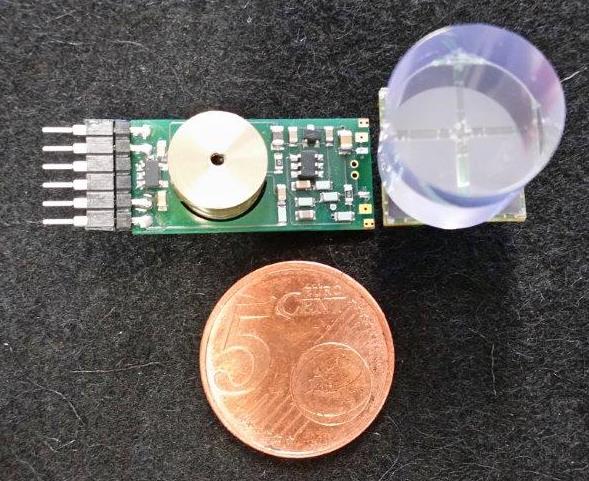
Berkeley Nucleonics offers ScintIQ detectors with SiPM readout across a wide range of crystal types and sizes. Individual SiPM elements measure 3×3 mm or 6×6 mm and can be combined into arrays to cover larger crystal faces. The readout electronics include an integrated bias generator and preamplifier module that corrects for the temperature dependence of SiPM gain, delivering stable spectroscopic performance without external compensation circuitry.
2Features
- Low bias voltage: 25–30 V (no high-voltage supply required)
- High gain: 106
- Completely insensitive to magnetic fields
- Mechanically compact, no fragile vacuum envelope
- SiPM elements: 3×3 mm and 6×6 mm; configurable as arrays
- Operable to 60 °C
- Integrated bias generator / preamplifier module
- Gain drift with temperature internally corrected
- Supply voltage: 5.2–16 V
- Power consumption: <30 mW
- Compatible with NaI(Tl), CsI(Tl), and other ScintIQ crystals
- Selectable termination (1 MΩ or 50 Ω) to suit downstream electronics
3Description
SiPM Technology
A silicon photomultiplier is a solid-state photodetector built from a dense array of avalanche photodiode microcells operated in Geiger mode. When a scintillation photon strikes a microcell, it triggers a Geiger discharge that produces a standardized charge pulse. The sum of all fired microcells constitutes the SiPM output pulse, whose amplitude is proportional to the number of detected photons, and therefore to the deposited radiation energy.
SiPM gain is a strong function of the applied bias voltage relative to the device breakdown voltage. Careful bias selection is critical: too low a bias reduces gain and degrades resolution; too high a bias increases dark count rate and nonlinearity. The operating point must be chosen to match the scintillator speed and the application's resolution requirements.
Bias Generator / Preamplifier Module
Berkeley Nucleonics supplies an integrated bias generator and preamplifier module designed specifically for SiPM-coupled scintillation detectors. The module runs from a single low-voltage supply (5.2–16 V) and consumes less than 30 mW, making it compatible with battery-operated instruments and compact embedded systems. Critically, the module includes internal temperature compensation: gain drift as a function of temperature is corrected without any external circuitry, maintaining stable spectroscopic performance across the operating temperature range.
Array Configurations
For crystal faces larger than a single SiPM element can cover, multiple elements are tiled into an array. The number of SiPMs required depends on crystal dimensions and the fraction of light-exit face that must be instrumented. Berkeley Nucleonics configures SiPM arrays to suit each detector geometry, balancing coverage, capacitance, and electronic noise.
4Energy Resolution Performance
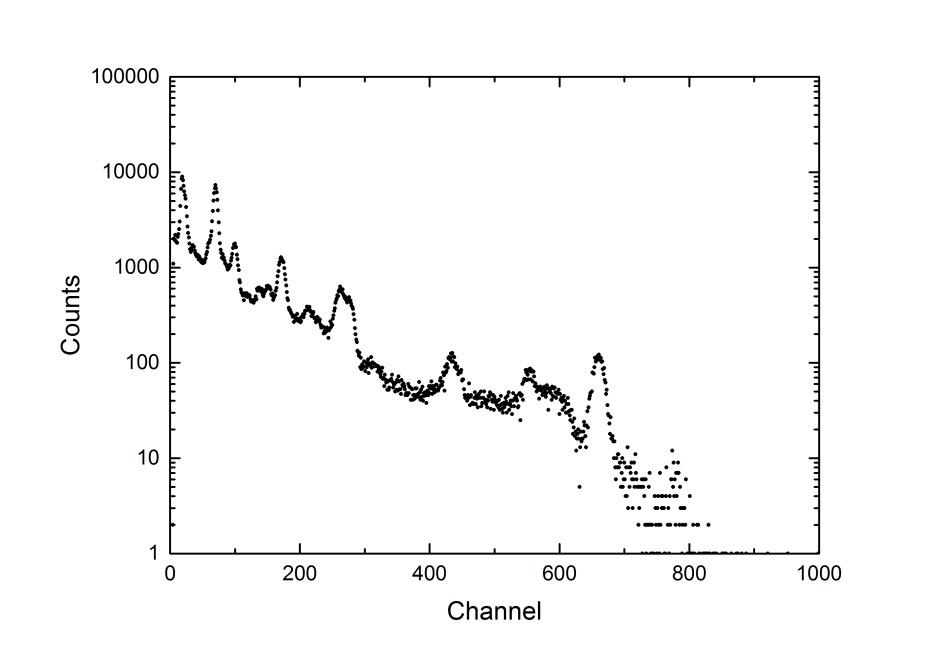
Energy resolution with SiPM readout depends on crystal type and dimensions, the fraction of light-exit area covered by SiPMs, and the operating bias point. The table below lists typical energy resolution values at 662 keV (Cs-137) for representative crystal sizes and types. Values are listed as the upper bound achievable with optimized readout.
| Crystal Type | Crystal Size (mm) | Energy Resolution at 662 keV |
|---|---|---|
| NaI(Tl) | 32 × 25 | <8.0% |
| CsI(Tl) | 25 × 25 | <7.0% |
| CsI(Tl) | 35 × 51 | <7.5% |
| CsI(Tl) | 48 × 35 | <7.5% |
Note: CsI(Tl) is an excellent match for SiPM readout because its 550 nm emission peak aligns well with the SiPM photon detection efficiency curve, and it is not hygroscopic, simplifying hermetic sealing of the detector assembly.
5Technical Specifications
SiPM Sensor
| Parameter | Value |
|---|---|
| Bias voltage | 25–30 V |
| Gain | 106 |
| Element sizes available | 3×3 mm, 6×6 mm |
| Maximum operating temperature | 60 °C |
| Magnetic field sensitivity | None (immune) |
| Array configuration | Custom; number of elements per crystal geometry (verify) |
Bias Generator / Preamplifier Module
| Parameter | Value |
|---|---|
| Supply voltage range | 5.2–16 V |
| Power consumption | <30 mW |
| Temperature compensation | Internal; gain drift corrected |
| Termination options | 1 MΩ, 50 Ω |
| Compatible crystal types | NaI(Tl), CsI(Tl), and other ScintIQ scintillators |
| Form factor | Compact module, dimensions verify |
Signal Characteristics
| Configuration | Signal Shape |
|---|---|
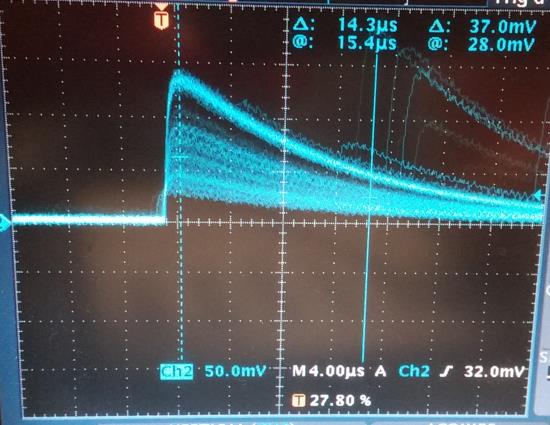
| 1 MΩ termination | Slow, large-amplitude pulse; suited to direct ADC or MCA input |
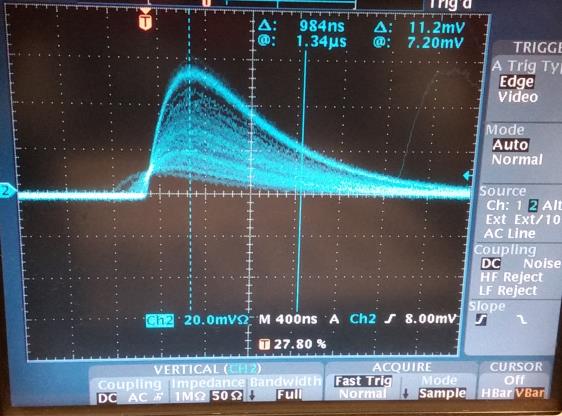
| 50 Ω termination | Fast pulse, lower amplitude; suited to shaping amplifiers and fast electronics |
6Applications
SiPM readout is the right choice when PMT high voltage is impractical, when the detector must operate inside or adjacent to a magnetic field, or when size and power constraints rule out vacuum-tube technology. Typical applications include:
- Handheld and wearable radiation monitors (battery-powered, compact)
- Detectors inside MRI, NMR, or other high-field environments
- Unmanned aerial vehicle (UAV) payload gamma/neutron sensors
- Embedded radiation monitors in nuclear facilities and research reactors
- PET scanner detector modules (LYSO/GAGG with SiPM arrays)
- Well-logging tools requiring rugged, vibration-tolerant readout
- Environmental and portal monitoring with low-power requirements
- Laboratory and field instruments where PMT fragility is a concern
7Ordering & Contact
ScintIQ SiPM readout detectors are configured to specification. Crystal type, dimensions, SiPM element size, array layout, housing, and preamplifier module options are all selected at time of order. To discuss your application and request a quotation, contact Berkeley Nucleonics directly.
Request a Quote or Speak with an Engineer
Berkeley Nucleonics Corporation
2955 Kerner Blvd, San Rafael, CA 94901
Email: info@berkeleynucleonics.com
Phone: 800-234-7858