
1Overview
The ScintIQ 51B51/SIP-E3-X is a fully integrated NaI(Tl) scintillation detector module in the classic 2-inch-by-2-inch format. It pairs a thallium-activated sodium iodide crystal (51 mm diameter, 51 mm length) with a Silicon Photomultiplier (SiPM) array readout, eliminating the high-voltage supply traditionally required for photomultiplier tube (PMT) based designs. All bias generation and signal conditioning are internal to the housing.
The detector accepts a single low-voltage supply of +5 to +16 V at just 3 mA, making it suitable for battery-powered instruments and compact OEM integration. A temperature-compensated bias circuit maintains stable SiPM gain across environmental changes, and the built-in preamplifier delivers a clean analog pulse directly to a connected multichannel analyzer (MCA) or digitizer. Warm-up to stable operation takes approximately 30 seconds.
NaI(Tl) is the established standard for gamma-ray detection and spectroscopy: it offers a combination of high light yield, emission well-matched to silicon photosensors, and cost-effective manufacturability in a wide range of sizes. The 2-inch-by-2-inch geometry provides a good balance of detection efficiency and portability for field instruments, laboratory counters, and OEM integrators.
2Features
- NaI(Tl) crystal, 51 mm diameter x 51 mm length (2″ x 2″ format)
- SiPM array readout (J-60035-4P): no high-voltage power supply required
- Integrated temperature-compensated SiPM bias generator
- Built-in charge-sensitive preamplifier; analog pulse output
- Single supply: +5 to +16 V at 3 mA (compatible with USB power banks and portable instruments)
- Ready in 30 seconds from power-on
- Aluminum housing, 59.2 mm diameter, 75.3 mm height
- LEMO ERA0S302 connector; 3 m LIYCY cable with flying leads
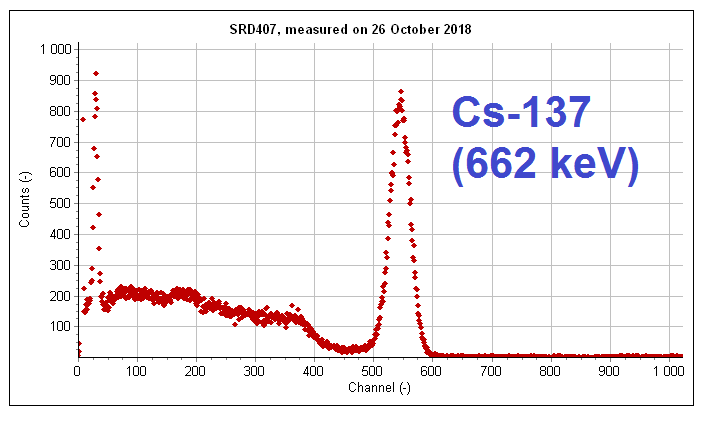
- Energy resolution better than 7.5% FWHM at 662 keV
- Noise level below 15 keV equivalent
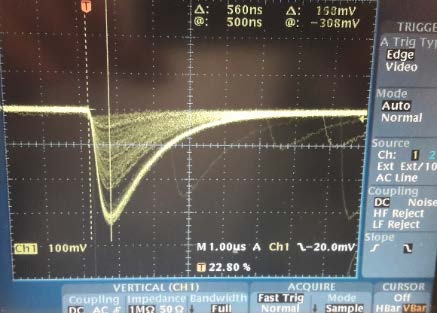
- Pulse rise time 560 ns (0 to 100%); pulse fall time 1.4 μs (1/e)
- Output gain approximately 450 mV/MeV
3Description
SiPM Readout Architecture
Traditional NaI(Tl) detectors use PMTs that require several hundred volts of bias. The 51B51/SIP-E3-X replaces the PMT with an array of Silicon Photomultipliers (SiPMs). SiPMs operate on low voltage, are insensitive to magnetic fields, and are not damaged by ambient light when powered off. The J-60035-4P array format covers the crystal exit face with matched active area, preserving collection efficiency comparable to a conventional PMT design.
Because SiPM gain is temperature-dependent, a dedicated compensation circuit tracks ambient temperature and adjusts the bias voltage to hold gain stable. This keeps the energy scale from drifting in field conditions where temperature may change by tens of degrees over a deployment period.
Signal Chain
Scintillation photons from the NaI(Tl) crystal are converted to charge by the SiPM array. The internal preamplifier integrates this charge and outputs a voltage pulse. Rise time is 560 ns (0 to 100%), with a 1/e fall time of 1.4 μs. Pulse height is proportional to deposited gamma-ray energy at approximately 450 mV/MeV. The output is delivered via LEMO ERA0S302 connector on a 3 m shielded LIYCY cable and is compatible with standard NIM MCAs, USB MCAs, and direct digitizers.
Housing and Integration
The aluminum housing is compact and lightweight. At 59.2 mm outer diameter and 75.3 mm overall height, the assembly integrates into standard instrument heads and OEM enclosures designed for the 2-inch detector format. The housing provides light-tight sealing for the hygroscopic NaI(Tl) crystal and the SiPM assembly.
4Technical Specifications
Crystal
| Parameter | Value |
|---|---|
| Scintillation material | NaI(Tl) |
| Crystal size | Ø51 mm × 51 mm (2″ × 2″) |
| Emission peak | 415 nm |
| Decay time | 0.23 μs |
| Density | 3.67 g/cm³ |
| Hygroscopic | Yes (hermetically sealed) |
Readout
| Parameter | Value |
|---|---|
| Photodetector | SiPM Array J-60035-4P |
| Bias generation | Internal, temperature-compensated |
| Preamplifier | Built-in charge-sensitive |
Mechanical
| Parameter | Value |
|---|---|
| Housing material | Aluminum |
| Outer diameter | 59.2 mm |
| Overall height | 75.3 mm |
| Drawing number | V-1593 |
Electrical
| Parameter | Value |
|---|---|
| Supply voltage | +5 to +16 V |
| Supply current | 3 mA (typical) |
| Warm-up time | 30 seconds |
| Output connector | LEMO ERA0S302 |
| Cable | 3 m LIYCY, flying leads |
Performance
| Parameter | Value |
|---|---|
| Energy resolution | < 7.5% FWHM at 662 keV |
| Noise level | < 15 keV |
| Pulse rise time (0–100%) | 560 ns |
| Pulse fall time (1/e) | 1.4 μs |
| Gain | Approx. 450 mV/MeV |
5Electrical Connections
The detector terminates in a LEMO ERA0S302 connector. A 3 m LIYCY shielded cable with flying leads is supplied. Pin assignments are as follows:
| Pin / Lead | Function | Wire color |
|---|---|---|
| Pin 1 | Power supply (+5 to +16 V) | Brown |
| Pin 2 | Signal output | (verify) |
| Shield/return | Ground / shield return | (verify) |
6Typical Energy Spectra
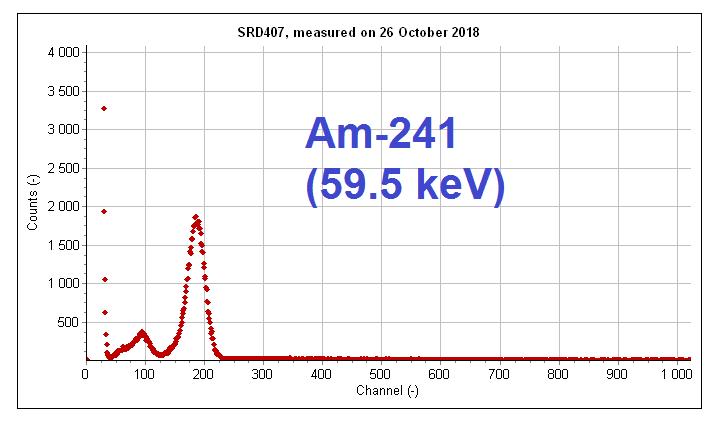
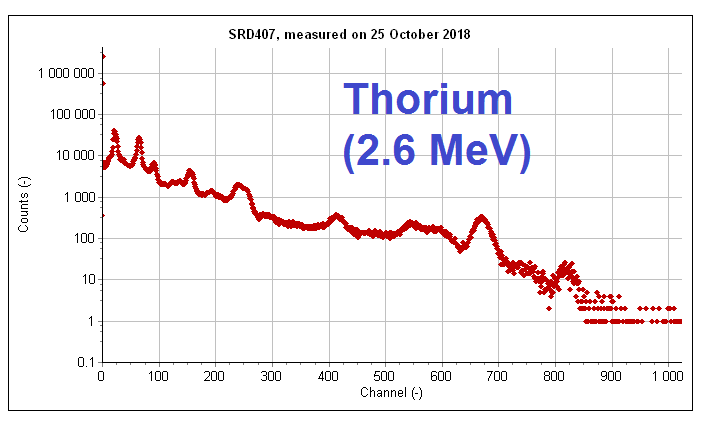
The plots below were acquired with the 51B51/SIP-E3-X connected to a standard MCA. They illustrate the detector's spectroscopic performance across the common gamma-ray energy range. Resolution and peak position will vary slightly with temperature and operating voltage; the integrated temperature-compensation circuit minimizes these effects under normal field conditions.
7Applications
The 51B51/SIP-E3-X is well-suited to any application requiring a compact, self-contained gamma-ray detector with low supply voltage and standard pulse output. Typical uses include:
- Portable gamma-ray spectrometry: field instruments, personal dosimeters with spectroscopy capability, and compact RIIDs
- Health physics and environmental monitoring: area monitors, soil and water sample counting, dose-rate instruments
- Laboratory gamma counting: bench-top sample counting and isotope identification in research and QA/QC settings
- OEM instrument integration: the low supply voltage and compact housing simplify integration into custom detector heads, drones, and embedded systems
- Homeland security and border monitoring: handheld and vehicle-mounted gamma detection systems
- Industrial gauging and process control: density gauges and level sensors requiring gamma detection
- Nuclear medicine support: laboratory counting and quality-control measurement of radio-pharmaceutical sources
- Education and training: university and teaching labs where low-voltage operation simplifies student-safe instrument design
8Ordering & Contact
Model Selection
| Model Number | Description |
|---|---|
| 51B51/SIP-E3-X | 2″ × 2″ NaI(Tl) SiPM detector, integrated bias and preamplifier, LEMO output, 3 m cable |
Custom configurations, alternate crystal sizes, different connector types, or modified cable lengths are available. Contact Berkeley Nucleonics to discuss your specific requirements.
Berkeley Nucleonics Corporation
2955 Kerner Blvd, San Rafael, CA 94901
Email: info@berkeleynucleonics.com
Phone: 800-234-7858
Web: berkeleynucleonics.com
For additional ScintIQ detector configurations, comparison of scintillation materials, or to build a complete detection system with MCA or readout electronics, see the ScintIQ documentation library or use the online detector configurator.