1Overview
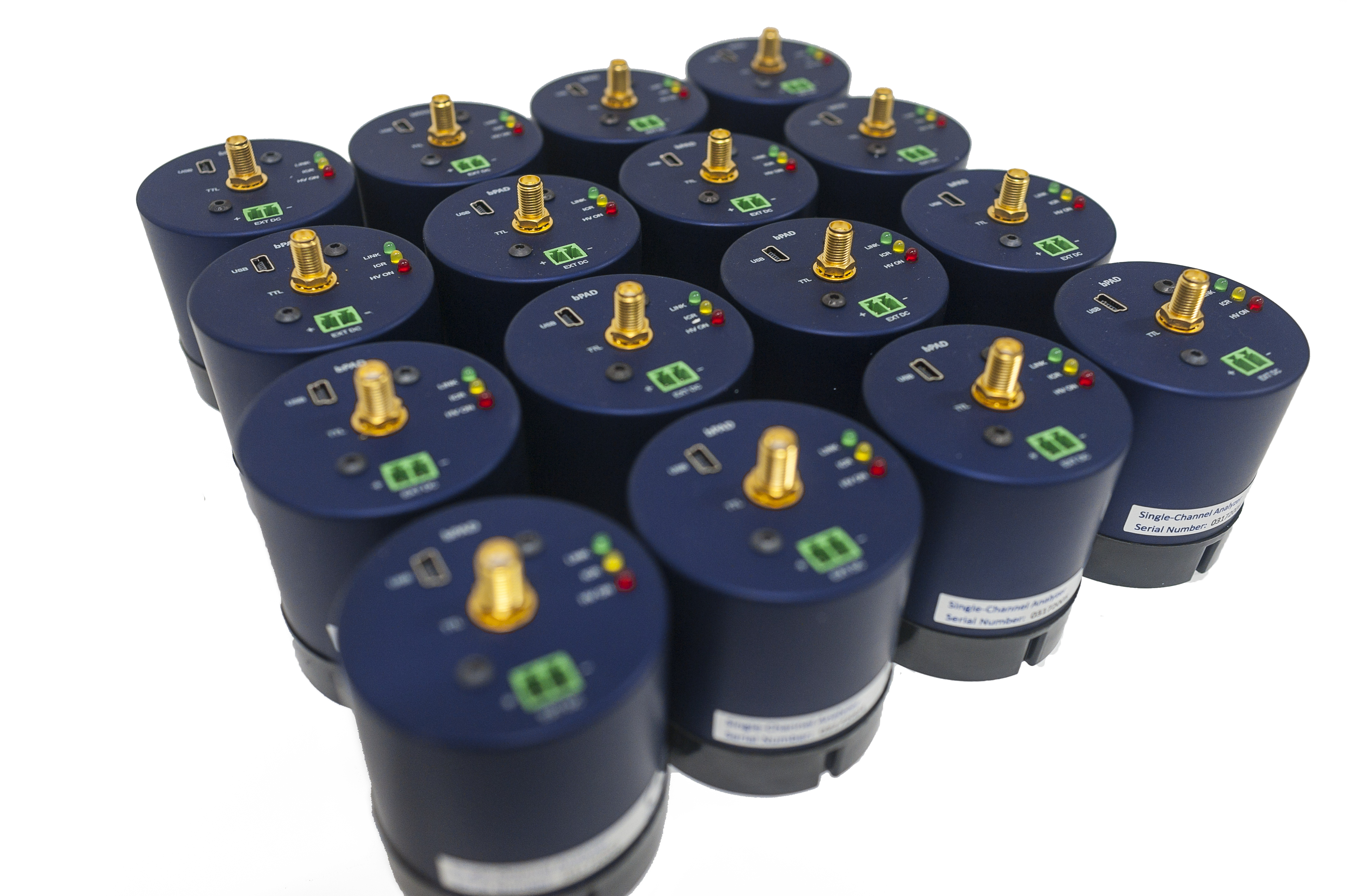
The bPAD is a compact, microcontroller-based Single Channel Analyzer designed to mount directly on a standard 14-pin photomultiplier tube (PMT). It integrates all the analog signal chain components, a high-voltage supply, and digital control in one small assembly. The result is a self-contained photon-counting module that requires only USB or DC power and a connection to a host PC for configuration.
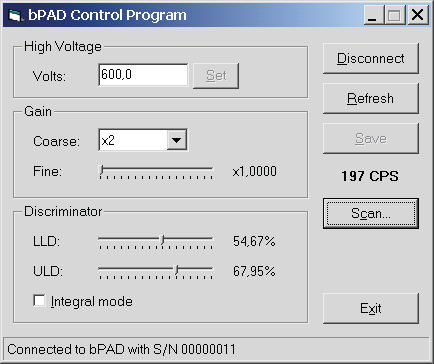
Unlike conventional SCAs, the bPAD is fully microprocessor-controlled. All operational parameters, including gain, discriminator window, and HV level, are set via USB using the included Windows PC software. Once configured, settings are stored in non-volatile memory so the device operates autonomously without a host computer. A three-color LED array gives immediate visual confirmation of HV status, incoming count rate (ICR), and power/communication health.
The bPAD suits any application where reliable photon counting is needed in a compact, easy-to-integrate package. It works with a broad range of PMT-coupled scintillators, including NaI(Tl), LaBr3, CeBr3, and plastic scintillators (PVC).
2Features
- Compact Single Channel Analyzer with microprocessor control on a 14-pin photomultiplier tube base
- Integrates preamplifier, amplifier, discriminator, and HV power supply in one assembly
- Two acquisition modes: Integral (above threshold) and Differential (energy window SCA)
- 5 V TTL output pulses, 2.5 µsec duration (10 µsec option available)
- Programmable HV supply: 0 to 1500 V in 4096 steps
- Coarse gain: x1, x2, x4, x8 (optionally x16, x32, x64, x128)
- Fine gain: x1 to x2 in 4096 steps
- Discriminator window resolution: 2048 steps (upper and lower level)
- USB 2.0 communications; cable included
- TTL output via SMA connector; cable included
- Powered via USB or external DC supply (6 to 36 V)
- Very low power consumption: 1 W maximum
- Compact form factor: 56 mm diameter x 71 mm height, approximately 80 g
- Three-color LED status indicators (HV, ICR, power/comms)
- Windows PC configuration software with pseudo-PHA spectrum mode
- Settings stored in non-volatile memory for autonomous operation
- CE certified
3Description
Signal Chain
The bPAD contains a charge-sensitive preamplifier that accepts the PMT anode signal directly, followed by a variable-gain amplifier with selectable coarse gain (x1, x2, x4, x8; optionally up to x128) and a fine gain stage adjustable from x1 to x2 in 4096 steps. The amplified pulse then passes to a window discriminator with independently settable upper and lower level discriminators, each with 2048-step resolution. Any pulse falling within the defined energy window generates a 5 V TTL output pulse of 2.5 µsec duration. An optional 10 µsec pulse duration is available on order.
Two acquisition modes are supported. In Integral mode, counts are recorded for all signals above the lower-level threshold. In Differential mode, only signals within the defined upper-lower window are counted, providing true SCA operation for isotope-specific monitoring.
High-Voltage Power Supply
A miniature, efficient HV power supply is embedded within the bPAD assembly. The output voltage is programmable from 0 to 1500 V in 4096 steps, covering the majority of PMTs used with scintillation detectors. The HV is set via software and stored in non-volatile memory. The red LED illuminates whenever HV is active.
Configuration Software and Pseudo-PHA Mode
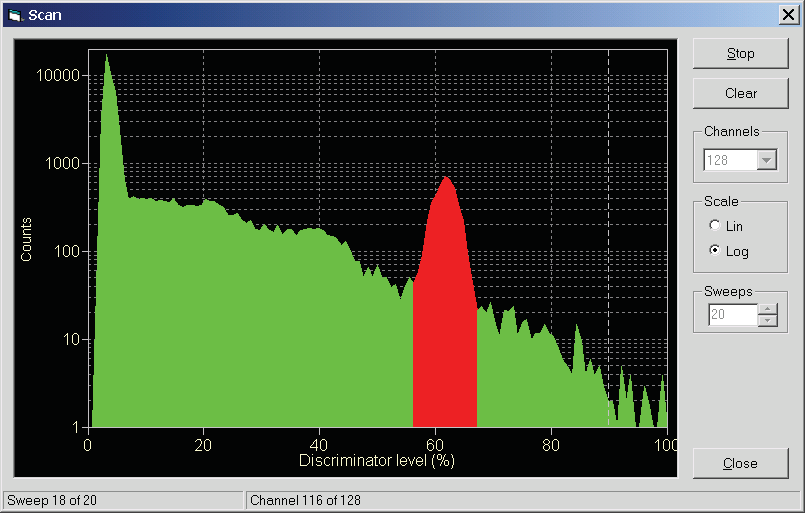
The included Windows software connects to the bPAD over USB 2.0 and provides full access to all device parameters. A standout capability is the pseudo-PHA mode: the software steps the SCA window across the full input range, accumulating counts at each position to construct an approximate energy spectrum. This allows the user to visually identify the energy region of interest and place the discriminator window correctly, rather than relying on trial-and-error adjustment. Once settings are confirmed, they are saved to the device and the bPAD can operate independently.
Power and Connectivity
The bPAD accepts power from its USB mini-B connector (PC-powered) or from an external DC supply of 6 to 36 V via a pluggable terminal block. Total power consumption does not exceed 1 W. The TTL output is provided on an SMA connector. All cables are included with the device.

4Technical Specifications
Device and Digital Settings
| Parameter | Value / Range |
|---|---|
| Acquisition modes | Integral and Differential (SCA) |
| Coarse gain settings | x1, x2, x4, x8 (optional: x16, x32, x64, x128) |
| Fine gain range | x1 to x2, in 4096 steps |
| Discriminator resolution (ULD / LLD) | 2048 steps each |
| TTL output pulse amplitude | 5 V |
| TTL output pulse duration | 2.5 µsec standard; 10 µsec option |
| Non-volatile settings storage | Yes, all parameters retained without power |
High-Voltage Power Supply
| Parameter | Value / Range |
|---|---|
| HV type | Miniature, programmable, embedded |
| Output voltage range | 0 to 1500 V |
| HV programming resolution | 4096 steps |
| PMT base compatibility | Standard 14-pin photomultiplier tube |
Data Communication
| Parameter | Value / Range |
|---|---|
| PC interface | USB 2.0; cable included |
| USB connector type | Mini-B |
| TTL output connector | SMA; cable included |
Physical
| Parameter | Value |
|---|---|
| Diameter | 56 mm |
| Height (including TTL connector) | 71 mm |
| Height (excluding TTL connector) | 60 mm (approx.) |
| Weight | Approximately 80 g |
| Power input (external) | 6 to 36 V DC via pluggable terminal block; plug included |
| Power input (USB) | USB mini-B (PC-powered) |
| Power consumption | 1 W maximum |
Status Indicators
| LED Color | Function |
|---|---|
| Red | Detector high voltage active |
| Yellow | Incoming count rate (ICR) |
| Green | Power and communication status |
Software and Certifications
| Parameter | Value |
|---|---|
| Included software | Windows PC software for setup, pseudo-PHA mode, and CPS display |
| Operating system | Windows (verify specific version support with BNC) |
| Regulatory compliance | CE certified |
5Applications
The bPAD is a versatile readout module suited to any measurement environment where photon counting with a defined energy region of interest is required. Typical application areas include:
- Industrial photon counting: process monitoring, level gauging, and online measurement systems using scintillation detectors in automated or embedded configurations
- Environmental monitoring: area gamma monitoring, dosimetry, and continuous-count radiation survey systems using NaI(Tl) or CsI(Tl) detectors
- Health physics: personnel monitoring, contamination surveys, and shielding verification with PMT-coupled scintillators
- Laboratory nuclear counting: isotope-specific counting using the SCA window to isolate a photopeak, replacing dedicated benchtop NIM-based SCA modules in compact setups
- Security and border monitoring: portal and vehicle monitoring where a compact, autonomous count-rate output is integrated into a larger detection system
- OEM and embedded detector systems: integrating a complete signal chain into custom instruments without bulky NIM or CAMAC hardware
- Research and education: teaching nuclear physics lab setups; rapid prototyping with standard scintillation detectors
The bPAD is compatible with NaI(Tl), LaBr3(Ce), CeBr3, CsI(Tl), and plastic (PVC) scintillation detectors coupled to standard 14-pin PMTs. Other scintillator-PMT combinations are supported; consult Berkeley Nucleonics for application-specific guidance.
6Ordering & Contact
The bPAD is available directly from Berkeley Nucleonics. Standard delivery includes the bPAD module, USB cable, TTL SMA cable, DC power connector plug, and Windows configuration software. Contact us for volume pricing, OEM integration support, or to discuss compatibility with your detector and PMT combination.
| Item | Description |
|---|---|
| bPAD | Compact Single Channel Analyzer, 14-pin PMT base, USB + SMA cables, Windows software, CE certified |
| TTL pulse option | 10 µsec output pulse duration in place of standard 2.5 µsec (order at time of purchase) |
| Extended gain option | Coarse gain extended to x16, x32, x64, x128 (order at time of purchase; verify) |
Talk to an Engineer
Berkeley Nucleonics has supported the nuclear R&D and radiation measurement community for more than 60 years. Our application engineers can help match the bPAD to your scintillation detector and integration requirements.