Purpose
This application note describes the achievable channel-to-channel phase coherence of Berkeley Nucleonics' 855B multi-channel signal sources.
Introduction
Early frequency synthesizers were not necessarily controlled by a single crystal standard. Adequate frequency stability was obtained using several internal crystal oscillators that contributed to the overall frequency stability of the output. These devices were considered non-coherent. As applied to frequency synthesizers, phase coherence describes the relation of the frequency standard to the output frequency. If the output frequency accurately reproduces the relative frequency stability of the standard, the device is considered coherent. Despite this definition, the assumption that all contemporary systems that use a single standard (external or internal) are coherent is incorrect. Many systems that utilize fractional-N or binary DDS fine-resolution synthesizers are not truly phase coherent; rather they have specified small but finite reference-to-output errors.
What is of particular interest is the phase stability observed over a long period of time between two independent signal sources that are phase locked to the same external (usually 10 MHz) reference.
This application note shows the phase coherence capability of Berkeley Nucleonics' 855B multi-output signal sources that can be phase synchronized to each other and to an external reference.
Berkeley Nucleonics' 855B-ULN multi-channel synthesized signal generator products are now available up to 20 GHz, enabling tight stability, phase coherency and extremely fast tuning speeds. Each channel can be programmed independently in frequency, phase, amplitude and modulation.
Test Setups
Figure 1a shows the test setup to determine the level of phase stability (coherence) between two individual outputs of a single instrument. A phase detector and a digital oscilloscope are used to monitor the phase stability between two RF channels over a long time interval, in this case approx. 24 hours. All tests were performed at 20°C ± 1°C.
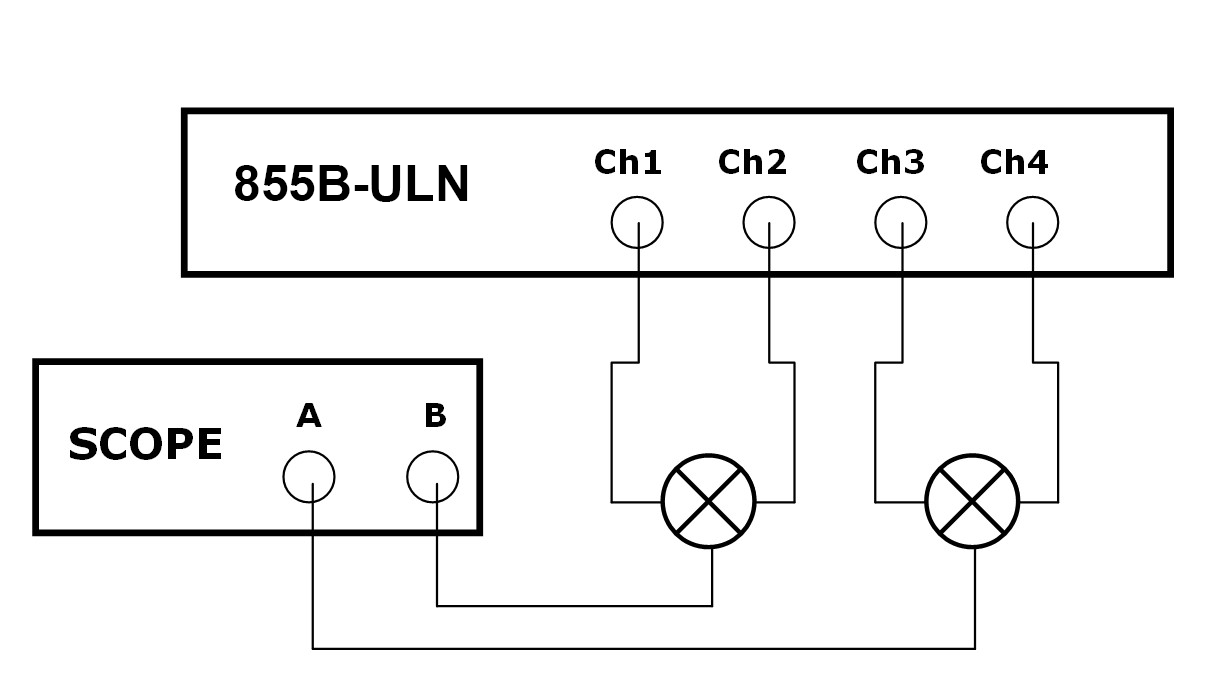
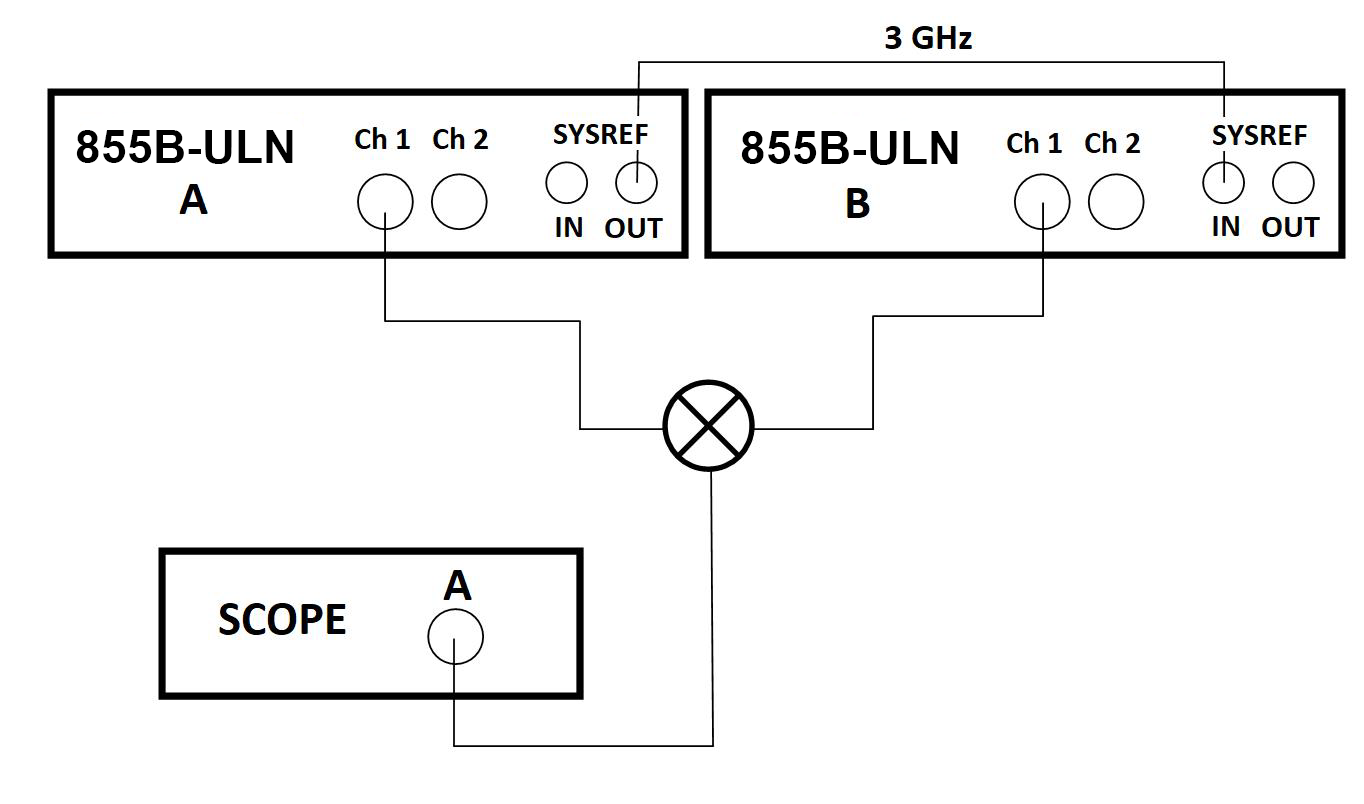
Figure 1b shows the test setup to verify phase stability between two outputs from two separate 855B units.
Test 1: Phase coherence for 855B-ULN for same frequencies
Based on test setup in Figure 1a, all channels are set to 5GHz. The signals of channels 1 and 2 are fed into a first phase detector while channels 3 and 4 are fed into a second phase detector. Phases of channel 1 and 3 are subsequently adjusted to achieve phase quadrature at the phase detector inputs. The output signals of both detectors are measured simultaneously on the two channels of the oscilloscope. The measurement is made over 24 hours.
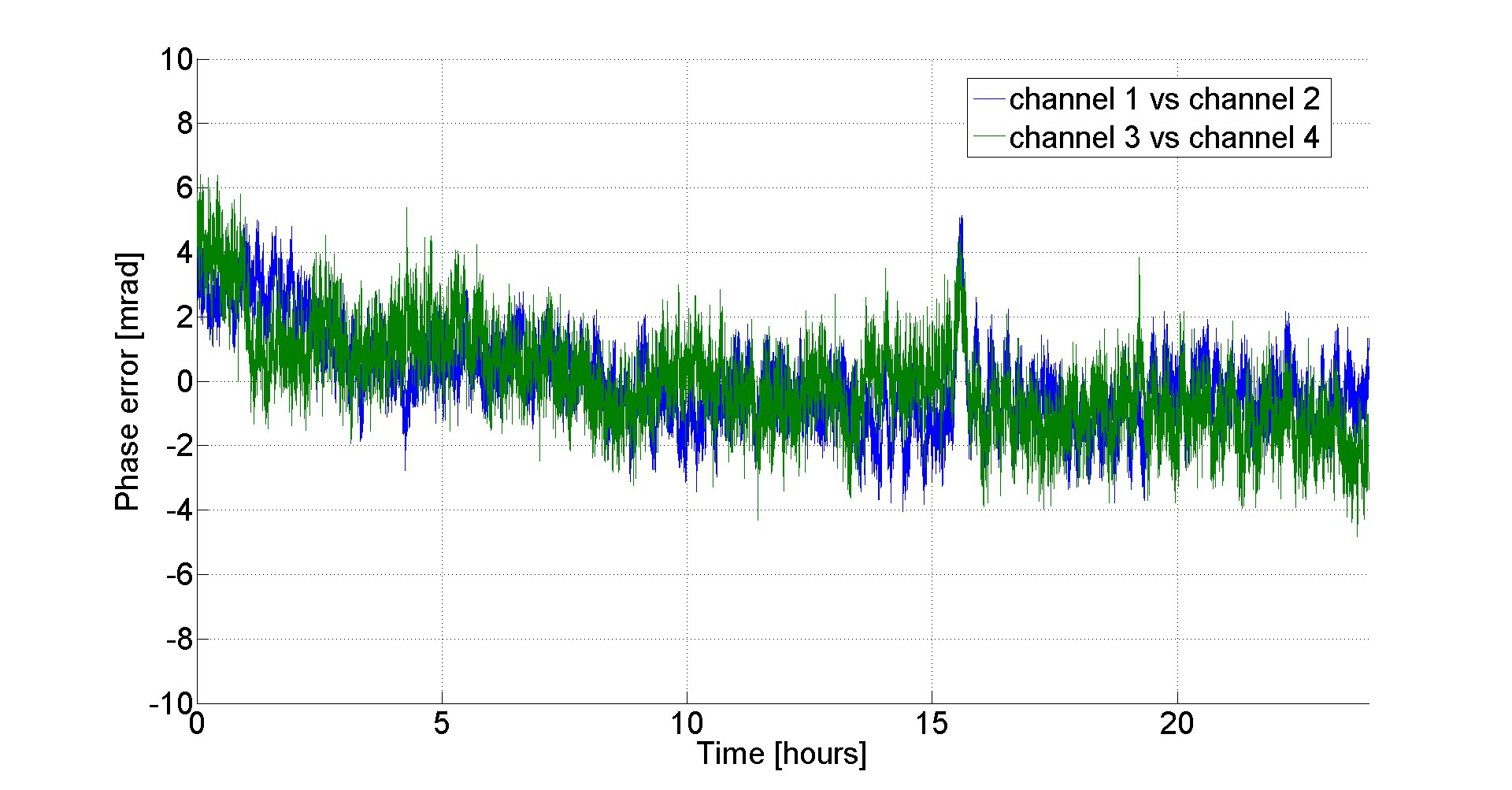
As shown in Figure 2, excellent phase stability is maintained over a long time period. For comparison, phase locking two independent signal generators using an external (10 MHz) reference will result in phase drifts of several hundreds of mrads!
Test 2: Phase coherence on 855B-ULN for variable frequencies
Based on test setup in Figure 1a, channel 1 is set to 5GHz, channel 2 to 5.01GHz, channel 3 to 5.02GHz and channel 4 to 5.03GHz. The signals of channels 1 and 2 are fed into a first phase detector while channels 3 and 4 are fed into a second phase detector. The channels are adjusted in phase such that the two output signal of the phase detectors (10 MHz) show a 180 degree phase shift.
The output signals of both detectors are then measured simultaneously on 2 channels of the oscilloscope. The oscilloscope is set to persistence mode and the measurement is continuously triggered on the rising slope of the signal on channel A. The measurement is done over a period of 24 hours.
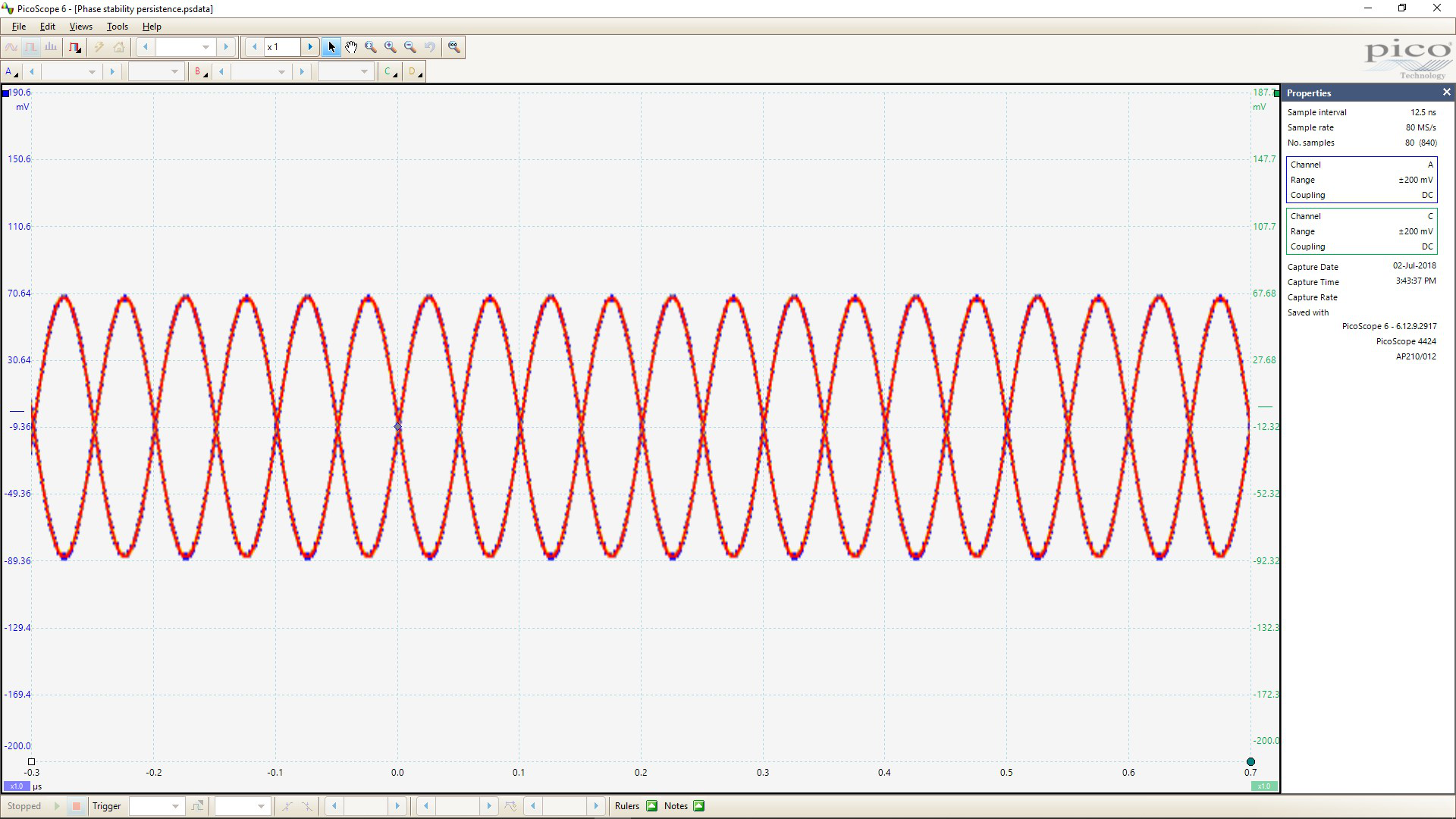
As in Figure 3, even after 24 hours, no phase drift can be observed between the two signal traces, indicating that the frequency synthesis is very accurate.
Test 3: Phase coherence between multiple 855B-ULN units using high-coherence clock synchronization
Some application may require more than just 4 independent outputs that should maintain phase stability over long time period. The 855B-ULN offers a dedicated clock synchronization mode to maintain highest phase coherence with a cascaded group of 855B-ULN devices.
Figure 4. show the channel to channel phase stability within a unit (blue trace) and the respective performance (green trace) when cascading two 855B-ULN units using the dedicated system synchronization clock (SYSREF ports, Figure 1b), and standard 100 MHz reference lock (red trace), respectively. As can be seen from the result, cascading multiple units using the dedicated synchronization clock will preserve the high stability between the outputs even across different units. Hence excellent phase stability can be maintained deploying a large number of channels.

Conclusion
Outstanding phase coherence can be achieved using Berkeley Nucleonics' 855B-ULN multi-channel signal sources. The individual channels can be programmed with sub mHz frequency resolution and individually tuned in phase. Channel to channel phase stability in combination with exact frequency synthesis make this instrument a viable candidate for applications, where accurate and stable phase relationship is required. Application that require more than 4 channels can also be served by coupling multiple 855B-ULN units with a dedicated synchronization mode.