Purpose
This application note defines common terms used when referring to Phase Coherent signals.
Introduction
When talking about signals and phase coherence, the vocabulary is sometimes used interchangeably, although each term has a very specific meaning. In this application note, we give illustrated definitions of the following terms: Phase Continuity, Phase Coherence, Phase Coherent Switching, Phase Memory and Phase Matched Outputs. This should help the reader better understand the features and capabilities of BNC's Multi-Channel Signal Generators (855B).
Phase Continuity
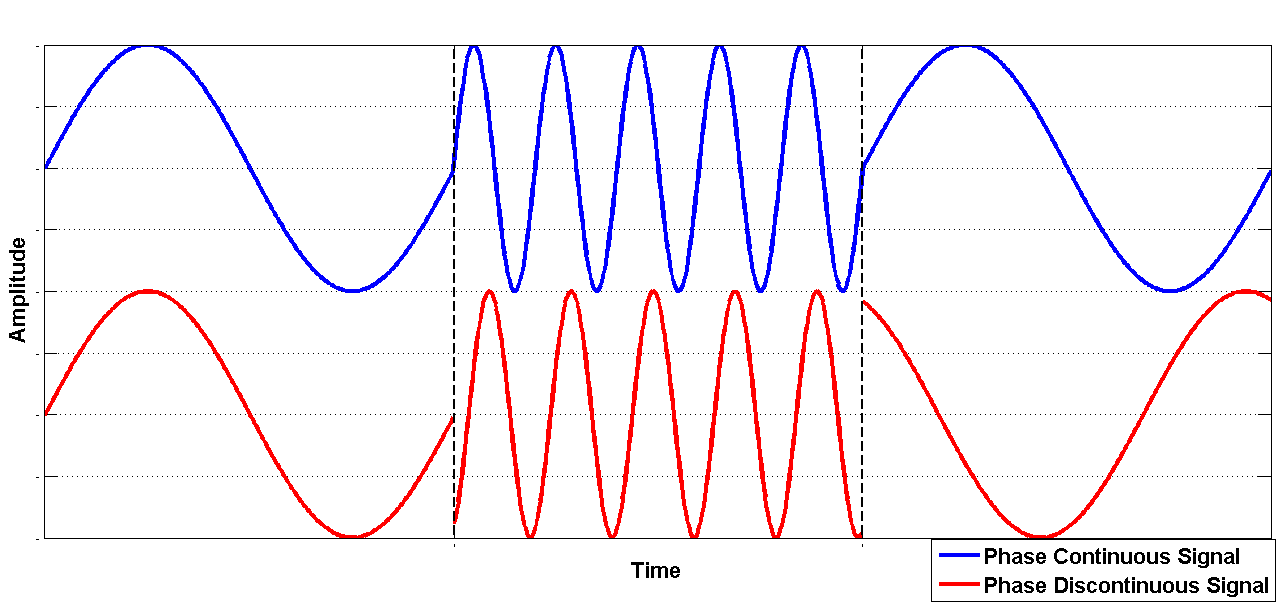
A signal is said to be phase continuous if, after switching its frequency, the phase of the signal is the same as before the switch occurred. This means that there is no discontinuity in the signal at the frequency switching point. Figure 1 compares a phase continuous signal with a phase discontinuous signal.
Single Channel Phase Coherence
As applied to single channel frequency synthesizers, phase coherence describes the relation of the frequency standard to the output frequency. If the output frequency accurately reproduces the relative frequency stability of the standard, the device is considered coherent.
Phase Coherence Between Two Channels
If the phase relationship of two signals remains constant, those two signals are considered to be phase coherent. This means that their relative phase stays constant over time.
A stricter definition only considers phase coherence between continuous wave (CW) signals of equal frequencies or when their frequencies are multiples of each other.
Phase Coherent Switching
When referring to the switching behavior of a signal, the term "phase coherence" defines the state of the signal's phase once the switching process is completed.
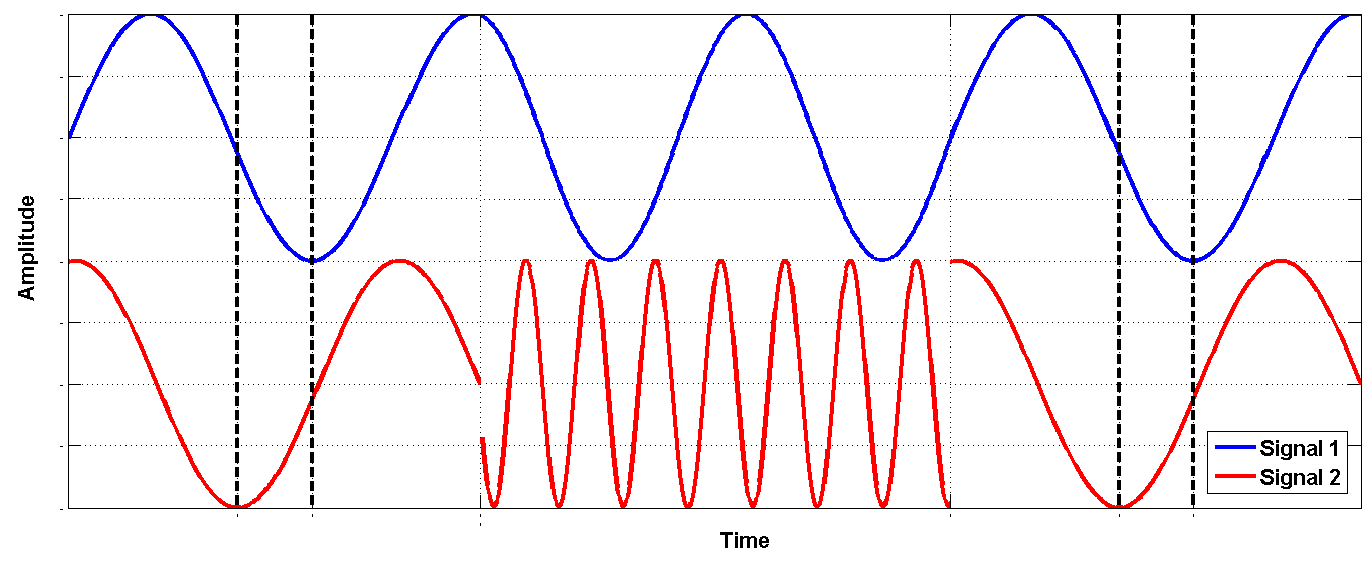
In order to illustrate this, let us consider two phase coherent signals, Signal 1 and Signal 2, at frequency f₁ with a relative phase . If Signal 2 is switched to frequency f₂ and then back to frequency f₁, the relative phase between the two signals will be again, if they are phase coherently switched.
Phase Memory
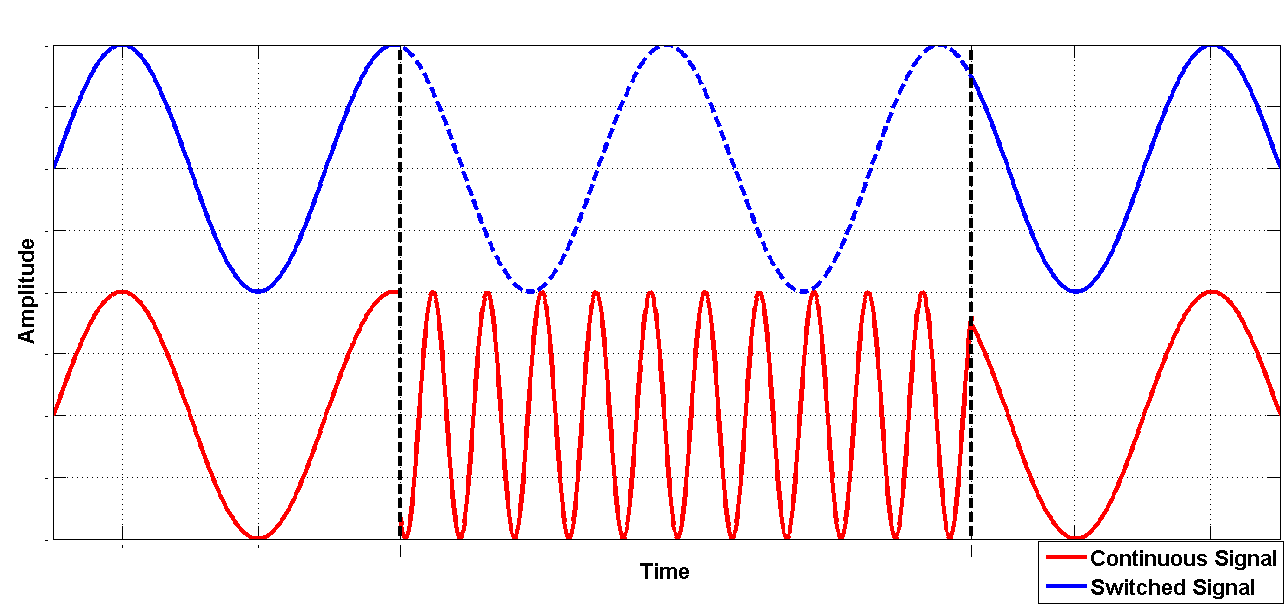
A signal is said to have phase memory if, when it is switched from frequency f₁ to frequency f₂ and then back to frequency f₁, the signal's phase resumes at the position it would have had if it had run continuously at frequency f₁. In other words, whenever the signal goes back to a previously set frequency, it behaves as if it had been running continuously at said frequency the whole time. Phase memory usually implies phase discontinuity; this is shown in Figure 3
Phase Matched Outputs
A multi-channel signal generator is said to have phase matched signals if the outputs are aligned to each other to have a calibrated 0 degree relative phase at all output frequencies. BNC's multi-channel signal generators outputs show good phase matching even without initial calibration. Optional calibration allows high degree of phase matching.
Conclusion
We have shown that there is a well defined terminology to describe the different characteristics of phase coherent signals. This terminology is sometimes used interchangeably; however it is important to understand the subtle differences that exist between the described phenomenons.
BNC's 855B multi-channel signal generators are able to address those requirements with high precision and stability. Thanks to its unique design, the 855B series provides outstanding channel-to-channel Phase Coherence; with the addition of Option PHS, the generators feature Phase Coherent Switching as well as Phase Memory and Phase Matched Outputs.